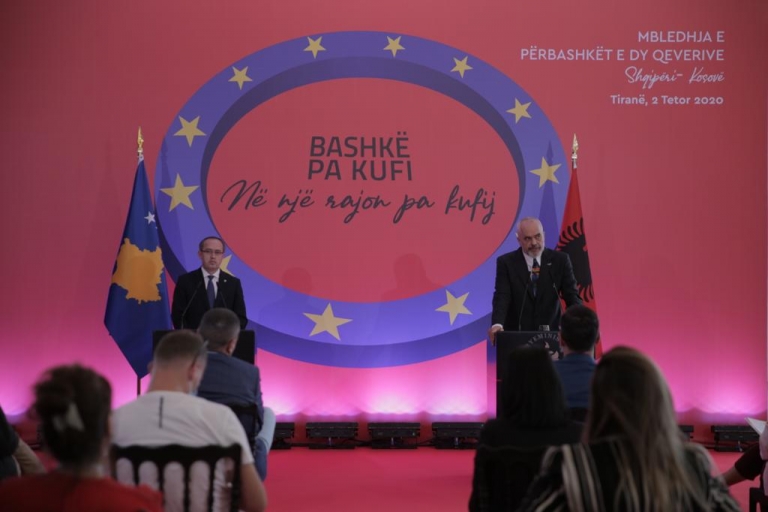
TIRANA, Albania – Albania’s and Kosovo’s cabinets signed 13 agreements during their joint regular annual meeting in the Albanian capital Tirana, held to discuss “ joining” their countries based on the principle of EU’s four freedoms – the free movement of goods, capital, services and labor.
The numerous package of agreements includes: cooperation in the railway system; creating a joint fund for the ethnic Albanian community in the Presevo Valley in southern Serbia; cooperation in case of calamities, emergencies; security; avoiding double taxation on income tax and preventing fiscal evasion; free movement on jobs and employees; cooperation in the digital area including 5G security; creating a joint league in basketball; joint digital platform on pre-university schooling; joint agenda for the cultural ministries; co-production of movies; cooperation between the culture ministries; and cooperation in their health systems in coping with COVID-19.
The top slogan of the event was: “Together without border. In a region without borders”, in line with the previous mood of past meetings where the line has also been sensationalistic but also acknowledging the change of heart of Kosovo regarding the mini-Schengen initiative after the recent talks at the White House.
The two prime ministers paid special attention to the fact that now workers in both countries will not pay double taxation in the country where they work and in their homeland. Turning the Durres port into one also belonging to Kosovo has long been a pledge that Cabinets meeting regularly, at least during the governing of Edi Rama in Albania, have always included in their annual joint meetings. Kosovo also stressed the fact of linking the railway system with Albania, pointing to Durres.
While Albania has an outdated rail system, Kosovo is regularly using rail to link to neighbouring countries. Constructing a new railway to link the two countries will be a big challenge in finding the money.
Both countries aim at becoming EU members one day and are at different stages of membership. After getting the EU’s green light for opening the full membership negotiations earlier this year, Albania is expecting to launch the first intergovernmental conference with Brussels.
Kosovo has applied for EU membership and has signed the Stabilization and Association agreement with the bloc, the first step toward membership.
In fact numerous agreements being signed under fanfare filled meetings are nothing new for senior foreign policy analysts who have called for Albania
and Kosovo to focus on establishing a normal and genuine strategic agenda.
More than seventy agreements have been signed between the two countries, but they have either not been implemented at all, or only partially and for insubstantial topics.
Though people on both sides of the border belong to the same ethnicity – Albanian – there has always been tension in the Albania-Kosovo relationship, and the existence of disagreements about fundamental issues of co-operation between the two countries, as well as divergent points of view about regional co-operation. The two countries have a weak economic co-operation, poor trading exchange and, in consequence, the lack of reciprocal investments.
Bilateral relations progress slowly, without any great significance for the two.
Kosovo naturally is focused on binding with the international pressure on improving relations with Serbia, its one-time foe. Negotiations resumed with Hoti’s government since June and the recently signed deal on normalizing economic relations signed at the White House last month are another step. Pristina insists that the final agreement with Serbia should be bilateral recognition, a move not accepted at all by Belgrade at the moment.
The EU mediation with its special envoy Miroslav Lajcak naturally aims at reaching an agreement soon as well.
Washington pressed last month with the Oval Office deal. Not much of that agreement is different from what Pristina and Belgrade have talked about and reached due to the EU mediation. The challenge remains with the application of the pledges. Washington, at least the Trump administration, has pledged billions to invest in both countries, and likely the region, to make normalization work.
During all this time it seems that Albania continues to try to adopt what experts have described as “a paternalistic and occasionally arrogant attitude towards Kosovo.”
Tirana continues to assist Kosovo in its recognition campaign, though not much has been achieved in the last years. Pristina properly thanked Tirana again today at the cabinets’ meeting.
Additionally Rama has involved some Kosovar officials in its Cabinet: one, Gent Cakaj still at the helm of the Foreign Affairs Ministry.
Often in her relations with Serbia, Albania has spoken on behalf of Kosovo, too, representing Kosovo and her institutions, trying to negotiate in Kosovo’s name, and even to mediate for her.
Such a move has not been generously accepted in Kosovo. Some senior leaders there have demanded that Tirana should cease playing this paternalistic role. Former Foreign Minister Enver Hoxhaj has said that, ‘Albania cannot play the intermediary between Serbia and Kosovo because Albania has neither the strength nor the capacity for the role’. Nevertheless, Rama has always kept Kosovo in its agenda whenever he has met with Serb President Aleksandar Vucic.
All international relations observers confirm that reconciliation between Albanians and Serbs in the region does not depend on Albania and Serbia, but on Kosovo and Serbia. They also iterate that populism of the kind repeated today of the removal of the border between the two countries does not help.
Friday’s meeting also showed differences of Albania and Kosovo in their foreign policies, at least on their ties with Israel, with Tirana saying being in line with the European Union and Pristina with the United States.
When asked about moving its embassy in Israel to Jerusalem in line with Washington’s policy, Albanian Prime Minister Edi Rama said that “in its foreign policy Albania is in line with the European Union.”
U.S. President Donald Trump’s administration recognized Jerusalem as Israel’s capital in late 2017 and moved the U.S. embassy there in May 2018, a move criticized by the Palestinians and many in Europe because the Israeli-Palestinian conflict remains unresolved.
Earlier Rama posted in Facebook a letter sent from Trump hailing Tirana’s regional role in exposing “China’s malign influence” and also supporting Washington’s policy on Israel.
Trump also urged Tirana to join Washington and other European countries “in moving your embassy to Jerusalem.”
But Tirana is in the first steps of launching full membership negotiations with the European Union and would not like to spoil ties with Brussels at this moment.
Unlike Kosovo, a predominantly Muslim country, which has never recognized Israel nor has Israel recognized Kosovo. Kosovar Prime Minister Avdullah Hoti said that as a young country being recognized by Israel is “of a different importance because it opens a new perspective in consolidating Kosovo’s statehood in the international arena.”
Kosovo has said it will open its embassy in Jerusalem after diplomatic ties are established.
Following the White House summit Kosovo, too, has agreed to be part of the mini-Schengen agreement the Western Balkan countries are trying to reach in line with EU’s four freedoms.
After the meeting wrapped up, opinion makers are left to ponder if the inverse in the number of agreements will yield any concrete results or the trade wars about flour, cement and potatoes will resume at the Albanian border soon.