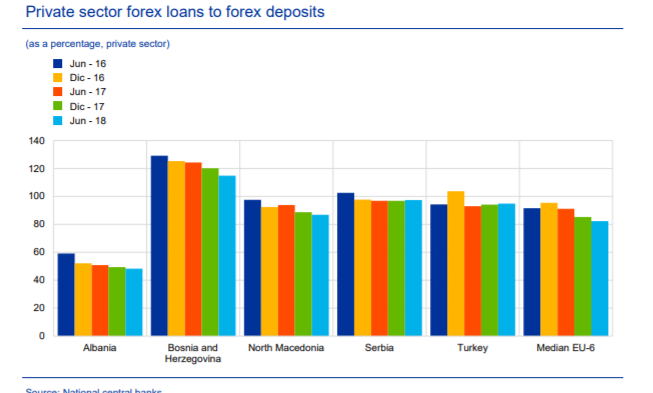
TIRANA, Oct 7 – Banks in Albania are insufficiently effective for the economy as they give out loans with a percentage far lower than that of deposits they keep. In an assessment report conducted during the last 10 years (2008-2018) on the banks of Western Balkans and Turkey, the European Central Bank pointed out that Albania has the lowest loan to deposit ratio and the lowest asset to GDP ratio in comparison to the rest of its region.
According to ECB, the current situation is due to the decline of loans for businesses in the private sector, while loans for individuals seeking financing for housing have increased. The ECB considers it surprising that loans are held back in the conditions of economic growth and high liquidity in banks. One of the reasons that banks in Albania have stopped handing out loans is linked to the “weaknesses in the rule of law and an increasing corruption level. Both of these factors have made banks reluctant in giving out loans, as in such circumstances the execution of the collateral can be hampered, leading to higher costs of borrowing. Therefore, the efforts of the national authorities to improve this environment are welcome,” the ECB evaluation report states.
Yet the decline of loans in Albania is also connected to the fact that banks have focused on lending to businesses only. National assessments show that lending standards for big corporations have been strengthened almost continuously since the start of 2016. The ECB also noted that the loans situation and lack of effectiveness in Albanian banks come as a result of the changes which the banking sector is going through as well as the decrease of foreign capital ownership.
During the last few years, national banks expanded their portfolio unlike foreign-owned banks whose portfolio shrank due to the selling of Credit Agricole and NGB bank’s affiliations to domestic owners. The distribution of shares somewhat moved to domestic ownership in the banking sector, controlling almost a quarter of the total lending. The gradual retreat of foreign-owned banks might have impacted the competition in the banking sector negatively. Until April of 2017, a majority of banks demonstrated that the market potential in Albania is low (unlike the majority of other countries in the Western Balkans).