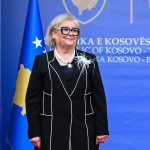
TIRANA, Sep. 12 – Kosova Prime Minister Agim Ceku on Wednesday appealed for the European Union to be united and determined at this crucial moment for the province’s status process and not to allow other nations to dictate its policies.
Ceku visited Tirana and met with Albanian top officials including President Bamir Topi, Prime Minister Sali Berisha, Foreign Minister Lulzim Basha and Defense Minister Fatmir Mediu.
Ceku visited Tirana where he also attended a European soccer qualifier between Albania and Netherlands.
“We believe that the Kosovo issue is a European problem that should be resolved by the European Union in a European way,” said Ceku at a news conference with Albanian counterpart Sali Berisha in Tirana.
Ceku said there was no other alternative than independence, based on (Martti) Ahtisaari’s proposal and within the existing borders, adding that Kosova’s partition was “absolutely unacceptable and damaging.“
The EU should be “united and determined, to take concrete decisions and not allow other countries to dictate EU policies on issues that are European,“ he said, apparently hinting at Russia’s stand.
“For Europe (Kosova) is a possibility to show its capabilities, courage and capacities of managing to resolve the issues in the region,“ he said.
Ceku turned down as unimportant recent calls from Belgrade that Serbia would likely use military force if Kosova declared independence unilaterally.
Albanian officials also repeated that Albania fully supported the proposal of the U.N. envoy, Martti Ahtisaari, as the only proper proposal, adding that the 120 days of talks now were a loss of time.
Though not hinting directly of military support, Tirana said that they are fully prepared to cope with any challenge in Kosova.
Berisha hailed the recent stand of Kosova’s Group of Unity negotiating team which is to present a treaty of friendship and cooperation between Kosova and Serbia.
Last month, ethnic Albanian leaders and Serbia’s officials met envoys from the United States, European Union and Russia to discuss the province’s future status. They are to meet face-to-face for the first time in New York on the sidelines of the U.N. General Assembly on Sept. 28.
The Contact Group troika, as the group of envoys is known, is to report to U.N. Secretary General Ban Ki-moon on the progress of the talks by Dec. 10.
Kosovo remains formally part of Serbia, although the province has been run by the United Nations and NATO since 1999, when NATO bombed Serbia to stop an onslaught against ethnic Albanian separatists.
Ethnic Albanians, who represent 90 percent of Kosovo’s 2 million people, are insisting on independence from Serbia. But Serbia, backed by Russia, refuses to let go of its historic heartland.
Serbia and Russia have, in the U.N. Security Council, rejected a Western-backed plan granting internationally supervised independence to Kosovo. The U.S. statement said that the plan represented the best option if no other compromise was agreed by December.