TIRANA, Nov. 13 – The European Commission has revised Albania’s 2018 growth outlook upward, but expects the Albanian economy to slightly slow down over the next couple of years due to lower electricity production and the completion of two large energy projects that drove FDI growth in the past few years.
In its new autumn forecast, the EU’s executive arm has raised Albania’s 2018 GDP outlook to 4.1 percent, down from a previous 3.6 percent earlier in spring after the Albanian economy grew by 4.4 percent in the year’s first half on the back of “very favorable weather conditions pushing agricultural and hydroelectricity production and a good tourist season.”
The outlook for 2019 when Albania hopes to launch EU accession talks has been left unchanged at 3.9 percent and the Commission expects growth to linger around the same level even in 2020.
In its lower forecast for the next couple of years, the Commission also cites negative effects from Euro’s free fall against the Albanian national currency hitting exports, in addition to lower contribution of the hydro-dependent electricity sector as well as the Trans Adriatic Pipeline and Devoll Hydropower, the two major energy-related projects that drove growth and FDI in the past four years but whose contribution is set to wane by early 2019 when their investment stage completes.
“Economic growth is expected to remain solid, driven mainly by private consumption. It is, however forecast to soften in 2019 as electricity production is unlikely to continue at the exceptional level of early 2018. The strengthening Albanian currency is likely to weigh on export growth. The high level of public debt as a share of GDP is forecast to continue its gradual decline,” says the Commission.
The European Commission’s forecasts are slightly higher compared to the World Bank and the IMF which expect Albania’s economy to slow down to 3.5 to 3.7 percent in 2019 on the back of lower FDI following the completion of two major energy-related investment, but yet lower compared to the Albanian government’s target of 4.3 percent for 2019 and growth gradually picking up to 4.5 percent by 2021 when Albania heads to general elections.
Macedonia and Montenegro are expected to grow between 2.8 to 3.1 percent over 2019-2020 while prospects for Serbia, the region’s largest economy have improved to 3.8 percent
Euro depreciation effect
Europe’s single currency trading at a 10-year low against the Albanian lek has so far not had any significant impact on the country’s overwhelmingly Eurozone-destined exports which grew by an annual 15 percent in the first three quarters of this year, apparently defying a 10 percent depreciation of the euro against the Albanian lek, despite exporters complaining of huge losses.
However, the European Commission warns the delayed negative exchange rate effects will likely appear next year when new investment decisions and contracts are made.
“The recent real appreciation of the Albanian currency weighs on price competitiveness and the export industries’ margins, but a negative effect on exports is likely to appear only in 2019 when new investment decisions and contracts will be made,” says the Commission.
The EU’s economic and financial affairs unit expects Albania’s oil industry to have a lower contribution to exports as uncertainties surround international oil prices which have fallen to a nearly 8-month low of $70 a barrel after gradually picking up since the mid-2014 slump. Albania’s hydro-dependent electricity sector is also expected to have a lower contribution as the country has been facing a new drought period in the past few months.
“In 2019 and 2020, export growth is forecast to decelerate partly on account of the lagged appreciation effect, but mainly because of lower oil and electricity exports,” says the Commission.
The euro has been trading at a 5-month low of 124.5 lek in the past few days, in a new downward trend since mid-Sept. 2018 after stabilizing at 126 lek since early June when Albania’s central bank decided to apply its uncommon emergency intervention policy and purchase excess euro from the local currency exchange.
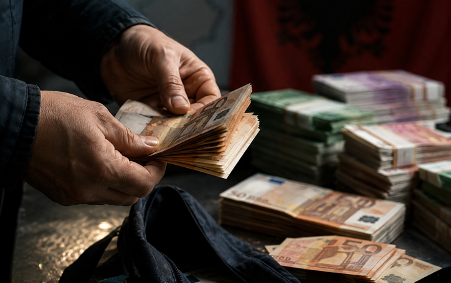
The main opposition Democrats, some local experts and even international financial institutions have blamed illegal euro inflows from crime proceeds for the euro’s free fall in Albania.
London-based financial institution recently said some ‘unrecorded cross-border activities’ may also be contributing to the appreciation pressures on the Albanian lek which it says reflects the ongoing de-euroisation policy initiative of the central bank in the financial sector, as well as the capital conversion of some banks.
Downside risks
The European Commission also warns a slowdown in reforms and public debt reduction agenda could pose downside risks to the country’s outlook. In addition, a slowdown in growth in Italy, Albania’s main trading partner and the destination of more than half of the country’s poorly diversified exports could mean more trouble for Albania.
“A slower than announced reduction of public debt would undermine financial markets’ new confidence and put infrastructure investments at risk which are key for sustaining growth and energy supplies. A slowdown of reforms could dampen the private demand while exports could suffer from lower than projected growth of Albania’s major trade partner Italy,” says the Commission.
Public debt currently stands at about 70 percent of the GDP, but the Albanian government’s target is bringing it down to a more affordable 60 percent of the GDP by 2021.
The Eurozone’s third largest economy, Italy is expected to slow down to 1.1 to 1.3 percent over 2018-2020 over fears that the breach of EU spending rules by its populist government could trigger a debt default.
Prospects in Greece, Albania’s traditional second largest trading partner and top investor, are more optimistic as its economy is forecast to grow by annual 2 percent over 2018-20 in ongoing recovery after overcoming its 8-year recession in 2016 that saw its economy shrink by about a quarter.
Recessions in Italy and Greece, Albania’s main trading partners, top investors and the hosts of 1 million Albanian migrants, had a series of negative effects on Albania through lower trade, investment and remittance flows in the aftermath of the 2008-2009 global financial crisis.
The Commission also expects Turkey, one of Albania’s main trading and investment partners, to slow down to 3.8 percent in 2018, less than half of last year’s 7.4 percent economic expansion, and fall into recession in 2019 before returning to moderate growth of 3 percent in 2020.
Prospects in Turkey, one of the fastest growing emerging economies until last year, received a severe blow this year when the Turkish lira lost 40 percent of its value against the US dollar leading to a double-digit inflation and a sharp downgrade in GDP growth forecasts.
Experts have earlier warned that due to stronger trade, investment and human ties with Italy, a possible slowdown in GDP growth in Italy, the Eurozone’s third largest economy and Albania’s top trading partner, could affect the Albanian economy more than the Turkey and global trade dispute spillover effects.
Albania conducts about 36 percent of its trade exchanges with Italy, the host of some 500,000 Albanian migrants who are a major source of remittances for Albanians at home. Over 90 percent of Albania’s garment and footwear products, an industry relying on cheap labor costs but employing about 100,000 people and producing the country’s top exports, go to Italy.