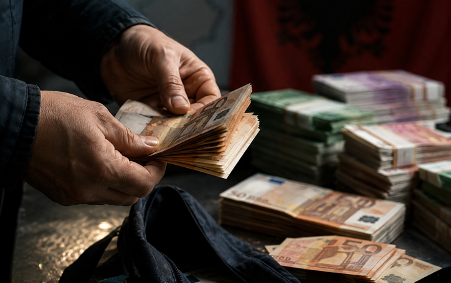
TIRANA, Oct. 2 – Europe’s single currency has been losing ground against the Albanian lek in the past couple of weeks in an unexpected renewed downward trend at a time when Albania’s central bank continues its emergency intervention and the end of the tourist season has sharply reduced euro inflows putting pressure on the national currency.
Europe’s single currency hit a 2-month low of 125.91 lek against Albania’s national currency this week to continue trading at a 10-year low after stabilizing at about 126 lek since early last June when Albania’s central bank decided to apply its uncommon emergency intervention policy and purchase excess euro from the local currency exchange market in a bid to prevent a further strengthening of the national currency which has a series of negative effects on Albania’s highly euroised economy.
However, under a free floating currency exchange regime determined by market demand and supply, the central bank’s ongoing intervention since early June has been unable to stop the national currency’s controversial strengthening.
Europe’s single currency has lost about 0.85 lek against Albania’s single currency in the past couple of weeks in a modest depreciation, but against expectations of a stronger euro starting September 2018 following the end of the peak tourist season that traditionally weakens the euro against the Albanian lek because of a hike in euro inflows from tourists and Albanian migrants coming home to spend their summer holidays.
The euro dropped to as low as 124.17 lek in early June 2018 before stabilizing to 126 lek in the past four months, but yet continues trading at about 6 percent below its late 2017 rate and is 10 percent below the mid-2015 level when its five-year reign of about 140 lek came to an end.
Euro’s free fall has had a series of negative effects for Albania’s highly euroised economy, mostly Eurozone-destined exports, local producers facing tougher competition from cheaper imports and sizeable Euro-denominated savings and remittances.
On the positive side, repayment of loans has become cheaper for about half of borrowings denominated in euro and the government’s external debt.
Albania’s central bank says it purchased about €109 million from commercial banks in the second quarter of this year in a bid to increase its foreign currency reserve and prevent a further depreciation of Europe’s single currency against the Albanian lek.
Emergency operations continue at a time when the key rate has been held at a new historic low of 1 percent since last June amid fears of disinflationary pressure from cheaper imports.
Albania’s inflation rate has been at an average of 2 percent this year, but is yet 1 percent below the 3 percent target estimated to have a positive impact on the economy, by stimulating demand.
A sharp strengthening of Albania’s national currency, lek, against Europe’s single currency is emerging as a new threat to the Albanian economy during this year, in addition to the already high public debt levels, sluggish credit and consumption as well as non-performing loans at declining but still high levels.
The government says its mid-year budget cut was triggered by a weaker euro and US dollar hitting public finances by 5 billion lek (€39.3 mln) for the first eight months of this year, about 2 percent of total government revenue.
The negative effects are mainly related to euro’s free fall against the Albanian lek making imports much cheaper and reducing the amount of the key value added tax that the Albanian government collects from imports, the overwhelming majority of which comes from the Eurozone.
Exporters have also reported a sharp cut in profits from euro depreciating by about 6 percent against the Albanian lek this year.
The U.S. dollar, whose weight on the Albanian economy is much lower compared to the euro, has also depreciated by about 9 percent since early 2017 and currently trades at a three-and-a-half year low of 109 lek, compared to a 12-year high of about 130 lek in early 2017.
Albania’s central bank says the stronger national currency reflects a recovering economy, higher euro inflows from major energy-related projects, the tourism sector and market expectations, but the main opposition Democratic Party and some economy experts have linked the national currency’s constant strengthening to alleged illegal euro inflows resulting from the peak 2016 cannabis cultivation and ongoing drug trafficking in the country, considered a major cannabis producer and a key transit route for cocaine and heroin for European markets.
The opposition claims crime proceeds are being laundered into the construction industry, which it says is booming amid sluggish credit recovery.