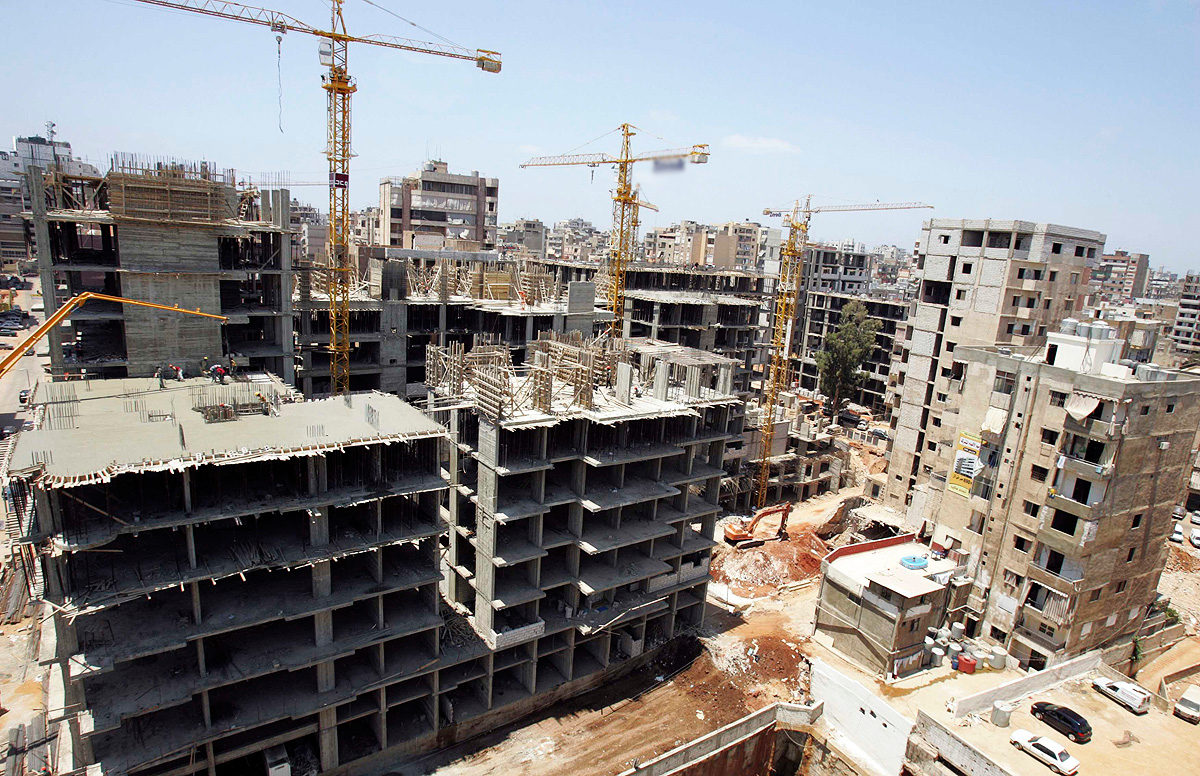
TIRANA, March 11- Tirana is already experiencing a construction boom, and is expected to suffer more construction sites this 2019. For 2018 are given 388 permissions with a construction area of 940 thousand square meters. According to the Albanian Institute of Statistics (INSTAT), comparing to 2017 the permissions given on 2018 increased by 80 percent.
All this area requires a minimal investment of 350 million euros. This amount is calculated in two ways, the first is by considering that the constructing cost amounts to 350-400 euro per square meter, and secondly by the expectations the Municipality of Tirana has regarding tax collections. The municipality foresees to collect 3.2-4 billion Albanian leks worth of taxes until 2021, which corresponds to about 350-400 million euros a year worth of investments in the sector of construction for the capital alone.
According to Colliers International in Albania the total area foreseen to be constructed within five years will be 538 thousand square meters, with the center of the capital as the most heavily compressed area. 22 construction projects are underway around the main areas of Tirana which are expected to finish within three years. Sales prices for apartments are expected to vary from 2000-2500 euros per square meter, whereas the prices for offices will cost buyers 2500-5000 euros per square meter.
According to data from the Structural Survey gathered by the Albanian Institute of Statistics, INSTAT, the Albanian economy declares annual profits amounting to 1.2 billion euros. The construction sectors contributes with about 188 million euros a year to the state’s profits. So how could Albania’s economy generate liquidities to support such large residential projects? Or more simply put, where is all the money invested in construction coming from?
This article is based on a detailed report conducted by Ornela Liperi for the Albanian economic magazine Monitor, and also other articles and reports to try to bring a fuller picture of the situation. The report starts by analysing the major construction companies which are enlisted among the 200 main enterprises in Albania considering annual turnover, that have enough resources to be involved in vast projects which justify the ending cost. The companies are Kastrati sh. a., Alb-Star, GENER 2, Alb-Building, and Balfin Group.
Kastrati sh. a. has as main activity the trading of fuels, but lately has been involved in construction as well. This company has short-term assets that can generate up to 90 million euros worth of liquidities, and an annual profit of 16 million euros. Its ratio between liabilities and capital is one to one.
Gener 2 which has under construction many residential projects in the capital, has short-term assets worthing 40 million euros, and a profit of 2 million euros a year. Other companies, like Fusha for example, have a minimal balance sheet. Fusha is the company which allegedly won a fictive tender for the construction of the new theatre building project and two towers nearby. The total short-term assets of the company amount to 14 million euros and its long-term ones are minimal. For 2017 the company had a revenue of 10 million euros and post-taxes profit of 400 thousand euros.
Other construction companies in general didn’t have more than 10-15 million euros worth of short-term assets. For example Inerte Express had an annual income of 6 million euros for 2017 and a 2.3 million euros short-term assets. Lately this company has officially introduced a 60 million euros project.
What has been noticed lately is that this construction boom is followed by an emerging of unknown construction companies. According to official data, these companies have had minimal to zero declared income. As projects undertaken by these companies have been performed with fast rhythms, it is unsure where the funds for them are coming from because banks don’t finance companies that have no sort of history. So how can construction companies with such low income manage to push projects worth tens of millions euros?
Oftentimes in construction projects the investor and the executive firm aren’t the same entities. Builder Hajredin Fratari said that it is difficult to identify who the investor of a construction project is. Another builder, Sokol Kika of Kika Construction which has been operating in Tirana since 1992, said that some of the risks this sector is facing are coming from newly-emerging companies which lack expertise in the field, and from companies that used to build but that are currently lacking in liquidities, although they have a constructing permission.
Decreasing loans during 2018
The banks have been quite set-back in financing construction projects during 2018 and have shown lack of enthusiasm regarding entrepreneurs rushing after this sector. According to data from the Bank of Albania the loan stock for construction in January 2019 was 47 billion lek (377 million euros). In September 2016 the stock value was 48.4 billion lek (388 million euros). Loans for the construction sector amount to 15 percent of the total given credit to enterprises within the country.
According to data provided by the Bank of Albania the loans given in the sector of construction for 2018 amounted to 25 billion leks, or about 200 million euros. Comparing to 2017 the loan granting has decreased by 7 percent. The bankers have admitted that most of the loans given in the construction sector are financing infrastructure projects, and only 20-25 percent are for residential projects in Tirana.
Bankers also admitted that banks have backed down from crediting because the banking system is in a process of restructuring regarding sales and purchases. The banks are mainly crediting already existing clients that hold good CVs, that have successfully passed two or three projects, that have nice locations, or that diversified their activities as well.
Construction is seen as risky sector due to its past problematic history. According to data from the Bank of Albania, until the end of 2015, the loans given to constructing companies which weren’t returned upon to scheduled date was 38.1 percent of the total. Even though the weight of the problematic loans has decreased due to clearing, the banks still have been guarded and careful towards granting new crediting.
Another issue apart risky loans is connected to the fact that banks prefer another type of collateral comparing to what financing requires, and little firms are able to ensure that type of collateral. However, the highest demand on financing from the constructing companies are for paying off the infrastructure taxes required by the Municipality.
The scheme followed to finance construction
The bankers claim that there are invisible investors that fund large residential projects which are built rather quickly. This entering of funds is camouflaged through clearing (getting property by providing other unpaid labor or supplies for example), unreal assets sales, financing from partners or third party contracts.
Construction is evaluated as a sector with a high profit rates as the building costs remain far lower than the price of sales. Builders explain that apartments with an average cost of 500 euros per meter square are sold with a minimum of 2000 euros per meter square. That is the reason why it is also attracting a wave of free money. Basically investors are “parking” their free money flow on these sites prior building, so they can acquire cheaper apartments than the final sales price.
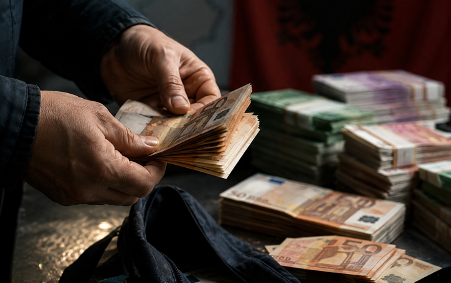
On the other hand, the money is entering through the apartments purchasing in cash, this allowed by the informal system in our country. Constructors admit that the sales prices are declared much cheaper than their real value. For example, an apartment with a real price of 1500 euros per meter square is declared as having a value of 800 euros per meter square. This system of informality is done so that people can avoid transactions over 1 million lek (8000 euros) through the banks. However, this entire mass investing of the free money in the construction sector came after making gambling unlawful.
The construction sector is unsupervised
The director of the Anti Money Laundering Agency Arlind Gjokuta said that the sector of construction has no regulating institutional body. He said that this sector vastly works with cash, adding that it is more than unusual that a construction company with no income to start executing a project. This happens because there is no supervising authority to conduct inspections to this sector. The ministries have a urban development department but these departments only supervise the licenses and tender documentation for constructing permissions, but don’t make more close inspection regarding fundings.
“Whatever is an unjustified income first tax it, then if it has a criminal origin, confiscate it,” said Gjokuta.
He said that it is necessary to establish such an authority to supervise the sector and investigate the phenomenon. He added that the police, the prosecutor’s office and the taxation agency should be more collaborative, with the taxation agency having a graver role. The construction sector requires a groundwork regulation for the way it functions and the liquidity that enters the system.
The Taxation Agency has admitted that the construction is a risky sector regarding fulfilling their tax obligations. The agency has increased its attention towards this sector and will be collaborating with other law enforcement institutions in structuring a plan to tackle it. The plan will add more visits from tax agents to follow the construction progress and their lawful tax declarations; a full detailed control on the accuracy and validation of the finished and sold objects; assigning inspectors specific controls in the various parts amounting the sector.
The most important parts where the inspectors will focus will be regarding the relationships and transactions made between the landowners where the construction site is happening with the investors and executing company; the work done as specified in the contracts signed; budget control and financial data with their origin regarding the funding of the construction project; a construction specialist will accompany the inspectors to provide more detailed information regarding the building materials to avoid evasion; the control of the sold objects using the market and reference area prices, along with the building costs and price-lists used in the analysis of each building unit.
Both construction and gambling have resulted risky and on the top lists of the Anti Money Laundering Agency. Gambling is already made unlawful by the government closing all sports betting houses and casinos starting as of January 2019. With construction though still remains a space where the institutions can work to fight informality and close the money-laundering loopholes. Gjokuta however, said that these two sectors are the most problematic worldwide.
The Moneyval report on monitoring money laundering in Albania pointed out that the main mechanisms used for this unlawful phenomenon were gambling and real estate. Moneyval is a permanent monitoring body of the Council of Europe entrusted with the task of assessing compliance with the principal international standards to counter money laundering and the financing of terrorism and the effectiveness of their implementation, as well as with the task of making recommendations to national authorities in respect of necessary improvements to their systems.
The report writes that the gambling sector through the threat of criminal infiltration into ownership and activity, and the construction sector are seen as highly risky for money laundering. If the notary used to be considered as a delicate profession due to their involving with the real estate transactions, nowadays it is riskier to have transactions made without the involving of a notary and real estate agents.
The report stresses that there is an inflow of income from criminal activities which is being invested in Albania in the real estate sector and trading companies. The high level of informality together with the vast usage of cash money, creates a risk of money laundering. The report adds that according to the Anti Money Laundering Agency, the real estate agents are included in only 8 percent of the whole transactions. However, to be noted is that their activity is on the rise.
How the apartment prices are increasing
The unwarranted booming of residential construction projects from the liquidities generated by the formal economy and loan-granting, is also followed by a considerable high sales prices. The sales prices are reaching a level of 4000 euros per square meter, which the Colliers International considers it as the most expensive in the entire region. Tirana is now the most expensive capital in the Balkans region, surpassing Belgrade which sells its premium apartments at 3000 euros per square meter. Third place comes Podgorica with a maximum price of 2200 euros per square meter, and in Skopje the apartments don’t go higher than 2000 euros per square meter.
Managing partner to Colliers International in Albania Stela Dhami said that it is being built disregarding any market logic. The projects are being executed without considering a logical market development. She foresees that within two years there will most probably be created a bubble from all the unstandardized buildings.
“The investments are directed towards locations disregarding the developmental potentials, because it is perceived that the risk will be zero if the location is primary,” said Dhami.
President of Balfin Group and entrepreneur in many various sectors Samir Mane, has withdrawn from construction projects in the capital. He has admitted that in Tirana is being built more than the norm, and if all the projects manage to be executed and finalized they will most probably have issues with sales. He said that banks have an innate recoiling in real estate financing.
“If they are not supported by banks, a part of the business will either postpone the projects, or have difficulties finishing them, or will be transferred into other hands,” said Mane.
Dhami has also admitted that from conversations with bankers they have told her that that banks see this sector as risky and are pretty conservative in granting loans. The credits are given credible companies that have diversified activities. The manner of construction is through clearing, whereas most of the money comes from abroad.
The large projects will hit the market with a minimal price of 2500 euros per square meter, except from the Rruga e Kosovareve where the prices average from 1500-2200 euros. This offer is in a totally opposite direction from what the market requires and the real capacity of the Albanian economy. According to calculations from Colliers the prices are senseless because the rental yield is much lower than the real sales price. A rental yield is the return a property investor is likely to achieve on a property through rent. It is a percentage figure, calculated by taking the yearly rental income of a property and dividing it by the total amount that has been invested in that property. Also the facts that people are emigrating and there is no economic boom in the country are two issues which add a sort of surprising twist into the whole construction roar.
Real buyers usually demand to buy an apartment which comprises two bedrooms and a living room, with average prices between 700 to 1200 euros per square meter. Loans director to Union Bank Enkeleida Hasho said that the average loans for apartments given to individuals vary from 40-50 thousand euros. She said that the banks mainly receive applications for apartments on residential blocks that are sold with 700-800 euros per square meter. Bankers say that expensive apartments are bought with cash because banks rarely grant large loans for housing. They are given mainly to individuals that have fine jobs in international institutions and have secured income.
And in Albania the average salary for an employee was 50 thousand leks or 400 euros a month at the end of September 2018. According to the Albanian Institute of Statistics, INSTAT, comparing to 2017 the salaries have experienced a dropping of 1 percent. Thus considering the aforementioned pushed apartment prices, a family with average income would need a century to buy an apartment located in a good precinct which would cost 200 thousand euros for an area of 100 square meters.
Data from Eurostat show that the income of Albanians in 2017 was only 30 percent of the European Union’s average. This value has remained the same since 2014 indicating that the country hasn’t progressed much in the process of convergence. Convergence means experiencing a faster growth than the developed EU countries so their standard can be caught on. Eurostat writes that Albania has the lowest income per capita in the region. Bosnia-Herzegovina has 32 percent of the EU median, Montenegro has 46 percent, and Serbia with Macedonia hold 36 percent. Also in the prectrum of the individual consumption per capita Albania results last with 39 percent of the European mean, Bosnia holds a 41 percent, Serbia 45 percent, Montenegro 56 percent, and Macedonia 41 percent.
A concerning issue are the pessimistic projections released by INSTAT which claim that if the population follows the same tendency, then Albania will have around 2 million citizens by 2061. Data from INSTAT show that Albania is already experiencing a population aging as the country is rapidly changing its structure in obstruction for youth and the pension age is increasing.
INSTAT claims that as of January 2019 the population for groupages 0-24 years old fell with over 31 thousand persons comparing to 2018. Groupage 15-24 experienced the biggest drop in population number with over 17 thousand persons. The population rupture in this groupage is connected to mass emigration and the drastic drop in births. These changes in the population show that the age group of over 55 years old experienced an increase of 30 thousand persons this 2019 comparing to the previous year.
This tendency is expected to give the biggest impacts in a mid-term future, by straining the pension scheme and lowering the work productivity, which in a chain reaction will negatively influence the incomes and purchasing power to a country, that it wouldn’t be surprising if by 2061 will have more offices and apartments than people.