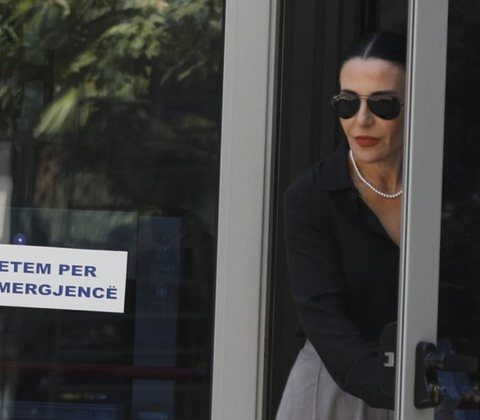
The protest from Astir area residents looking to stop the Great Ring construction project which will leave some of them without housing and proper compensation left officer Ina Muka without a finger due to a firecracker that exploded near her hand.
Experts from the State Police investigated the case and also conducted some experiments regarding the hazards these explosives cause.
The experiments conducted concluded that the explosives could also break apart bones and weak metals such as aluminum, along with soft materials and tissue. The findings were made public in a press conference on Nov. 27 by Deputy Interior Minister Romina Kuko.
The findings led to the Interior Ministry to impose new rulings regarding the explosives and their variations. The police would start to levy explosives and fireworks being merchandised, and the Ministry of Interior requested the merchants to stop importing and selling these products. Kuko also implored citizens and parents to be careful and not buy these products.
The Ministry of Interior together with the Defense Ministry and the Finance Ministry, signed a joint ruling regarding civil explosives of categories F2 and F3, which was released on Dec. 18. The ruling comes two weeks prior the New Year’s Eve, a day which is Albania is overwhelmed by fireworks lit by the citizens and their released gases. On this day over the years there have been recorded accidents due to irresponsible fireworks operation. However, on the past two years these accidents have occurred less, however incidents relating to intoxication still occur.
The law foresees a set of measures to be taken by the State Institutions in stopping the production, import, export, storage, merchandize and using of pyrotechnics and fireworks by civilians and the public.
The products which are forbidden to trade are specified in the joint signed order by the three ministers as below:
- Of second category F2, the use of which in open spaces outside inhabiting buildings, requires a distance of five to eight meters from citizens and objects;
- Of third category F3, the use of which is open spaces requires a distance of over 25 meters from citizens.
The law also forbids the merchandize, production, import, export, storage and use of the pyrotechnics and fireworks which consist sulfur, phosphorus mixed with potassium chlorate or other chlorates, and/or consisting of the aforementioned mixtures as ingredients.
The law also foresees the relevant institutions with their obligations and competences regarding this order. The Licensing Commission should be able to stop the production of pyrotechnics and fireworks of categories F2 and F3 in the licensed businesses. The Commision should also review the issued licenses for import and production, and thus seize their marketing and merchandize to civilians. The General Directorate of Customs should also forbid the import of pyrotechnics and fireworks of categories F2 and F3 for the internal market.
The law however, doesn’t forbid the usage of pyrotechnics and fireworks to a full extent. The order specifies that these products can be used in specified events, such as national festivities, local festivities organized by the local institutions, or even family festivities such as weddings and birthdays. The usage however, can only be done by the specific licensed subjects and after the local Police has been notified.
A Task Force will be raised to inspect and verify the conditions of the production lines and storing from the licenced entities for productions, import and export of the pyrotechnics. The local structures of the General Directory of Taxes, State Police, the Fire and Emergency Protection Service will be responsible for controlling and verifying the transport, storing and market sales conditions of these products according to the specific territorial jurisdiction.
The State Control Authority for Exports of the Defense Ministry will be responsible for notifying the licensed subjects in regard to import and production of the pyrotechnics. The licensed entities can retrieve their products from the market and store them for a later usage in specific events as the law foresees, or for their export.
Category F1 are called Indoor Fireworks, and present a very low hazard and intended for use in confined areas like inside domestic buildings. Examples of F1 fireworks are party poppers, sparklers, throwdowns and Christmas firecrackers.
Category F2 or Garden Fireworks present a low hazard and are intended for outdoor use in areas such as small gardens. Category F3 or Display Fireworks, present a medium hazard, which are intended for outdoor use in large open areas such as fields. Examples of F2 and F3 fireworks are bangers, rockets, fountains, roman candles, shells and aerial wheels.
Albania was one of the few countries left worldwide to allow the distribution, merchandize and use of F1, F2 and F3 pyrotechnics and fireworks for all civilians. Fireworks in most Europe countries are regulated to be sold mostly during Christmas, the New Year’s Eve and other national festivities.
In Germany, fireworks are available for purchase from most stores in the 3 days prior to New Year’s Eve, allowing families to have their own celebrations in their backyard.
In Iceland, fireworks are sold from December 28–31 and again on January 6. In Ireland, the import of consumer fireworks is strictly controlled, and the use of them must be overseen by a professional fireworks operator. In the Netherlands, fireworks (except F1) cannot be sold to anyone under 16 years old. They are only sold the last three days of the year and may only be fired between 6pm until 2am on New Year’s Eve.
In Norway, fireworks cannot be sold to anyone under the age of 18. Class 1, 2 and 3 fireworks are for sale from December 27- 31 and may only be fired between 6 p.m. until 2 a.m. on New Year’s Eve.
In Finland, fireworks (except F1) are usually sold between Christmas and New Years, but it is legal to sell fireworks all year around (predominantly through online retailers), but can only be used on New Year’s Eve from 6pm to 2am the following morning.
In the United Kingdom, fireworks cannot be sold to anyone under the age of 18 and are not permitted to be set off between 11pm and 7am. Exceptions are made for New Year, Bonfire Night (5 Nov.), the Chinese New Year and Diwali. Fireworks are available from specialist stores year round and their use is also permitted throughout the year within the specified time limits. The sale of Categories 1 (Indoor), 2 (Garden) and 3 (Display) are available to the general public, with Category 4 (Professional) being restricted to permit holders.
In Belgium, fireworks (except category 1) cannot be sold to anyone under the age of 16. Fireworks are available for purchase year round, but may only be used by police permission. In Poland, fireworks cannot be sold to anyone under the age of 18. Fireworks are available for purchase year round, but are primarily sold before New Year’s Eve.
In North America, the laws regarding the merchandize and use of the pyrotechnics and fireworks depend per state (USA) and province (Canada). Generally in both countries F1 fireworks are permitted for consumers, but the other categories are to be used on specific events with permissions and set-off by licensed individuals.
However, such practice has started to happen internationally. Now most countries around the world forbid the sales and use of the F2 and F3 categories for consumers, allowing only those of F1.