
TIRANA, March 1 – The Territory Regulation Council headed by Prime Minister Sali Berisha on Thursday defined a southwestern area for three gas terminals and power plants in an effort to overcome the power crisis that has gripped the post-communist country and also turn into an important transit point in the international gas networks. The council set three areas of 60, 120 and 30 hectares (respectively 148, 296 and 74 acres) around Vjosa River in Fieri district, 100 kilometers (62 miles) southwest of capital Tirana, for terminals of liquefied natural gas, or LNG, to be built by three international companies, according to a statement from the premier’s office.
Swiss EGL, Lugano-based (Switzerland) international consortium ASG Power SA and the Dutch-based Trans European Energy have been authorized to build the terminals and power plants, said the statement. The ASG Powers SA and Trans European Energy were more advanced and would likely start their projects later this year, while EGL was more interested in building a gas pipeline.
The ASG Power SA has said that it will start in August to build a US$1.9 billion power plant and regasification terminal in southwestern Albania until 2009 to provide power and gas to the region. The consortium, made up of the AET Swiss public utility company and other European and U.S. investors, have signed a memorandum of understanding with the Albanian government in March, according to the consortium’s statement. The project, to be built in the Fieri district, 100 kilometers southwest of capital Tirana, would consist of an LNG regasification plant with an annual capacity of 10 billion cubic meters and a combined cycle power plant to be constructed in three phases of 400 MW each. The project, expected to be completed in 2009, is to provide Albania with all of its power, as well as providing gas and power through international connections to the European grid, turning Albania one of the biggest producers and exporters of gas and power in Europe, the consortium said. Power grids linking Albania to Italy and Greece would comply with the European Union technical requirements, allowing for connection to the European grid. “In 18 months Albania will import energy with a low cost,” aaccording to Agim Gjinali of the ASG Powers.
Albania was expected to use 2 billion cubic meters of gas for the power plant and other industry, and the remaining 8 billion cubic meters of gas would be transported via an undersea gas transmission pipeline to Italy. The project would stimulate economic development in southern Albania with as many as 3,500 jobs during construction and 300 during operation.
Authorities could not give exact timing or the amount of the investment money for each of them. But they said they were soon expecting requests for deposit and construction licenses and the government would cut short the bureaucracy in providing them. Liquefied natural gas is transported by being cooled and condensed into a liquid form. It is “regasified” at receiving terminals, where it is stored until it can be converted back into a gaseous form and delivered via pipeline to customers. The projects will provide Albania with power, as well as providing gas and power through international connections to the European grid. The tiny Balkan country has suffered power cuts during post-communist period since 1990.
Last month the Albanian Electro-Energy Corp., known as KESH, signed a 92 million (US$121.6 million) contract with Italy’s Maire Engineering SpA to build a 100 MWh oil-based thermo-power plant in Vlora, 140 kilometers (85 miles) southwest of the capital, Tirana, completing it in two years. The Vlora plant will also be supplied with gas from the Fieri terminals.
Government sets Vjosa area for three new gas terminals, power plants

Change font size:
Recommended Articles

Latest from Business & Economy

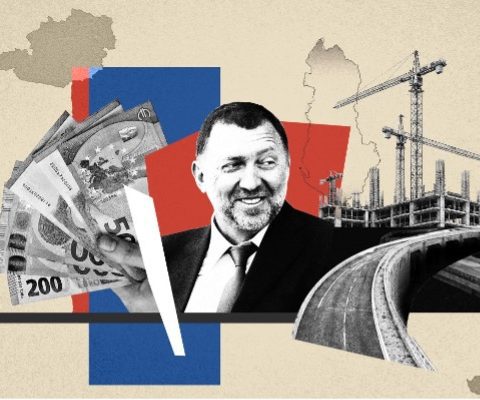
How a Sanctioned Russian Oligarch’s Business Interests Reached Albanian Public Contracts
Change font size: - + Reset Millions of euros flowed to companies linked to Strabag while Oleg Deripaska remained a major shareholder, exposing gaps in Albania’s ability to identify who ultimately benefits
Albania’s Cash Boom Raises Money Laundering Concerns
Change font size: - + Reset Cash outside Albania’s banking system reached a record 5.6 billion euros, last month. Tirana Times, August 30, 2026 – The amount of cash circulating outside Albania’s

Vlora Airport Heads to Arbitration
Change font size: - + Reset Albania faces another potentially costly international dispute after losing several arbitration cases in recent years that have exposed the state to hundreds of millions of euros

Concrete, Cocaine and Corruption: Albania’s Fragile Growth Model
Change font size: - + Reset Albania’s Concrete Economy: How Construction Became the Country’s Dominant Growth Model Tirana Times, July 10, 2026 – A booming construction sector has made Albania an outlier

Austria Leads FDI, but Real Estate Tells the Bigger Story
Change font size: - + Reset Bank of Albania data show Austria topping first-quarter foreign investment flows, while property and construction continue to shape Albania’s FDI model. Tirana Times June 25, 2026