 TIRANA, April – The Albanian government says it is negotiating with the Trans Adriatic Pipeline to increase the country’s benefits from the gas pipeline bringing Caspian gas to Europe.
Speaking in Durres where the first TAP pipes were delivered this week, Prime Minister Edi Rama praised the pipeline’s contribution to the Albanian economy but said Albania’s benefits under the original contract were asymmetrical compared to the other countries where TAP crosses through.
“We have regretfully noticed that the signed contract does not bring any symmetric benefit to the Albanian government compared to the other countries where TAP crosses through and we have opened up negotiations to get symmetric benefits because we believe that there is no reason why Greece or other countries profit for the same works, service and availability and Albania profits nothing,” said Rama.
The Prime Minister said the TAP consortium had expressed its readiness to renegotiate Albania’s TAP benefits.
Energy Minister Damian Gjiknuri said negotiations will start next May.
“There are a big number of financial benefits that Greece has benefited but not Albania. Albania has profited less than other partners. We have received TAP’s understanding on several issues and the differences will be addressed in May when negotiations open,” said Gjiknuri.
Albania is seeking more benefits regarding employment, investments, community projects and the participation of Albanian companies in the pipeline construction.
Since mid-2015, when the construction of access roads and bridges was launched, TAP has already turned into a driver of economic and social development in the country by improving infrastructure access for rural communities which also benefit from the long-term land lease.
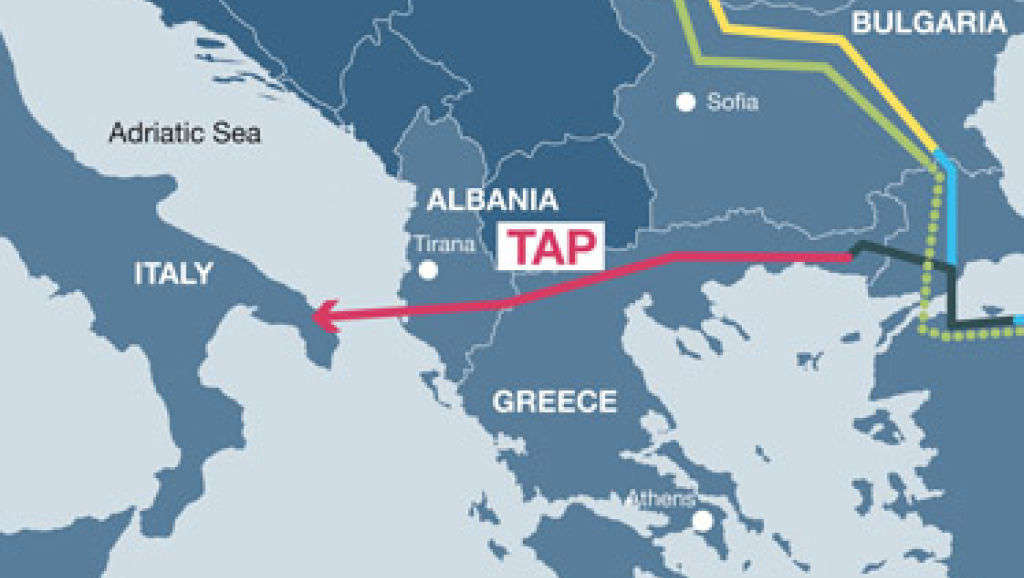
The pipeline in Albania will be approximately 211 km long, starting at Bilisht Qendà«r in the Korça region, southeastern Albania on the border with Greece. TAP’s landfall in Albania will be located 17 km north-west of Fier, up to 400 metres inland from the shoreline. The offshore section in Albanian territorial waters will be about 37 km.
TAP’s route across the Adriatic Sea will take the pipeline approximately 105 km along the seabed from the Albanian to the Italian coast.
Economic benefits
TAP which is expected to bring gas to Europe through Greece, Albania and Italy will generate one of that Albania’s largest FDI projects, with important benefits for a number of industries, including manufacturing, utilities and transport, experts say.
The pipeline which is expected to carry the first gas by 2020 will transport natural gas from the giant Shah Deniz II development in Azerbaijan through Greece and Albania to Italy, from which it can be transported farther into Western and Central Europe.
Findings by an Oxford Economics study show that during its four years of construction (2015-18), inclusive of direct, indirect and induced effects, TAP will contribute a total of Euro 370 million to Albanian GDP, create an average of 9,900 jobs per year and generate Euro 90 million for the Albanian treasury.
Albanian experts have described TAP as an opportunity that would benefit Albania both economically and politically, making the country an important hub of the international gas pipeline for the Western Balkans.
The European Union and the Azerbaijani government are assisting Albania in the country’s gasification ahead of the first gas flows in 2020.
With domestic electricity generation 100 percent dependent on hydropower plants and rainfall, TAP would be another opportunity to diversify generation especially in the newly-built Vlora thermal power plant. TAP scheduled to bring Caspian gas to Europe through Albania, Greece and Italy is the only hope to make operational the costly Vlora thermal power plant, a new 97 MW USD 112 millions low-sulphur distillate oil fuelled power plant, available for use since 2010, but which has not been put to use because of high fuel costs.
TAP would also help the country’s gasification by offering gas, already massively used as a cheaper alternative to electricity for cooking and heating, although the country’s buildings lack gas infrastructure. The passing of the oil pipeline through Albania would also pave the way for the construction of the Ionian-Adriatic pipeline making Albania a gas hub to other Balkan regional countries, experts say.
“Albania should not lose its chance and the country should not suffice with the fact that a gas pipeline passes through which is very important strategically. We are working to get huge economic benefits from gas,” Energy Minister Damian Gjiknuri has earlier noted.
After the withdrawal of Norway’s Statoil, TAP’s shareholding is now comprised of UK’s BP (20 percent), Azerbaijan’s SOCAR (20 percent), Italy’s Snam (20 percent), Belgium’s Fluxys (19 percent), Spain’s Enagà¡s (16 percent) and Switzerland’s Axpo (5 percent).
With first gas sales to Georgia and Turkey targeted for late 2018, first deliveries to Europe will follow approximately in early 2020.