TIRANA, Dec. 3 – Italian Prime Minister Romano Prodi, in his first official visit to Albania, pledged Rome’s full support for Albania’s integration efforts into NATO and the European Union.
Prodi made a one-day visit to the country on Monday.
The Italian premier said that NATO aimed at inviting the three Adriatic 3 Charter members, Albania, Croatia and Macedonia, at next year’s Bucharest summit.
However, there remains no final decision and everything depended each country’s performance.
Italy has been a close ally and provided support for the Albanian army reforms during the post-communist period.
Prodi also strongly suggested that Albania’s integration into the European Union was its main challenge.
He further said that the European family would not be completed unless other countries of the western Balkans were included.
However, that needed more time, efforts, and reforms from these nations.
He also said that Albania has continually made good progress in past years. It was Prodi who urged the signing of the Stabilization and Association Agreement four years ago when he was head of the European Commission, though it was only ratified last year.
Prodi urged, however, the Albanian authorities to further reform the judiciary, improve the political climate and hailed the country’s moderating role in the region.
Bilateral ties
Prodi said bilateral Italian-Albanian ties would significantly improve in the upcoming years.
The Italian prime minister said that the presence of the Italian banks in the country would serve as the main tool, an instrument of transferring Italian funding to the development of the Albanian economy.
He paid special attention to the energy sector in the country.
Italian ENEL and Albanian Ministry of Economy, Trade and Energy signed a memorandum of understanding, which he considered the first step in such cooperation, that would include not only electricity, but also the gas and oil processing industries.
That cooperation included not only local production but also establishing an inter-connection link between the two countries.
Prodi said that Corridor 8, which passes through Albania, was vital to the country to serve as the Balkans’ main entrance and it was also vital for Italy which was the northern corridor to western Europe. Prodi said there is a “real climate of cooperation ahead” and saw “optimism in their future.”
“Today this country is completely different from what it was years ago,” he said.
Prodi visited Albania also during the anarchic year of 1997 when Italy played the most important role in the international military peacekeepers sent to the country to re-establish peace and stability after the fall of the failed pyramid investment schemes, which had caused an enormous turmoil in the country when people lost their life savings.
Prodi on Kosova
Prodi also urged the Kosova ethnic Albanian leadership not to take any unilateral action on independence which would negatively affect efforts of the European Union member countries to achieve a joint stand on the province.
Prodi referred openly to the internationally supervised independence proposed by U.N. envoy and former Finnish President, Martti Ahtisaari, as the best way for the province to proceed, adding there was progress among EU member countries on a joint stand, but gave no details.
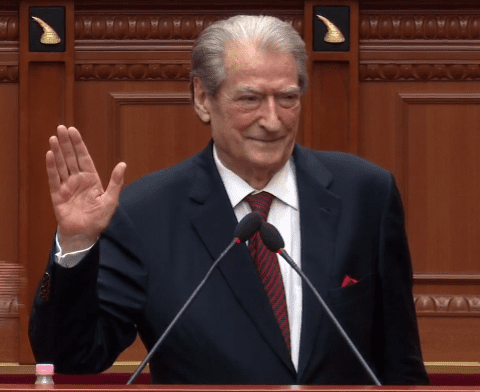
“Responsibility for peace in Kosovo is a direct one for the EU,” said Prodi at a news conference after talks with Albanian Prime Mininster Sali Berisha.
The European Union is preparing to take over control of the international mission in the province from the U.N..
Kosova remains a province of Serbia and has been under U.N. and NATO administration since a 78-day NATO-led air war that halted a Serb crackdown on ethnic Albanian separatists in 1999.
Western powers are in favor of statehood for Kosova, but fear a unilateral declaration of independence could throw the region into turmoil.
“During the last week there has been progress on a (EU) convergent stand on Kosovo but that progress, that convergence needs more time to be realized and that would be irreplaceably destroyed if there would be hasty unilateral decisions on December 10,” he said.
Kosova ethnic Albanian leaders’ talks with Serbian officials under international mediation failed to broker a deal on whether Kosova would become independent or remain linked to Serbia.
The international envoys of the troika, theU.S., EU and Russia, will report back to the United Nations secretary-general, Ban Ki-Moon, on how the talks proceeded.
Kosova’s leaders have said they would declare independence if the talks ended without a deal, but have pledged to coordinate their decision with the European Union and the United States.
The Albanian premier said that Kosova Albanians did not plan to declare independence on December 10. ” December 10 has not been set as a date for any unilateral action from the Kosova leadership. During this period, it is of extraordinary importance for the Kosova leadership to have intensive collaboration with international institutions,” said Berisha.
Albania has been the strongest supporter of independence for Kosova, where ethnic Albanians make up 90 percent of its population, saying that a delay in its status would possibly have negative effects on regional peace and stability.