Importance of an independent judiciary is paramount, experts say, as prosecutor general and other justice officials come under political attack.
By Andi Balla
TIRANA, Feb 02 – As they attempt to investigate politically sensitive cases, Albanian prosecutors, judges and other justice system officials are facing increasing attacks from politicians, something international representatives and independent analysts say threatens Albania’s democratic and rule of law credentials as well as puts its EU integration process in jeopardy.
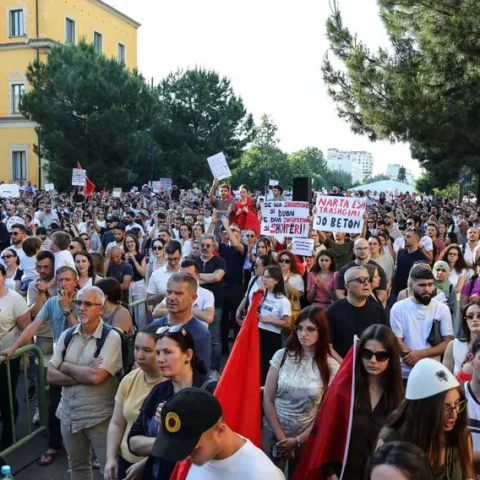
Much of the recent pressure comes from Prime Minister Sali Berisha and the ruling Democratic Party, which accuse Albanian Prosecutor General Ina Rama of being biased and fostering an anti-government agenda in the investigation of the Jan. 21, 2011 deadly protest in front of the government building in which four opposition protesters died.
The ruling party’s accusations also come after the junior government partner, the Socialist Movement for Integration, had accused prosecutors of having a political agenda for sending its leader, Ilir Meta, to trial on corruption allegations. He was found innocent late last month after a marathon trial.
Ms. Rama took the Jan. 21 case head on, announcing three new arrests last week. In a press conference, she said recent findings indicated the protesters were killed by government security forces and that officials had allegedly tried to hide the evidence.
Prosecutor general has supporters, critics
The prosecutor general has the support of the international community and her counterparts in other countries, and independent observers note her treatment of the Jan. 21 investigation has been competent and balanced, offering proper arguments against those accused of abusing power and also investigating opposition members of parliament for instigating violence against the police and security forces protecting the government building during the protest.
However, Ms. Rama’s critics accuse of her bias, saying she is not doing enough to investigate the organizers of the violent protest and all she can to punish those protecting government institutions.
In several public statements the Democratic Party has said Ms. Rama is doing the opposition’s bidding. The recent statements have been somewhat toned down from a year ago. However, it’s clear the ruling party is not happy with the prosecutor general. Mr. Berisha said this week the protest will be investigated again by the new prosecutor general, expected to replace Ina Rama later this year, indicating Ms. Rama’s work is worthless in the eyes of the government.
These repeated attacks have raised concerns among independent observers. In an interview this week with Albania’s ABC News television station, U.S. Ambassador to Tirana Alexander Arvizu said there is a difference in calling for an impartial investigation and attacking the prosecutors to exert political pressure. There would be consequences if a line was crossed and criticism becomes a direct threat, he added.
Mr. Arvizu is part of a choir of concerned diplomats and experts. Ms. Rama’s British counterpart also commented on her predicament during a visit to Tirana last week. British Director of Public Prosecutions Keir Starmer said independence of the judiciary is a crucial element in the rule of law. He added that although the government is responsible for anti-crime policies, it should not interfere in the work of prosecutors and judges.
“As head of an independent body, I am concerned by the personal and public attacks on the integrity of independent institutions and individuals in them. These attacks affect not only the targeted individuals, but also the democratic elements of the system. If there are real concerns, or evidence of violations, then those claims must be pursued through the proper channels and not … used to exert pressure on individuals,” Starmer said at a public event in Tirana.
Investigation by committee
The top British prosecutor also implied the prosecution should be in charge of politically-sensitive investigations, not parliamentary committees.
Independent analysts note a trend of investigative parliamentary committees is worrisome as politicians are using them for show trials against independent officials unwilling to bend to government pressure. “They are generally leaving a bad taste with the public, because they bring back memories of similar bodies being used under Albania’s brutal communist regime,” one analyst tells Tirana Times.
Mr. Starner added that a country without an independent judiciary cannot effectively be governed, because someone has to keep the politicians in line and make sure they follow the laws. The top British prosecutor made the comments at an EU-organized event where Albania’s chief prosecutor also spoke.
Ms. Rama said she is not worried about the political pressure on investigation, because she is following the letter of the law and will continue to do so.
Other top justice official under attack
The prosecutor general is not the only member of the judiciary under attack. The deputy chairman of the High Council of Justice, Kreshnik Spahiu, is facing a parliamentary committee of his own. The investigative committee wants to sack him for taking part in what the committee sees as unacceptable political activities at the Red and Black Alliance, a national pride movement that is not a political party but which most believe will become an active party in time for the 2013 elections.
The alliance, clearly led by Mr. Spahiu, has drawn the ire of the ruling party for opposing the government on issues like the census and seeking term limits for party leaders.
Mr. Spahiu has said he won’t give up his position under pressure and that the parliamentary committee lacks the constitutional ability to fire him since the judiciary is supposed to be independent of the legislative body.
But Mr. Spahiu’s heated public battle with members of parliament (at one point he was kicked out of the committee meeting) has further highlighted the role of the investigate parliamentary committees, which critics note have a role set in constitution but they are currently being misused by the ruling majority.
Justice system ‘vital to democracy’
The justice system is vital in any democracy and is also one of the biggest problems Albania faces, says Nicholas Pano, a top U.S. experts on Albania and a retired university professor. Professor Pano, in a recent interview with the Albanian service of the Voice of America, said the justice system issues are one of the fundamental problems of post-communist transition.
“First, there is the need to de-politicize the legal system. Properly qualified lawyers should be appointed in leading position,” he said. “Some judges … are head over heels involved in corruption, which undermines the credibility of the legal system.”
Mr. Pano adds the European Union has always emphasized in its reports that the judicial system in Albania is often corrupt and not functioning effectively. “In Western jurisprudence has a principle that goes: justice delayed is justice denied. If we see some key cases of several years ago, they still are not resolved,” he adds, mentioning the Gerdec trial and Jan. 21 case, both of which have heavy political undertones and remain open.
He added that without having a strong justice system in place “Albania’s entry into the European Union will be delayed.”
EU’s efforts to support Albania’s justice system
Because it is a key priority, the European Union has strongly supported the justice system reform in Albania, allocating almost 100 million euros in the past 15 years. EURALIUS is one of key assistance projects provided by the European Union to assist the Albanian Ministry of Justice and institutions of the justice system to develop an independent, impartial, efficient, professional, transparent and modern justice system, and thus contribute to the restoring of people’s confidence in their institutions and to the consolidation of democracy and rule of law in Albania.
Head of the European Union Delegation to Albania, Ambassador Ettore Sequi says, “Justice Reform is a top priority, key to the country’s integration aspirations and therefore an area the EU pays great attention to.” But he also adds, “It is important to see comprehensive and convincing progress in this key priority for Albania to progress in the EU integration path and to demonstrate that the country has institutions able to exercise democratic governance and protect fundamental rights.”
(With background and reporting from Tirana Times staff)