TIRANA, May 24 – The long-awaited approval and implementation of the justice reform is considered a precondition for the improvement of the business climate and attraction of much-needed foreign direct investment in Albania. The appeal comes by the American Chamber of Commerce in Albania and the Foreign Investors Association of Albania, two of the key associations representing foreign investors in Albania, at a time when key political forces have been struggling to reach consensus on the justice reform, perceived as one of the country’s most corrupt sectors, and a precondition for the country to open accession negotiations after Albania was granted EU candidate status in mid-2014.
Statements by foreign investors that several investors are leaving and Albania is losing its competitiveness were dismissed as untrue and ill-intentioned by Prime Minister Edi Rama, sparking a debate whether investors are leaving the country or not and how they perceive the current business environment.
“Without a better justice system, Albania will continue to face serious challenges attracting investment and growing its economy,” said David Muniz, the Charge D’Affaires of the U.S. embassy in Tirana.
The senior embassy official warned Albania was losing millions of dollars in potential foreign investment each year due to its failed judicial system.
“U.S. investors avoid the justice system in Albania because they have lost faith in it. That is not a very encouraging sign. In the past year alone, we have spoken with multiple companies — one seeking to invest up to $250 million. These companies have opted to invest elsewhere out of fear that they would not be able to get a fair trial in Albanian courts,” said Muniz.
“There was one specific observation we heard over and over again – the courts in this country exist to serve the corrupt at the expense of legitimate businesses. This chaos around property cases is frequently cited by investors as yet another way that the justice system is discouraging investment,” he added.
The embassy official mentioned cases of U.S. investors freezing investment and even leaving Albania over corrupt practices in Albanian judiciary.
“A good climate, strong agricultural opportunities, potential for tourism, and even improved infrastructure are all helpful, but a well-functioning justice system is indispensable for fixing the kind of problems I’ve described above,” said Muniz.
“By adopting the comprehensive, Venice Commission-endorsed package of justice reforms, Albania will send a very strong signal, not just to the EU, not just to this region, not just to the U.S., but to all foreign investors,” he added.
The U.S. and EU have set the end of June or early July, just before parliament concludes its season ahead of the summer vacations, as a deadline for the approval of the justice reform to the Albanian political class.
Earlier this month, the U.S. embassy in Tirana expressed its concern over the country’s business climate and that two major North American companies were leaving the country rather than expanding their presence in Albania.
The concern about major North American companies leaving the country is related to Canada-based Bankers Petroleum and U.S.-based TransAtlantic Petroleum.
Last March, Canada-based Bankers Petroleum signed a preliminary deal with China’s Geo-Jade Petroleum Corporation to sell its major Albania assets and a newly acquired minor oil block in Hungary for a reported C$575 million (€392 mln). The surprise announcement came as the country’s biggest oil producer has recently been facing tough times after more than a decade of operations in Albania due to a sharp cut in international oil prices and tax and environmental disputes with the Albanian government.
U.S.-based TransAtlantic Petroleum also announced the sale of its loss-making Albanian unit to GBC Oil only one year after acquiring it.
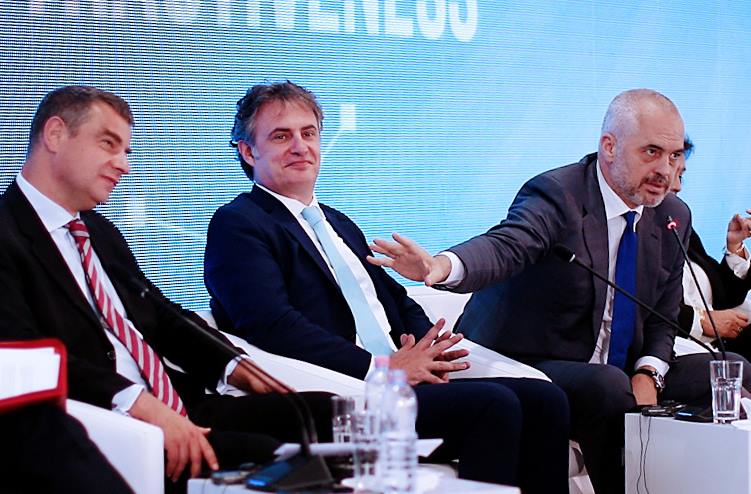
Addressing the conference, EU Ambassador to Albania Romana Vlahutin highlighted how foreign investments can help Albania grow, and how important the justice reform is in order to attract them. “Both the European Union and the United States are fully behind, and we are just waiting for the Parliament to finish its procedures. We stand ready, I know that Albanian people stand ready as well. We just wait for the Parliament, before the end of June,” said ambassador Vlahutin.
Silvio Pedrazi, the president of the Foreign Investors Association (FIAA), said Albania needs clarity and rule of law to boost investment.
Courts, frequent changes in legislation and tax procedures and their clarity, informal competition, corruption and investment stimulation policies are the top five concerns for foreign investors and their joint ventures with Albanian partners in Albania, according to a FIAA survey.
Tahseen Sayed, the World Bank country manager for Albania, said Albania needs to grow by 4.5 percent annually in the next few decades in order to reach living standards in EU countries.
“Albania needs to integrate into the global economy more successfully in order to grow at these higher levels and create more jobs. This also requires a structural shift toward increased productivity among firms and a boost in the external competitiveness of the economy,” she said.
Debate over investment
Speaking in another meeting with investors this week, Prime Minister Edi Rama said there were no investors leaving Albania and big investors such as Bankers Petroleum were simply switching hands.
“Who is saying that investors are leaving? Which investor is leaving? I have heard it from representatives of foreign chambers of commerce. Tell me a single investor who is leaving. Bankers Petroleum is not leaving but being sold which means it is making a profit,” Rama told investors.
A French bitumen investor complained to the Prime Minister that because of the new fiscal package he cut 80 workers from his bitumen plant in Selenica, southern Albania.
Last December, the government set a 2,371 lek (€17)/ton mining royalty on bitumen, lifting the 5 percent rate to handle the revenue decline from the sharp cut in international commodity prices.
Jens Reinke, the IMF resident representative in Albania, said the business climate in Albania still remains tough and investors’ confidence is low.
Opposition leader Lulzim Basha said Rama’s meeting with investors had a boomerang effect for the Prime Minister.
“Albania has been removed from the list of foreign investors because of uncertainties linked to criminals, the unfavourable business climate, high taxes and fines which are stifling SMEs and big businesses,” said Basha.
One year ahead of the 2017 general elections, the opposition Democratic Party has unveiled an economic platform based on a 9 percent flat tax compared to a current 15 percent rate on corporate income tax, dividends, rents and capital gains.
Business climate
Albania has been losing pace in the regional competitiveness race for foreign direct investment in the past couple of years as its business climate deteriorates mainly due to an increase in the tax burden and continued lack of rule of law.
The latest survey by the German Association of Industry and Trade in Albania, the ranking in the 2016 Doing Business report but also concerns by other foreign and local business representatives confirm the deteriorated situation.
Albania continues remaining one of least attractive destinations for German investors among 16 Central and South East European countries, according to an annual survey conducted by the German Association of Industry and Trade in Albania (DIHA).
A decline in commodity prices affecting exports, sluggish domestic consumption, public debt at around 72 percent of the GDP, non-performing loans at about 20 percent, exports and lending struggling to recover to positive growth rates and an ongoing decline in migrant remittances hint Albania will face another tough year in 2016.
Albanian and foreign business associations have also appealed for measures needed to improve the country’s business environment after Albania lost 35 places to rank 97th out of 189 countries in the latest Doing Business report published by the World Bank.
Business associations have continuously appealed for a review downward of taxes on profit, dividend and personal income and a return to a flat tax regime of 10 percent as an incentive giving the business community more room to develop and increase registration numbers.
Since 2014, the corporate income tax and the withholding tax on dividends, rents and capital gains have increased by 5 percent to 15 percent, making the tax burden in Albania one of the region’s highest.
Albania’s total tax rate as a percentage of commercial profit of rose to 36.5 percent in 2015, up from 30.7 percent in 2014, lower only compared to Serbia among regional competitors.
The Albanian economy has grown between 1 to 3 percent since 2009 compared to a pre-crisis decade of 6 percent.