Prime minister and president take their disagreements to a new level as a very public fight leaves president out of national unity commemoration. Democrats step up attacks on rising new rivals.
Tirana Times
TIRANA, March 8 – The conflict between Prime Minister Sali Berisha and President Bamir Topi has risen to a new level, after the ruling Democratic Party launched a new wave of public attacks on Mr. Topi, who was once that party’s and Mr. Berisha’s number two. The president was also was denied the right to give a speech at an event commemorating national unity, in what independent analysts said was clear breach of protocol.
President Topi, who is nearing the end of his mandate and has kept largely quiet as his role doesn’t allow for political leanings, went on a public outburst for the first time this week as he answered a barrage of accusations against him by Mr. Berisha’s Democratic Party, including one relating to a lustration law Mr. Topi vetoed, citing clauses that were unconstitutional. The law relates to making public secret police files of the communist regime period.
Mr. Topi, whose own background, due to age and family background, is not tied to the communist regime, was clearly angry at the connotation that he did not want the files opened – something Democrats often use to intimidate opponents.
“The man accusing me [the prime minister] needs to explain several photos of him with members of the politburo ŠHe had been a member of the Labour Party since 1968, a [communist] party secretary, and for 22 years, he tells tails about communism, and does nothing though he has the power,” Mr. Topi said of Mr. Berisha. “I support opening the files, and be sure that when they are opened, there will be wonders for everyone to see.”
By the time he snapped in public, Mr. Topi has been on the receiving end of almost daily attacks by the Democrats who have been after him once he made it clear he intends to head a new center-right party when he leaves the presidency. The party, made up largely from the splinter group of the Democratic Party, where Mr. Topi used to serve as Mr. Berisha’s deputy, is a threat to the Democrats razor-thin majority in parliament and would make it much harder for them to win the 2013 elections, analysts note.
The Democrats have used several attacks on the president, but the latest, dealing with Mr. Topi’s failure to sign the lustration law clearly hit a nerve with the president. Prime MinisterBerishasaidthe president hadnot signed into law a lustration bill that would have offered full disclosure on crimes under communism, and that should reflect on the type of man the president is.
Aday before,a DP member of parliament, Edi Paloka, also said President Topi was serving the agenda of Opposition leaderEdiRama. “He was dishonored his post as head of state,” Mr. Paloka said.
Mr. Topi told reporters that instead of attacking him, the prime minister should keep his promises and to compensate the former property owners and those persecuted under the communist regime. “He has the power to do it, and has done nothing,” Mr. Topi said.
Disunity at Lezha event
Topi’s outburst came after another conflict with the prime minister earlier in the week over the 568th anniversary of the Covenant of Lezha, the event which marked the unification of Albanians in the fight against the Ottoman invaders in the 1400s. All national celebrations have special significance this year, as 2012 marks Albania’s 100 years of independence.
The commemorative ceremonies organized in Lezha were to be attended by the highest authorities of the government and parliament as well as Albanian politicians from Kosovo, Macedonia and Montenegro. In his speech, Prime Minister Berisha praised the Covenant of Lezha as an event that marked the beginning of Albanian unity.
The problem was there was no national unity at the commemoration itself as President Topi was denied the right to speak by the State Protocol officials. Topi decided not to attend the event, speaking instead from his office. “Albania needs a covenant about democratic values,” he said.
The use of protocol officials to deny the president the right to speak was called “a disgrace” by several independent analysts who are concerned that toxic politics have reached every corner of Albanian life.
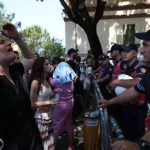
In addition to the incident with the president, another potential rival of the Democrats, the Red and Black Alliance was denied the right by police to hold a rally to commemorate the Lezha Covenant in that northwestern Albanian town where there is a monument in honor of Skanderbeg and the other Albanian princes who joined forces against the Ottomans.
RBA leader Kreshnik Spahiu went ahead and held the rally anyway, criticizing ruling politicians of keeping the country divided, something he said is an indicator that Albania needs new leaders.
Democrats threatened by new, energetic rivals
Like President Topi, Mr. Spahiu is a direct threat to Mr. Berisha’s reelection bid, so he too was attacked by the Democrats and threatened with dismissal and criminal prosecution by an investigative committee when he was leader of the High Council of Justice. Mr. Spahiu eventually quit his official post following a heated public battle with Democratic members of parliament.
A firebrand speaker with a nationalist agenda, Mr. Spahiu is bringing into Albanian politics young voters and would either not vote or vote for the right. Though not officially aligned with Mr. Topi’s new party, the two are seen as natural allies against Mr. Berisha by analysts. In essence, the right part of the political spectrum in Albania is seeing a split like it never has before.
This comes as a delight to the Socialists who hope to ride the wave of discontent with Mr. Berisha’s governance into a victory in 2013, partially thanks to the split of votes on the right. “A government that blames the opposition for everything Šis the face of failure,” Opposition leader Edi Rama wrote on his Twitter feed. “The fact the Democratic Party has split in three shows these failures.”
The RBA has vowed to never form a coalition with the two main parties though, and Mr. Topi’s party is yet untested with the electorate. But if these new entrants do manage to get votes and support, Albania might be headed for a situation in which no party is able to form a government on its own.