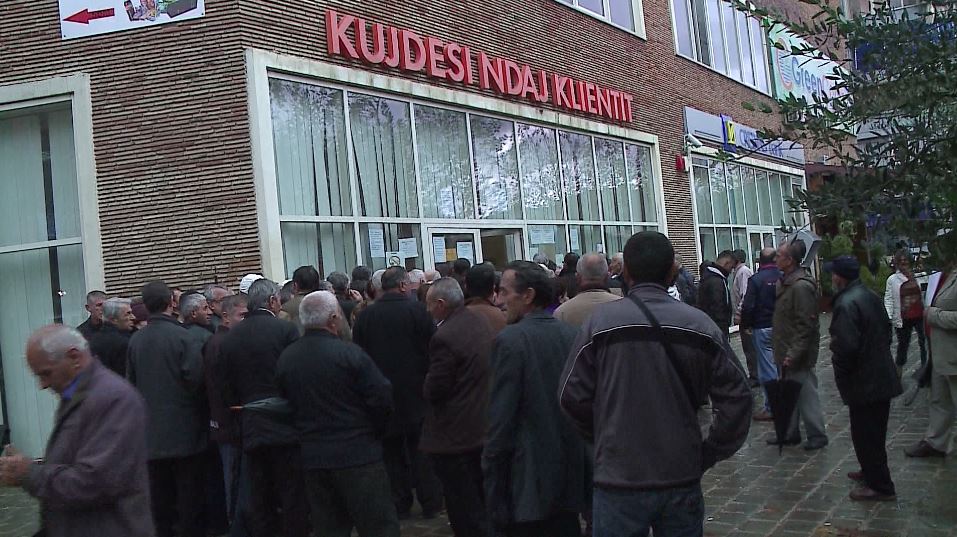
TIRANA, May 26 – While a nationwide campaign to collect accumulated unpaid bills is underway since late 2014, affecting thousands of poor households, the Albanian Ombudsman’s Office has called on government to consider an amnesty for families receiving social assistance.
In a recommendation sent to the Albanian government, Ombudsman Igli Totozani, calls on government to consider legal action for the pardon of accumulated unpaid bills for households in need benefiting from the social assistance sysyem and offer affordable incentives for its payment.
“Under conditions when one of the priorities of the European Union is human rights and when the government has committed to having the protection of vulnerable groups rights at its focus, we estimate that because of the difficult conditions this social group faces today, it would be indispensable to carry out a study and finding a way to pardon accumulated unpaid bills for all households currently benefiting from the social assistance system,” the ombudsman noted in his letter to Prime Minister Rama.
Citing article 52 of the Albanian Constitution “Everyone who is without work involuntarily, and has no other means of support, has the right to assistance under the conditions provided by law,” the Ombudsman says that although the distribution operator has offered households the opportunity to pay their accumulated debts in monthly installments of 1,000 lek (€6.7) compared to 2,500 lek (€17.4) for other debtor households, “we must be aware that there exist households that can’t make ends meet and face extreme poverty.”
Data published by the country’s state statistical institute, INSTAT, shows some 70,857 households benefited modest social assistance of around 4,000 lek (€28) a month at the end of 2014, compared to 82,554 at the end of 2013.
The Social Welfare Ministry says the more than 10,000 households which have been removed from the social assistance system illegally benefited it or did not meet all required conditions, but the Ombudsman’s office has called on the ministry to make field verifications on the stripped households following hundreds of complaints.
The removal of families in need from the social assistance system and the unaffordable payment of current and accumulated electricity bills has been one of the reasons for a wave of Albanians leaving the country and seeking asylum in EU countries, especially Germany.
The energy distribution operator says it collected an extra $100 million in the first four months of this year, mainly in accumulated unpaid bills as part of its nationwide campaign launched last October to curb electricity thefts and losses of around Euro 150 million a year.
The central bank estimates that the payment of accumulated unpaid bills as part of a nationwide campaign affected consumption in the final quarter of 2014.
“The payment of accumulated unpaid bills and a drop in confidence made consumers more hesitant about spending in this period. This was mostly reflected on lower consumption of services and big purchases,” notes the central bank.
It added, “The incomplete utilization of the labour market and production capacity among businesses is keeping the economic activity below its potential and the inflation rate below the central bank’s target.”
The central bank expects the Albanian economy to accelerate to around 3 percent this year, up from 2 percent in 2014.