By: AGRON ALIBALI
Filed away in the archives of the Official Gazette of the Republic of Albania is a decree that dates back to the year 1963 on, “The Ratification of the International Tele-communications Convention. Attached to the Convention is the following declaration: “The Albanian Government declares that the Decision adopted by the Plenipotentiary Conference of the International Telecommunications Union, Geneva 1959, on ‘the recognition at the Plenipotentiary of the representatives of Chang Kai-shek (Taiwan, our note), to participate in the conference and to sign the final acts on behalf of China is unlawful because the legitimate representatives of China can be none other than those appointed by the Government of the People’s Republic of China.”‘ [Decree No.3661, dated 10.04.1963, GZ 63/10/188].
Similar declarations were delivered at other meetings and forums of the United Nations and other international organizations.
And this is how one of the most interesting battles in the history of Albanian diplomacy and International Law as well began, during which a small country, like Albania, made use of every international forum accessible to it to seek the recognition of the legitimate rights of the government of the Republic of China, as the sole representative of all the Chinese people.
Even before it was studied at the Albanian University Law Faculty, or by Albanian diplomacy, this battle reached its climax in September of 1971, when, following years of efforts, Albanian diplomacy managed to get the Resolution approved that granted the People’s Republic of China its rightful place in the United Nations Organization and on the Security Council. Understandably, this would have been achieved sooner or later, however, this accomplishment by Albanian diplomacy objectively constituted the curtain-raiser on what was to be known as “Ping-Pong Diplomacy,” when US President Richard Nixon met the Leader of the Chinese people, Mao Tse- tung – the turning of a completely new leaf in the history book of international relations.
Today, on the sixtieth anniversary of New China, the historical importance of Sino-Albanian relations cannot be denied and neither can the establishment of American-Chinese relations. Today, China is the world’s third greatest economy; today USA-China relations are exceedingly more interlaced and strategic in almost all fields; China is the largest purchaser of American treasury bonds – just to mention a few facts.
The proclamation of the People’s Republic of China by Mao Tse-Tung on 1 October, 1949, marked a final turning point in the almost six thousand year old history of China and in the role it has played on the world scene. The sun set, once and for all, on those times when China kowtowed to the colonial powers, as was the case with the Opium Wars against the British Empire (1839-1860), or when China languished, divided and weak – as was the case prior to and during the Japanese invasion.
Although worlds apart, in their histories and customs, the Albanian and Chinese peoples have always had things in common. Official historiography accepts 1 September, 1939 as marking the beginning of World War Two. However, for the Albanians the War had begun with the Italian invasion of Albania on 7 April, 1939; whereas the Chinese people had been fighting for a full eight years against the Japanese invaders, ever since the 18 September, 1931 Incident and the subsequent invasion of Manchuria.
In China, the Japanese occupiers were to commit some of the most horrific massacres history has ever recorded, including the Nanking Massacre, during which more than 300.000 persons were raped and slaughtered; chemical and bacteriological weapons were used for the first time ever (the dissemination of the Plague by releasing infectious insects), and so on.
These and countless other war crimes reached their culmination with the “The Three Alls” warfare tactics [‘Sanko Sakusen’ or – “Kill All, Burn All and Loot All”], praticed in China during the period from 1942 to 1945, which caused upwards of two million victims.
Coming back to the developments of the seventies’, contrary to the pragmatic handling (and most certainly in the interests of both their countries), of bilateral relations by President Nixon and Chairman Mao, Albania, at that time, placed ideological criteria above the interests of its nation and people, hence allowing itself to drift to the periphery of the tumultuous developments the times imposed.
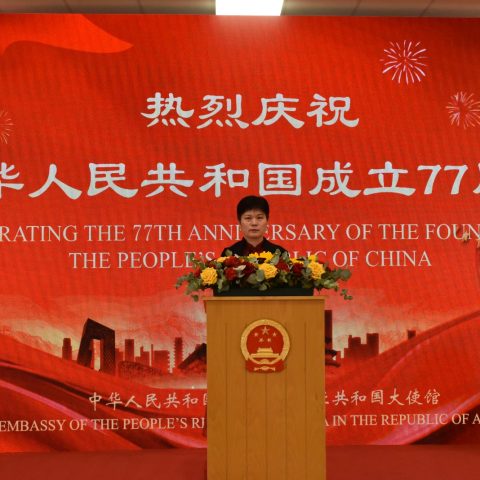
Nonetheless, respect, gratitude and sincere friendship remained steadfast between the two countries and peoples. Evidence of this are a Nine Point Declaration signed between the Prime Ministers Wen Jiabao and Fatos Nano on 14 September, 2004 and especially the Joint Berisha- Wen Jiabao Declaration “On the deepening of the Traditional Friendship between the People’s Republic of China and the Republic of Albania,” of 21 April, 2009.
The Berisha- Wen Jiabao Declaration endorses that 60th anniversary of the establishment of diplomatic relations between our two countries, constitutes a priceless asset, created by both peoples, which remains solid within the foundations of the further strengthening of bilateral relations, which is not impeded by distinctions of the historical past, social system, ideology or model of development.”
The Declaration underscores the desire to see the growth of bilateral cooperation in all fields, based on the five fundamental principles of International Law, a growth that will take place at all levels, government, parliament, between political parties etc.
The development of trade, of economic relations and investments occupy a place of major importance in this Declaration.
The use of the expression, “to realize a balanced trade in the near future,” as well as the fact that, “the Chinese side welcomes the introduction of more Albanian products onto the Chinese market,” are also to be emphasized.
To grasp the significance of this point, all we need do is mention the fact that today China constitutes an all-important market for the consumption of American commodities, fundamentally contributing, in this manner, to the softening of the crisis, the growth of employment and the economic revival of America.
It goes without saying that it is no easy undertaking to compete on the Chinese market, for a multitude of reasons including the high quality and the low prices of local commodities. However, China is probably one of the very rare countries in the world, where the trade mark “Made in Albania,” is still regarded with interest and compassion. The entrance of Albanian companies on the Chinese market would mean extraordinary assistance to the country’s economic growth, to the softening of poverty, the lowering of unemployment etc.
In this direction, it is of the utmost importance that the Joint Inter-Government Commission of Economic and Trade Cooperation be immediately activated. It is vital that this Commission comes together once every six months, beginning right away.
Of paramount importance is the opening of Sino-Albanian Chamber of Commerce. It should be emphasized here that the American Chamber of Commerce has one of its most active and powerful organizations in the People’s Republic of China. Apart from this, there is also a USA-China Chamber of Commerce centered in Chicago, which is also very active and powerful.
The Berisha- Wen Jiabao Declaration emphasizes the wish to extend cooperation in the fields of culture, education, radio-television, the film industry, as well as tourism, agriculture, public healthcare, science and technology, in the fields of local government as well as between social and non-governmental organizations. But, Chinese assistance could also be sought in the field of Justice, and especially in the UNO Convention on Maritime Rights, where China has among the world’s leading experts.
Albania was amongst the first countries to recognize New China sixty years ago. Today, however, what is laid down as a vital necessity of this country is the concretization without further delay of all the commitments in the Berisha- Wen Jiabao Declaration.
Meanwhile, other countries are not wasting any time. Serbia is going all out to reinforce relations with China; what stands out here is an Agreement signed on 2e3 October of this year for the construction of a super-modern bridge spanning the Danube in Belgrade.
Why can’t Albania develop its obsolete railways system with Chinese concessions; its internal air transport with the fleet of aircraft needed, or the tunnels on the road and rail route Prrenjas (Albania) to Struga (Macedonia), just for starters?
The strengthening of Sino-Albanian relations is not spearheaded against anyone and should not cause anyone any concern. There exist unsubstantiated claims that allegedly it is the USA that opposes these relations between Albania and China.
But, is there any sense in the reasoning that, on the one hand, the American Administration maintains brilliant relations with China (for example President Obama’s November visit to China and his talks with President Hu Jintao on 21 October), but then, on the other hand is allegedly not interested in Albania having such ties with this country?
Albania-China relations even need to be revived in the military field. Once again we have the American example: General Xu Caihou Vice Chairman of the Communist Party of China’s Central Military Commission is being received with full honours in Washington these days and US Defence Secretary Gates is expected to return the visit very soon.
Treated without a thread of dignity and almost like a beggar at the Gates of Brussels, Albania should not hesitate to preserve and strengthen close, binding, strategic relations both with the USA, which, historically obstructed the country’s partitioning by the European States, and with China, which, with its economic supremacy remains today a real opportunity to create a prosperous, economically strong Albania which would enjoy dignity at international level. This is the only way it can be accepted as an equal partner in a still cold and skeptical Europe.