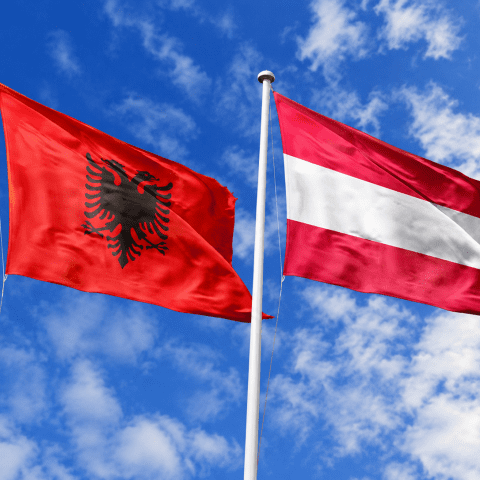
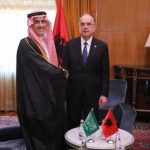
TIRANA, March 15 – Deputy Prime Minister and Foreign Minister Ilir Meta made an historic visit to Serbia where the two countries, while still voicing their division over Kosovo independence, continued to pledge to improve their relations as they both seek to join the European Union.
In the first-high level contact between the two countries since 2005, Meta went to Belgrade marking a “new era of relations” that will prove “a milestone for stability in the region.”
Meta’s visit was the second, taking into consideration the first due to the warm relations he had with the late Serbian premier Zoran Djindic. Met also laid a wreath at his tomb in Belgrade.
Serbian counterpart Vuk Jeremic said the two ministers “confirmed the mutual stance that the future of entire Western Balkans is in the European Union.”
Relations between Belgrade and Tirana have been strained over Kosovo, first over Albania’s support for ethnic Albanians in Kosovo during the 1998-1999 conflict there, and then over its support for Kosovo’s independence drive.
Kosovo unilaterally declared independence from Serbia in February 2008, which Serbia does not recognize.
“These differences have not been overcome in today’s talks, but it is extremely positive that we agreed to make our best efforts to isolate them in a way that will not further burden our other relations,” Jeremic said.
Meta also met with Serbian President Boris Tadic, Serbian Deputy Prime Minister Bozidar Djelic and Interior Minister Ivica Dacic. Meta and Dacic signed an accord of cooperation against organized crime and illegal drug and arms trafficking
Serbia and Albania pledged to improve their relations as they both seek to join the European Union.
There is little trade exchange between the two countries, though it is said there are about 100 Serb companies operating in Albania.
The Albanian minister’s visit was considered as a gesture of rapprochement in relations between Belgrade and Tirana after Albania had recognized Kosovo’s ethnic Albanians’ unilateral independence declaration.
But it seemed that was little to add to the bilateral ties and could be more considered as a gesture of Tirana’s good will for friendly ties in the region.
The cabinet of the Albanian foreign minister had considered Meta’s trip to Belgrade as “historic”.
Meta also visited the Presevo Bujanovc region in southern Serbia which has a considerable ethnic Albanian minority.
Albanian lawmaker Riza Halimi in the Serbian parliament said, “We know that the Presevo valley, is in a way, a hostage of this, so to speak, unbearable situation which currently exist between Belgrade and Prishtina and it’s probably not a factor which is helpful for relations between Belgrade and Tirana, but I still think that there is a big mutual interest.”
Surprisingly Serbian authorities also expressed their concern on the Serb minority in Albania.
That could be a sign why one could say the visit was more diplomatically and bilaterally exploited by Belgrade. There is practically an almost non-existent Serb minority in Albania. There is a small Montenegrin one but hardly any recognizable Serb one. Still Belgrade made the show.
“All around the Balkans, our nations are somewhere majority and somewhere else minority. The only solution is to apply the same European standards for minorities,” said Meta.
During his visit to Belgrade, Meta also signed a treaty on cooperation in combat against organized crime, international illegal drug trade and international terrorism.
Tat could be a clear result of the visit. Both countries are looking forward to becoming EU members and the bloc insists that first the regional western Balkan countries should establish normal operational relations among themselves.
The official visit of Deputy Prime Minister and Minister of Foreign Affairs Meta in Belgrade is a clear sign of the priority that the Albanian foreign policy gives to the development and to the strengthening of relations with the countries of the region, as part of the acceleration of the European perspective for our countries.
Not everyone in Albania was pleased with the visit.
While main opposition Socialist Party lawmaker Kastriot Islami, a former foreign minister, said that the world had always praised Tirana’s moderate policy in the war-torn region and acknowledged that any intensification of the ties in the region would help their road toward the integration process into the European Union, Pellumb Xhufi, a former deputy foreign minister, believed there was not need for such a commitment to strengthening ties with Belgrade as Serbia was not a direct neighbor to Albania.
Islami also favored the idea that intensifying contacts with Serbia could help Belgrade understand the irreversible reality of Kosovo. Islami considered Meta’s visit to Belgrade as a ‘demotivating message” for all those nationalist persons trying to stop the European progress of the region.
Xhufi said Kosovo was a top issue existing between the two capitals, Tirana and Belgrade. He harshly criticized the ministers of post-communist Albania of declaring that ties with Belgrade would be developed despite Kosovo. No one would expect any stand change from Belgrade officials on Kosovo. If they would make such a drastic change to their stance toward Kosovo, for sure Serbian president or foreign minister would run to Brussels or Washington to make it known, not to Tirana or with Tirana.
Xhufi said that Tirana should have waited for any clear encouraging sign from Belgrade before rushing to go there.
If one notes the bilateral meetings it could be clearly seen it has always been Tirana’s initiative in most of them, while Serb officials have either come while passing by in the area or due to regional obligations.
Albania has recently upgraded its diplomatic level to an ambassador in Belgrade, something which is not done by Serbia keeping a lower diplomatic level in the last two decades.
There were also voices against the visit. Socialist lawmaker Pandeli Majko, also former premier, criticized the visit as being only in favor of Belgrade.
But Meta made it clear that despite the division on Kosovo the visit only served to help the European integration efforts of both countries.
“On the issue of Kosovo, our two governments have quite different positions. But, on the other hand, we agreed that the future of the entire region is within the European Union, without leaving anyone behind,” said Meta.
Kosovo’s Prime Minister Hashim Thaci also hailed Meta’s visit to Belgrade as a, “ưositive step in building up friendly relations and the stability in the region that will be reflected in the Serbia-Kosovo ties.”
“We should all be committed in building a good inter-state neighborhood and that is why that was a good message for regional peace, stability and cooperation and I do think that is a message that Belgrade should build good ties with the countries that have recognized Kosovo as an independent, sovereign and democratic state. That is assistance to Serbia so that it may later recognize Kosovo as an independent and democratic state,” said Thaci.
Kosovo’s future in EU
During his recent visit to Belgrade Meta also paid special attention to Kosovo in his numerous interviews to the international news agencies and radio stations.
Meta said that although Belgrade and Tirana have different views on Kosovo’s status, he believed they agree that the region’s future is in the European Union.
Meta said it is well known that, “Ưur positions on Kosovo independence are fundamentally different.”
“We share the belief that despite key differences on the [Kosovo] status issue, bilateral and regional cooperation should not be conditioned by those disagreements,” Meta said. “I believe that the same principle is valid even in the relationships between Prishtina and Belgrade. Despite the disagreements between Kosovo and Serbian leaderships it is in the interests of Kosovo citizens and in the regional interests to solve all practical issues related with the daily life of Kosovar citizens through dialogue.”
Meta also added that Albania would cooperate fully with any investigation with the International Criminal Tribunal for the former Yugoslavia or the Council of Europe on allegations of organ trafficking during the Kosovo war “so these speculations can come to an end.”
“Albania is ready for a full investigation to (put) an end to these allegations of (former UN war crimes prosecutor) Carla del Ponte,” the minister told AFP at the end of a rare two-day visit to Serbia.
Claims that ethnic Albanian rebels kidnapped and killed Kosovo Serbs in Albania to sell their organs abroad first surfaced in Del Ponte’s book “Madame Prosecutor”.
“We are ready to cooperate very openly and also in a very transparent way for a full investigation which (will) end these allegations and speculations,” Meta said.
“I am convinced they are unfounded,” the minister told a press conference earlier when asked about the claims.