TIRANA, Oct. 30 – Thousands of Albanian households nationwide have had their social assistance cut off in the past three years as part of a reform removing abusers from the scheme and offering vocational education training to beneficiaries no longer qualifying for assistance to prepare them for labor market needs.
Data published by Albania’s state-run statistical institute, INSTAT, shows Albania had had some 53,000 households benefiting social assistance in mid-2018, around 31,000 fewer compared to mid-2015 when Albania was piloting the current system in the country’s three largest regions.
The sharpest cut in the number of beneficiary households was registered in early 2018 after a new scoring formula identifying the poorest households and removing abusers was applied nationwide, cutting off some 26,000 former beneficiaries from the social assistance system.
Earlier this year, the World Bank-supported reform triggered protests in some of the hardest-hit regions, especially the northern Dibra and Kukes, the country’s poorest regions where agriculture and mining are the main employers and whose residents often rely on remittances to make ends meet.
While the reform has identified people already employed and owning cars as abusively receiving social assistance, there have also been cases when households were punished and stripped of their assistance following inspections because of failing to declare their home appliances in their application forms.
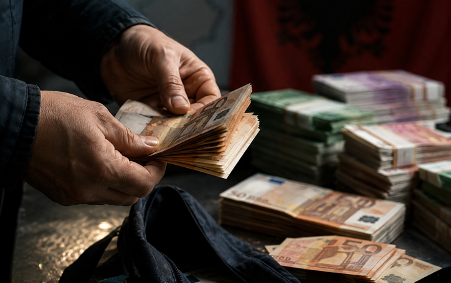
An average Albanian family of four gets modest monthly assistance of an average of 5,247 lek (€42), a small amount in a country where the minimum wage is at 24,000 lek (€191) and has an estimated subsistence level of 16,000 lek (€128) a month.
The modest assistance that ranges up to 8,000 lek (€64) a month relying on a points-based electronic system is not even enough to lift an average Albanian household of four out of extreme poverty, estimated at living on less than $2 a day.
The World Bank which has been assisting the Albanian government improve the efficiency of social assistance programs supporting the low-income and people with disabilities, says the modernization project has improved both coverage and targeting by introducing a new scoring formula that has been rolled out nationally.
“The new systems have increased the administrative efficiency by reducing the time needed to determine eligibility to 5 days, compared to 25 at the project start,” says the World Bank which earlier this year approved US$11 million of additional financing for the Albania social assistance modernization project.
Need for an exit strategy
As part of an exit strategy for social assistance beneficiaries, the Albanian government has been offering households who have at least one person able to work free vocational education training and a modest cash reward in order to integrate them into the labor market where they can earn at least four times more compared to what they get in assistance.
Albania currently provides social assistance to households with insufficient income for a period of up to five years, but the World Bank says there is no ‘exit strategy’ in place for existing beneficiaries once they reach the fifth year of benefits.
“There is a need to elaborate elements of an exit strategy (for example, exceptions, activation measures, and possibility to reapply to economic assistance among others) tailored to the profile of beneficiaries and a communication strategy to gradually alert and support beneficiaries well in advance of their actual exit from the program. Interpreting the law in a strict way, the first beneficiaries will need to exit the program in 2021, within the expected life of this additional financing project,” says the World Bank.
The World Bank social assistance project also supports a reform boosting current limited access to support services for people with disabilities in the country.
“At the heart of the disability reform is the holistic idea that people may not just require cash benefits but also services (physiotherapy, psycho-social, day care, and residential care services for both adults and children),” says the World Bank.
Back in 2016, Albania also reformed unemployment benefits by increasing the amount of compensation and reducing the number of beneficiaries.
Albania had some 1,933 jobless people receiving unemployment benefits of 11,000 lek (€88) for a period of up to 12 months in mid-2018, down from more than 6,000 people in 2015 when monthly benefits were at 6,850 lek (€55).
Another 35,600 jobseekers registered with unemployment offices receive modest social assistance, while more than half of total registered jobseekers, some 40,800 get no assistance at all.
Albania currently has more than a quarter of its population living on less than US$5.5/day, in one of the highest rates among EU aspirant Western Balkan countries.
The World Bank expects Albania’s poverty rate measured at US$5.5/day in purchasing power parity to drop to about a quarter of population by 2020, down from about 28 percent, but yet remain one of the highest in the region.
Official jobless rate drops
Albania’s official unemployment rate dropped to an almost record low of 12.4 percent at the end of the first half of this year and youth jobless rates were down to 22.6 percent. However, the official numbers don’t include a staggering 462,000 people employed in the largely informal private agriculture sector, where people living in rural areas and possessing land are automatically considered as self-employed in the agriculture sector. Albania had some 36,520 farmers paying social security contributions at the end of 2017, less than a tenth of the total number.
High migration rates following an asylum exodus in the past four years and more and more youngsters leaving the country to study or work abroad are also estimated to have contributed to lower jobless rates.
A considerable number of officially reported jobs in the private sector are a result of nationwide campaigns against tax evasion that lifted thousands of workers out of informality and imposed tougher penalties on the shadow economy, estimated at about 30 percent of the country’s GDP.
Albania’s public sector was surprisingly more efficient in reducing unemployment rates in the first half of this year compared to the key private sector, the generator of about 85 percent of Albania’s jobs, signaling that the decade-high energy-sector fuelled 4.4 percent growth rate that Albania registered in the first half of the first year failed to produce enough jobs.