TIRANA, Nov. 4 – Antoni Clave, one of Spain’s most influential 20th century artists, is for the first time having the best of his artworks created during his 70-year career at the National Arts Gallery in Tirana. The exhibition called “Antoni Clave – A World of Art, Works 1934-2002” was inaugurated on Thursday afternoon as part of the Spanish Cultural Autumn events that are being held in Albania in a ceremony attended by Spanish ambassador Manuel Montobbio as well as Albanian culture officials and art lovers.
The inauguration was preceded by a press conference by Jose Francisco Yvars, the exhibition’s curator, who unveiled the late artist’s creativity to the Albanian public.
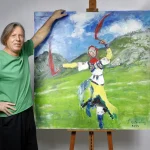
Antoni Clave’s exhibition will have 44 artworks on display, including collage art, movie posters, theatrical stage design and paintings, all of which created from 1934 until 2002, three years before the artists passed away. The artworks have been especially selected for this exhibition from private collections in Spain and around the world, organizers said.
The exhibition, which will be open to the public until December 15, is a joint project brought by the Albanian National Gallery of Arts, the State Corporation for Spanish Cultural Action Abroad (SEACEX), and the Spanish Embassy in Tirana.
The Spanish embassy considers the exhibition an exceptional opportunity to see the works and talent of one of its most respected and celebrated artists.
Clave’s career & art
Antoni Clav顷as born in Barcelona on 5 April 1913. His work evolved from a baroque, ornamental style to a pure, minimal aesthetic. In his later years, his work was completely abstract, employing expressive lines and exploring the boundaries of shading, texture and color. He is best known for his lyrical abstractions, works which combine paint with collage.
During the 1940s Clave’s painting showed the stylistic influence of Bonnard, Vuillard, Rouault and especially Picasso, with whom he became acquainted in 1944. Clav騳 motifs at the time were scenes of tranquil domesticity tinged with melancholy, puppet-like female figures, children, clowns and harlequins, according to his official website.
The early 1980s saw the Clav顳eries “Hommage ࡐicasso”, followed by a series inspired by urban living in New York, which Clav顶isited in 1972 and 1989. After one-man shows in museums and galleries in Zurich, Barcelona, Paris and Tokyo, Clav顷as given a comprehensive retrospective at the Centre Pompidou Musꥠd’Art Moderne in Paris in 1978. The Spanish pavilion at the 1984 Venice Biennale was dedicated to Antoni Clav鮍
Spanish Cultural Autumn
The exhibition held as part of the 4th Spanish Cultural Autumn in Albania, called ‘Nostrum, The Mediterranean Trough the Five Senses’ is the third big event which the embassy brings to Tirana.
This year’s events opened on October 12 with a Flamenco concert by Ni