
TIRANA, March 6 – The government showed that authorities have completed six more chapters of the questionnaire required by the European Commission.
The new completed chapters covered the free movement of capital, information and the media society, taxes, environment, financial control, and finances and budget. That makes a total of 14 out of 35 Albanian chapters complete.
Albania applied for candidate status last year after all EU member states had ratified the Stabilization and Association Agreement.
Albania hopes to complete the questionnaire this spring and then wait for the EC answer to its request for candidate status, likely by year end.
Meanwhile the EU’s Spanish presidency Saturday proposed a high level meeting of European Union and Balkan officials in June to “reinforce the European perspective of the region.”
“We must show the countries in the region that we continue to care even more than we did ten years ago,” Spain and Italy said in a statement to their EU partners circulated at a meeting of EU foreign ministers in Cordoba, Spain.
It is ten years since a Zagreb summit affirmed the “European perspective” of the likes of Bosnia, Croatia, Serbia and Kosovo, though the last had not yet claimed independence.
“The challenges now are different from those faced ten years ago,” the paper argued, with democracy consolidated and economies improved, despite the recent global recession.
“The challenge now is to accelerate and reinforce reforms,” the statement said, calling for the meeting to be held in Sarajevo, “by early June”.
“Relevant partners” such as the US, Russia and Turkey, could be invited to attend part of the meeting, the document proposed.
European leaders have said that all countries of the Western Balkans can become EU members, if they fulfill the strict criteria to do so.
“The high level meeting will be the opportunity to take stock of where we are regarding each country of the region and what our objectives are for each of them,” the Spanish-Italian statement said.
Fifteen years after the war which helped dismantle the former Yugoslavia, and 10 years after the Kosovo conflict, the 25 million inhabitants of the Western Balkans are on the path to EU membership, though at differing paces.
Slovenia joined the European club in 2004.
Croatia and FYROM are official candidate nations while Serbia, Montenegro and Albania have applied.
The laggard is Bosnia, where reforms have been glacial.
Kosovo, which proclaimed independence in 2008 has still not been recognized by all EU nations, including Spain.
Tirana makes ready more chapters of the EU questionnaire

Change font size:
Recommended Articles

Latest from News
Mecca Defense Pact Signals Saudi Arabia’s Bid to Shape a New Security Order
Change font size: - + Reset The agreement with Turkey and nuclear-armed Pakistan strengthens Riyadh’s position as a central architect of regional security, while reflecting a broader shift toward a more multipolar

SPAK Brings New Charges Against Former Deputy PM Balluku
Change font size: - + Reset Tirana Times, August 07, 2026 — Albania’s Special Prosecution Office Against Corruption and Organized Crime has brought new allegations against former Deputy Prime Minister Belinda Balluku, widening
Milošević’s Language Returns to Serbia’s Government
Change font size: - + Reset Ethnic Cleansing Remark Tests Serbia’s Claim to Have Broken With Milošević A Serbian minister’s declared willingness to expel Kosovo Albanians has drawn condemnation across the region
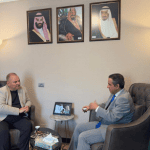
Saudi Ambassador Meets Head of Albania–Saudi Parliamentary Friendship Group
Change font size: - + Reset Tirana Times, July 6,2026 – Saudi Arabia’s Ambassador to Albania, H.E. Turki bin Ibrahim Al-Madi, received Albanian MP Baldi Çomo, Chairman of the Albania–Saudi Arabia Parliamentary Friendship

Anti-Government Protests Escalate in Tirana as Demonstrators Block Parliament
Change font size: - + Reset Tirana Times, July 03, 2026 – Albania’s month-long anti-government protest movement entered a more confrontational phase on Thursday, as demonstrators gathered outside Parliament, blocked access points