TIRANA, Apr. 3- The changes in the VAT reimbursement scheme for agriculture and dairy industry has put the entire sector in a cramp. The lack of real and stable policies has made the farmers of one of the most agricultural countries in the region pretty unhappy, claiming that these changes will make the Albanian farmer noncompetitive, and will most probably encourage them to import the raw materials.
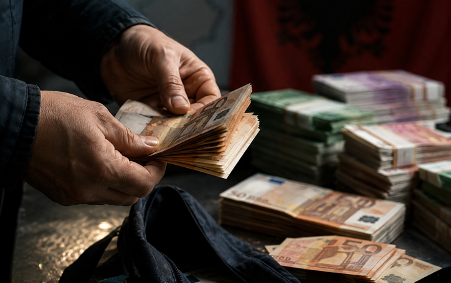
Milk and dairy processing company Erzeni Ltd representative Saimir Begaj said that this new introduced scheme will harm not only the sector in which he operates, but also the entire agriculture industry. With the new Fiscal Package the VAT reimbursement for small farmers in sales will be 6 percent, from 20 percent that it was in 2014. Thus, the sales with 20 percent VAT in each 100 lek, would be 120 lek, whereas with the new 2019 package it will be 106 lek.
In response to that farmers have started out demonstrative protests by spilling milk and other products on the street. Farmers said that lowering the prices would be impossible, and even if they did it, it would highly discourage individuals to do start a business in agriculture. Erzeni’s representative Saimir Begaj said that only in the first two months of 2019 has paid respectively 2.7 (21,563 euros) and 2.4 (19,167 euros) million lek more, and the company expects to pay as much as 3.5 million (27,952 euros) lek during the peak months from March to June. Thus, the company predicts to have losses. The company was making investments worth of 1 million euros in Vlore and Berat, which are now suspended.
Luis Ndreka who is representative of milk processing company Lufra said that they are in support of the farmer. He said they are between two choices, to either lower the buying price at the farmers, or close the factories, because if the price won’t drop then the agro-processing industry will go to bankruptcy. Lufra so far has paid 3.2 million lek (25,560 euros) more in VAT.
So far the burden has been held by the companies themselves. The actual ram material milk price bought at farmers by the companies is 45 lek (36 cents) per liter. So the companies won’t be losing money, the farmers will have to lower their prices by 7-8 lek per liter. The alternative of increasing the final product price is impossible, as the local companies are competing with the importing ones, which are helped with subsidies by their countries of origin.
“If the prices of the final products for consumption are raised by 14 percent, it is certain that the Albanian companies fade out,” said Ndreka.
Even if the prices are lowered by the farmers, in a few months the cow heads in Albania will be decreased as the new VAT scheme discourages farmers. According to data from the Albanian Institute of Taxes (INSTAT), in 2017 131 million kg of milk have be collected, with a 5 percent annual increase, or a 15 percent growth since 2014.
Two centers that strongly opposed the VAT compensation reduction, the Albanian Export Center and Albanian Food Industry, explained that according to the previous procedure, any agricultural producer who applied for a 20 percent standardized farmer compensation scheme benefited from compensation. The buyer, the taxable person, issued a tax invoice to the agricultural producer for each supply of goods and services received from him. The value of the invoice represented the value of the supply paid by the buyer on behalf of the seller, including the compensation rate.
The compensation that the taxable person paid to the agricultural producer seller, is the VAT deductible for the taxable person and was declared during the tax period when the invoice was issued. With the old scheme, the compensation value was 20 percent, and now it will be 6 percent, consequently the VAT payment by the buyers will be at least three times higher. The government took this measure fostered by the abusive compensation that the merchants were taking in the Lushnja and Fier manufacturing areas.
Farmers’ compensation scheme changes
Until August 2014 the scheme has been as the one applied recently, where for every farmer’s sales 6 percent of VAT was applied, however, most market actors said that there was a high informality in the agricultural sector until that period, thus the current issues were not identified. Although they do agree that when the prices of agricultural products are not monitored or quoted on a stock exchange, the state administration is unable to verify whether the trader has given the farmer 20 percent or 6 percent above the market price.
VAT is applied as a percentage tax on the goods and services prices, and becomes payable after the VAT deduction that directly impairs the cost elements of goods and services. In 2019, the old scheme with 6 percent compensation for farmers came into force again. Because now, the turnover of agricultural products in the commercial and agro-processing network has been formalized to a considerable extent, the application of this scheme brought the defects of the VAT law and agro-processors are facing two choices:
- To raise the sales prices by 14 percent
or
- To lower the buying price by 14 percent.
Lawyer and financier in the agricultural sector Eduart Sharka, estimates that for an item that is bought at 100 leks and sold for 110 leks, if with the 20 percent VAT scheme the remaining profit of the agro-processor was 8.3 leks, with the new scheme of the 6 percent reimbursement, there is a loss of 2.7 lek. The agro-processor has two choices, either to increase the final consumer price by 12 percent to maintain the same profit, which is impossible due to competition, or to lower the farmer’s purchase price, which has led to farmers’ reaction by protesting when the law was changed, and they have also planned a peaceful rally in Lushnje on April 3.
“This issue doesn’t belong only to the milk sector, but affects the processors of meats, fruits and vegetables cultivators, beekeepers, etc.,” has said the director of Albanian Food Industry Alban Zusi.
The scheme lowers informality
Prior to this law discussed in this report, the milk industry has been almost informal. The raising of the compensation VAT value has positively impacted in formalizing the market. Luis Ndreka from Lufra milk company said that five years ago the average milk price was 35 lek per liter, but with the rising of sales and induced competition, it encouraged farmers to raise the price. Sajmir Begaj from Erzeni milk company shares the same thought.
Setting the reimbursable 20 percent VAT in 2014 for farmers sparked their interest in doing with agriculture and urged all agro-processing companies to get formalized. Official data reported by companies on annual balances show that their revenues have grown by two-digit rates after 2014, while for three years the annual turnover has doubled and tripled for the main operators on the market.
The largest operator in the market is Lufra, with 1 billion lek (7.99 million euros) in income, followed by Erzeni with 870 million lek (6.95 million euros). Although revenue has risen, the declared profit rate remains minimal, fluctuating between 2 and 5 percent, which makes it almost impossible for this industry to withstand the cost of the increased payable VAT without raising prices to consumers or without lowering them to the milk they buy from farmers.
Local industry less competitive
The Zdravo company has been operating in the Albanian market since 1998. Arben Zdravo, a partner at this company said they buy vegetables from farmers in the country and then process them into pickles. According to Zdravo, with the change of the VAT scheme for the farmer, the domestic processed products become automatically more expensive. From the information Zdravo periodically collects from the field, he says that the import goods have begun to enter the country. If the final consumer prices are raised, then the domestic traders are confident that they will lose the domestic markets to importing, which has been also favored by the devalued currency in the country. The head of Albania Food Industry Alban Zusi, said that the Fiscal Package has given them the biggest hit with this reduction of the VAT for the farmer to 6 percent from previously being 20 percent.
“For our sector this will be the second blow after the euro. With this decision, the costs for domestic raw materials are increased by 14 percent, making them uncompetitive,” said Zusi.
Medicinal herbs also to suffer
The year 2018 was successfully closed in the collection and processing sector of medicinal herbs and spices. The value of exports for this year exceeds 45 million US dollars, so there has been a growth as industry. Filip Gjoka who is head of the Medicinal Plant Association said that 2019 was expected with optimism, but with the reduction of the VAT reimbursement for the farmer, there is a fear that there will be a decrease in the production of medicinal herbs and spices.
“For us it is worrying the accelerated way that this law passed and moreover, without consulting. The law has reduced the compensation for farmers by justifying the fact that they have reduced the VAT on agricultural inputs. This law has not been consulted with business associations. The introduction of compensation to farmers in 2014 increased production and made us have enough quantities to address the markets and giant companies,” said Gjoka.
The industry is afraid it can lose these markets, as the farmers’ interest in cultivating will be smaller. Their biggest fear is the collapse of production by farmers. Until 2014, some farmers worked unregistered. Gjoka said that the reduction by 14 percent of the VAT compensation is unheard of and came in a wrong time.
Gjoka adds that our country has the smallest support and subsidies compared to the countries of the region such as Macedonia or Kosovo. He said it would be better to cut from 20 percent to 15 percent, but gradually. Farmers and individuals who have invested in agriculture face a sudden change of law, thus it has to be gradual. If the law bill of 2014 brought a large increase in production, this immediate reduction would give a blow in the opposite direction. The industry Gjoka operates on does not use agricultural inputs, as it deals with organic crops, which is what consumers are looking for worldwide.
Probable withdrawal in the milk industry
Business associations have been in intensive talks with the Ministry of Finance and Agriculture in the recent weeks, demanding the annulment of this decision. The Ministry of Finance officially says that there is no concrete development, but it is learned that a working group will be set up in the Ministry of Agriculture to analyze the effects and derailments, while a first withdrawal may come for the dairy industry which is the most hit. Resources from the Agriculture Ministry has alleged that their proposal was only for reducing or abolishing of VAT on agricultural inputs, while reducing VAT for farmers from 20 to 6 percent was not their initiative, but of the Ministry of Finance.
Who abused with the scheme
Tomorr Ismaili is a farmer in the Berat area. He returned about 15 years ago from emigration and built a 3-hectare farm where besides making farming deals, he also raised a farm with about 35 cow heads and 20 calf heads. The farmer is pleased with the decision to reduce the VAT to 6 percent. According to him, the small farmer has not benefited anything from the VAT refund scheme and the money have gone into the collectors’ pockets. He says that small farmers in Albania have not been able to negotiate prices.
The abuse by some collectors-exporters with fictitious bills has been named the main reason for changing the VAT scheme for the farmer. Since the majority of farmers are provided with NIPT (taxpayer identification number) only for registration purposes, collectors declare the purchase of goods by auto-invoices. They bought the goods from farmers with 20 percent VAT and exported without VAT. They often declared the same sale price as that of the purchasing and the 20 percent of the reimbursable VAT “went into their pockets.” Luis Ndreka says that despite the fact that the change aimed at reducing the abuse, it was unaware of the effects caused on the sector.
The Albanian Export Center and the Albanian Food Industry have sent an official letter earlier this year to the Ministers of Finance and Agriculture for the knowledge of the Prime Minister Edi Rama, on the legal changes regarding the issue of VAT on agricultural products, warning that this situation will collapse the entire agricultural and food sector, violently impose compulsory evasion on operators at all levels and increase imports of food products, leading to lower domestic production.
The essence of these changes, according to the letter, consists in the fact that agricultural products will be purchased through self-financing (accounting for over 90 percents of sales by farmers) with 6 percent VAT and will be sold at the end customer with 20 percent VAT. This change, as stated in the letter, actually brings the situation before 2014. When it was changed in 2014, this differentiated level of VAT on purchases and sales of agricultural products was conclusively established that it was an absurd and had brought:
- exclusion of domestic products from the formal trading chain (in supermarkets and industry) of agricultural products
and
- constituted the main driving force to pursue informality.
In the letter it is noted that following the change in 2014, not only did exports increase significantly (more than twice as compared to 2014 and more than three times as compared to 2013), but imports of agricultural products were significantly reduced. However, the implementation of the new scheme was accompanied by a profoundly erroneous interpretation by the Ministry of Finance, without deepening the arguments put forward by the Ministry of Agriculture that preceded this major change. Thus, the new scheme extended its effects also in the case of exports of agricultural products, recognizing the VAT as self-repayable, although in these cases it is a neither collected, nor a paid VAT, as in export the VAT is zero.
- the 6 percent purchase scheme and the 20 percent sale of the same product seriously deforms the principle of paying the VAT, since the intermediary operator in addition to the 20 percent VAT that he adds to the product will have to pay 14 percent value created by another operator (informal farmer) before him.
- in the conditions of the government’s inability to force every farmer to sell with a VAT invoice, the reconciliation of the auto-invoiced VAT with the VAT in sale re-establishes the fiscal principle where each operator pays a tax only on the added value by it and consequently brings the results announced in the relations of the Agriculture Ministry.
- while reimbursement of the VAT (and not of the VAT paid by the exporters) for exported products for which the payable VAT is ZERO, constitutes a complete deformation as the operator is actually paid for a tax he has never paid: neither he, nor the creator of the previous value (the farmer).
The difference between traders trading in the domestic market and those exported consisted in the fact that domestic market operators were stripped of the obligation to pay others’ fees while exporters benefited not the tax they paid but effectively received a subsidy without being declared as such.
“Naturally, with the breakdown done above, we have no objections to subsidizing specific agriculture sectors for export, but this measure should be made directly as subsidized rather than deforming the principles of VAT -as a result of which there was no money in the budget and therefore again without giving it a second thought it is passed into a “backwards” solution that would seriously deform the market,” has written the Export Center in the letter sent to officials.