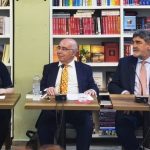
Last week, in one of the venues of the National Library an exhibition of hundreds of volumes opened devoted to Albania called “German speaking writers on Albania.” In this exhibition there are series of original volumes by some of the best known authors of Albanology such as Hahn, Meyer, Jokl, Nop衬 and Shuflai. There are also works by less known authors. The Albanian researcher Ardian Klosi has drafted a minianthology with their names, a brief biography and the works they wrote. Findings indicate that one of the earliest German writers on Albania was a German Knight, travellor and writer from Cologne, Arnold von Harff, who, in 1479 stopped over in Durr쳠in his travels to the Holy Land. Harff is regarded as the first to have written a text containing Albanian words, which the Albanologist Charles Hopf enlarged on in his book, “Chroniques Gr餯-Romanes” (1873). Later on, the figure of Scenderbeg occupied a substantial part of books related to Albania. The first to sow the seed of the genealogical tree of Albanology was the universal philosopher and thinker Gottfried Wilhelm von Leibniz. He is the first known interested party in the Albanian language, indicated by five letters sent to the principle linguists of the time, in the years 1705-1715. In these letters, Leibniz vacillates between calling Albanian sometimes a Slavic, sometimes a Greek language or again, at other times, an Illyrian language. Precisely, the letters in which the philological problems of Leibniz are written, published in 1768 in Geneva, are regarded as the foundation stone of the science of Albanology studies by German language speakers. In the middle of the 18th Century, it was to be the German speaking Swedish historian and linguist, Johan Thuman, who in his book, “Research into the history of the peoples of the East,” was to include a paragraph called, “The history and language of the Albanians and the Vllehs,” based on information he had gathered from the scholars of Voskopoja Konstandin Xhehaniu and Teodor Kavalioti. With his study, Thuman is regarded as the first foreigner to support the thesis on the Illyrian origin of the Albanians. In the field of linguistic studies, it was to be the founder of comparative, linguistic history Franz Bop, who defined that Albanian was a member of the Indo-European family of languages.
If Leibniz planted the seed of Albanology, von Hahn became the Father of this science. Although he was known as a linguist or a recognized historian, the work he left behind dedicated to Albania, entitled, “Albanian Studies,” is acknowledged as a very rare treasure in this field. It was also Hahn who floated the thesis of the Pelasgian origin of the Albanians. Another name just as remarkable as Hahn is that of Gustav Meyer, one of the most distinguished of all the Albanology scholars of the 19th Century, professor at the University of Graz, Austria, who passed on a wealth of knowledge and trained many other scholars in this field and many Albanian Academicians too. Meyer came out with the thesis that the Albanian language is a semi-Latin language and he compiled the first etymologic dictionary of the Albanian language (Strasburg 1891). He also left behind two major works in the field of albanological studies, such as “Albanian Studies,” and “A Summary of Albanian Grammar.”
The greatest name among the German Speaking Albanology scholars, but who was not an ethnic German, is the Hungarian, Franz Baron Nopca. In view of the fact that he was both a geologist and a paleontologist, he also devoted his attention to geological studies of Albania, but he dedicated his greatest work to aspects of the national heritage and culture, evidence of which he gathered and collected with so much painstaking care during his travels, especially throughout the North. It was Norbert Jokl, the expert on the Albanian language, on Slav and Baltic languages, who inherited the manuscripts of Nopca, but a part of these manuscripts, are also in the National Library and have still not been researched. A dictionary of the Albanian language by Norbert Jokl was lost, or more accurately, this was a dictionary that he improved, updated and enriched, originally written by Gustav Meyer, because during World War Two Jokl was executed by the Nazis. All these names of splendid scholars were to be followed in later years by another generation of researchers and scholars of Albanology, such as Stadmuller, Babinger, Bartli, Schmid, Martin Camaj, Fiedler, Haebler etc, some with leanings towards history and others towards linguistics.
Albanology of the German speakers also had another outstanding name, who was a specialist in the field of folklore and Philology. This was the Austrian linguist Maximilian Lambertz. He studied the figures of Albanian tales and legends and the beliefs of the people in great detail and depth. Lambertz is also recognized as a translator and commentator on the work, “Lahuta e Malcis,” (The Lahute1 of the Highlands) by Gjergj Fishta. Prince Vid, could also be included in the ranks of the distinguished names in the field of Albanology and who were German speaking. He is known in this field with the work, “The Album of the Dresden Gallery”, which he gifted to his professor of the Albanian language, Kol롋rahja.
1 Lahute: Two stringed folk instrument of the North of Albania