
TIRANA, Sep 8 – European Movement in Albania (EMA), a think tank devoted to improving the quality of the debate on the European Integration process and a forum for exchange of views on political, legal, economic and social challenges facing Albania in its path towards European Integration, published recently a research on the visa regime for Albania.
It wrote that non inclusion of Albania in the list of countries which would benefit from the lifting of the visa regime was sad news according to public opinion.
The opposition criticized the government for failure to implement reforms which would enable lifting of the visa regime.
Meanwhile, Prime Minister Berisha, for the first time following general elections of 28 June 2009, admitted that, “Ʃt is an undeniable fact that in certain areas we are suffering delays, as for example with biometric passports and accomplishment of any other requirement.”
It is true that the biometric passports are a crucial prerequisite, but it needs to be stressed that this is not the only condition. These benchmarks, which the Roadmap contains in a detailed manner, for Albania, unlike the other countries of the region, have been laid down as its own commitments in the Stabilization and Association Agreement (SAA). Although such criteria were laid down five years ago, Albania is assessed by the European Commission as not having a satisfactory level of the implementation of the Roadmap benchmarks.
In order to avert any suspicion on the objectivity of the assessment of the Western Balkan countries, Lars Wahlund, on behalf of the EU Swedish Presidency states that, “Albania and Bosnia and Herzegovina had to implement the same benchmarks, the same ‘roadmap’, as Serbia, Montenegro and other countries. These countries had to commit to reforms. The European Commission experts visited those countries and noticed that they did not fulfill the required standards.”
For a part of the media, confused by the government rhetoric, it was hard to believe that Albania, a NATO member state, did not fulfill the standards, whereas the very same standards were fulfilled by he Former Yugoslav Republic of Macedonia (FYROM), Montenegro and Serbia, which are not part of the NATO, thus, casting a shadow of doubt on the impartiality of the EU decision-making.
In fact, this is an easily rebutted argument because unlike the lifting of the visa regime, for which the EU has laid down specific benchmarks, the NATO membership was the result of combined reforms and geo-strategic decision-making by the Western Allies. It should not be forgotten that the Euro-Atlantic integration processes of Albania converge with each other but are not necessarily the same.
Implementation of the Roadmap benchmarks implies a long and difficult path for Albania.
This requires determination in carrying out reforms in the area of security of travel documents, freedom and fundamental rights, integrated border management, illegal migration and readmission, organized crime, trafficking and corruption and cooperation among various agencies involved in the fight against these phenomena. The Assembly of the Republic of Albania should put an overriding importance to the use of its constitutional monitoring instruments in order to give an impetus to the executive power for the fulfillment of specific benchmarks set out in the Roadmap.
To this end, the status report which the Albanian government should submit to the European Commission by October this year must be considered as a working document both for the Albanian government and for the Assembly.
Only tangible progress and not Albania’s simple rhetoric would make the European Commission more willing to send another assessment mission in the field next year.
A positive assessment would trigger a proposal to the EU Member States for the lifting of the visa regime with Albania.
At the same time the Albanian government needs to work closely with the governments of FYROM and Montenegro, which, after the lifting of the visa regime in the Schengen area from 1 January 2010, have potentially paved a way to introduce the visa regime with Albania. The justification is that they are aligning their visa policies with those of the Schengen countries, which would mean isolation of Albania from its neighbors.
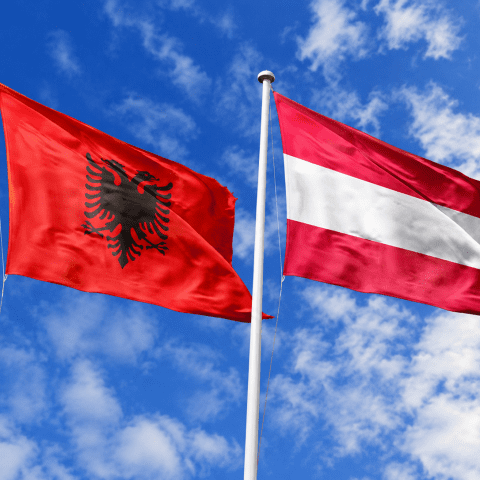
Albania, a NATO member state but still with visa in EU

Change font size:


Latest from News
Saudi Ambassador Presents Credentials To Albanian President As Ties Gain Momentum
Change font size: - + Reset Tirana Times, June 05, 2026 – Saudi Arabia’s new ambassador to Albania, Turki Ibraheem Almadhi, presented his credentials to President Bajram Begaj, marking the formal start

Germany’s New Enlargement Formula and Albania’s European Illusion
Change font size: - + Reset For Albania, the real issue is not which accession model Europe chooses, but whether democracy, rule of law, and state integrity can still be restored. By

Pushing Against Inertia: How Harnex Is Testing the Balkans’ Appetite for Innovation
Change font size: - + Reset Tirana loves a good spectacle. Walk through the capital today and you are greeted by sleek new glass towers, vibrant urban spaces, and a relentless political
Shadow Fleet, Weak Oversight: How Russian Sanctions Evasion Reached Albania’s Ports
Change font size: - + Reset Tirana Times, May 18, 2026 – Albania’s ports have emerged as a potential weak point in the international effort to enforce sanctions against Russia, following revelations
Albania–Italy Migration Deal Continues
Change font size: - + Reset Tirana Times, May 13, 2026 — The Albania–Italy migration agreement remains in force, despite a brief but politically sensitive controversy triggered by comments from Albanian Foreign Minister Ferit