Europe accepts Albania’s request for the candidate status. It will now send a set of questions the tiny Balkan country needs to answer to then be considered, a tough job the former communist country should do to get in line with the bloc’s standards.
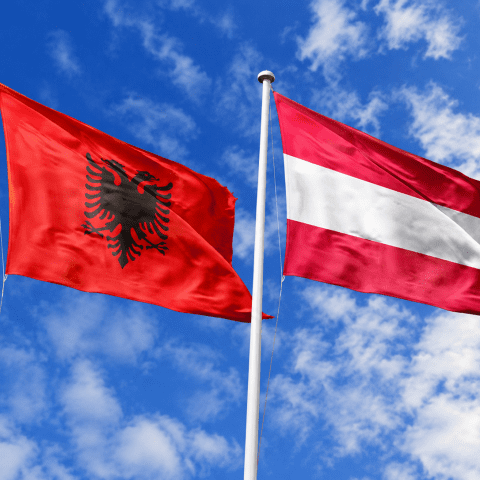
TIRANA, Nov 17 – The Council of European Union decided Monday to take into consideration Albania’s application for EU membership and invited the European Commission to submit an opinion on the application.
The Conclusion adopted by the EU Council recalled the renewed consensus on enlargement as expressed in the 2006 European Council conclusions. It reiterates that each country’s progress towards the EU depends on its individual efforts to comply with the Copenhagen criteria and the conditionality of the Stabilization and Association Process.
Albania submitted an application for EU membership on 28 April, 2009.
“The European Commission welcomes the decision of the EU Council and will start preparing the opinion procedures immediately. This process will be made on the basis of the answers of the Albanian Government to a questionnaire of more than 2000 questions on the ability of the applicant to fulfill the Copenhagen accession criteria,” said a statement.
In the light of the Commission’s recommendation, the Council unanimously decides whether or not to grant candidate country status to the applicant.
In its latest progress report, the European Commission noted that Albania has continued to make progress in addressing the political criteria in line with the European Partnership and noted the smooth implementation of the Stabilization and Association Agreement. The country needs to make progress, in particular regarding the rule of law and the fight against corruption, as well as the proper functioning of state institutions, especially the independence of the judiciary. Administrative and enforcement capacity require further strengthening.
That makes Albania an official candidate for EU membership, according to the EU.
The move was hailed by everyone in the country.
Prime Minister Sali Berisha considered that the greatest event since getting NATO membership.
“This unanimous decision of the EU 27 foreign ministers is historic because it is the most important political decision of the EU during the recent 18 years for Albania. Following NATO membership, today’s decision of the EU is the most important that the developed countries of Europe, EU members, have taken for Albania,” said Berisha at a news conference. “This decision is also the greatest assessment that is made to the Albanian democracy, government of Albania great efforts, the institutions of the country, but even of all Albanian citizens for their success, building of democracy and the market economy in this country, the success of the all-round reforms of the government I head which have made the Albanian democracy and the market economy more and more functional, more serious and reliable.”
The premier reassured Brussels of his cabinet’s “deep and all-round reforms, fight against organized crime and corruption with zero tolerance, the extension and consolidation of the human freedom and minority rights.”
He did not forget to say that the decision was also a confirmation that the June 28 election was free and fair.
He also appealed to the opposition to end the boycott and work together, “in these historic moments for every Albanian, for the nation and country as a whole; let us undertake together the deepest reforms as the most vital interest and to the benefit of the citizens of this country without any distinction of their political belonging and which consider their EU integration as a dream project to the extent of 96%.”
“I take this solemn opportunity to thank with deep gratitude and guarantee the EU foreign ministers that my government would undertake every reform, adopt every law, decision to accomplish all the obligations that stem from this new and historic decision for my nation so that to vitalize every day and non-stop Albania European project as the project of the most brilliant future of the Albanians,” he said.
Edi Rama of the main opposition Socialist Party also hailed the Brussels decision but also noted that was delayed due to the problems to the country’s democracy brought from the governing Democrats.
President Bamir Topi also considered that a “very important decision,” and said everyone should be pleased.
“Tomorrow is the start of a new qualitative and responsible commitment for all Albanians. I think that we, all together, are ready to cope with that,” he said.
“This Decision unveils an intensive, very demanding and an exceptionally significant process for Albania, in its path towards European integration. The Ministry of Foreign Affairs thanks the EU member states for this decision, assuring them that the Albanian Government is fully committed to conduct this exercise in the appropriate time and quality and that it will step up all its efforts to boost the dynamics of our relationships with the EU to the dimension of a direct partnership,” said a statement of the Foreign Ministry.
“We are conscious that this new stage requires the all – inclusive contribution, commitment and seriousness of the state institutions, independent institutions, other political actors, the civil society and the interest groups. While assuring all for our full readiness for an open and constructive cooperation, we invite them to become an active part in this process, benefiting the country’s national interests.”
Albania thus joined Croatia, FYROM and Turkey on the list of official EU candidate countries.
For example, Croatia was confirmed as a candidate country in June 2004. During a summit in December that year, leaders of the then-25-member bloc set March 17th 2005 as the starting date for Zagreb’s entry negotiations, making it conditional on the country’s full co-operation with the International Criminal Tribunal for the former Yugoslavia. But the talks did not open until October 3rd the same year, when Carla del Ponte, the chief UN war crimes prosecutor at the time, confirmed that Croatia had met the condition.
Turkey, an official EU candidate since December 1999, had to wait nearly six years for the launch of its negotiations, alongside those with Croatia. FYROM has been waiting for a starting date since December 2005.
Tirana is likely to be asked to implement a series of sweeping political and economic reforms before the launch of its negotiations with Brussels. Meeting such requirements may take years.
Europe is primarily expecting at the moment that Albania needs to strengthen the rule of law and the independence of the judiciary, as well as to ensure media freedom.