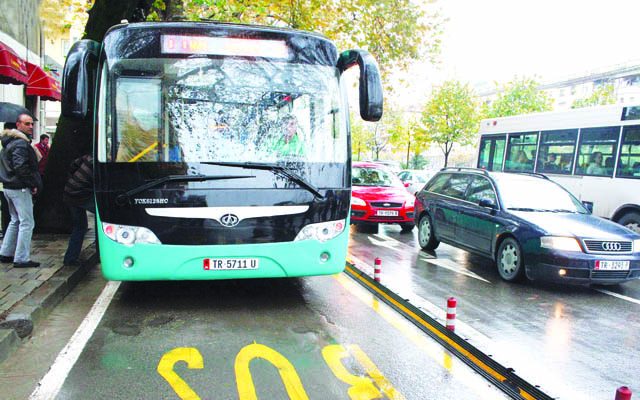
TIRANA, Jan. 4 – Public transport in Tirana continues operating normally in the first days 2016 after Tirana’s municipal council approved a 33 percent hike in bus fares in its latest meeting following pressure by local companies which had threatened to go on strike unless the municipality reviewed the ticket prices.
In its latest 2015 meeting, the left-wing majority at the Tirana municipal council approved amid debates at midnight, Dec. 30, a decision that will increase the Tirana city public transport bus fares by 10 lek (€0.07) to 40 lek (€0.29) starting February 2016. The municipality also approved a 400 lek (€2.9) hike in the monthly season ticket which starting February 2015 will cost public transport users in the city of Tirana 1,600 lek (€11.6).
Claiming deteriorating financial situation, the Association of Urban Transport in Tirana had continuously called during the past couple of years to increase bus fares to 70 lek (€0.5), up from lek 30 (€0.21) currently.
Tirana Mayor Erion Veliaj argued the decision with the critical situation of Tirana’s public transport companies and the normal operation of public transport in the Tirana municipality which now numbers about 1 million people.
“If we don’t make a decision that leads to a solution, for every Tirana citizen who on January 1 would not find a bus in the bus stops and would take a taxi, this would increase the bus fare ten-fold,” said Veliaj ahead of the approval of the decision, withdrawing from his previous stance not to increase the bus fare.
The Mayor had earlier described the local operators’ request to more than double bus fares as blackmail and absurd.
“Their service does not justify a price hike. Tirana is not ready to afford this price. Bus fares will never increase to 70 lek as long as I am in office as Tirana mayor,” said Veliaj.
Reila Bozdo a councilor for the opposition Democratic Party at the Tirana municipal council described the increase as a shameful and a corrupt practice by Mayor Veliaj.
“The increase in bus fares by 33 percent from 30 lek to 40 lek will cost Tirana citizens an extra $5.5 million annually. Veliaj could have asked his government to lift the excise rate on fuel for public transport but he chose the shortest and the meanest way,” she said.
Just a couple of weeks ago, representatives of the 10 city public transport companies operating in Tirana claimed they were on the brink of bankruptcy, facing rising difficulty to pay off loans and salaries to their staff.
“On January 1 we will suspend the service. There will be no public transport. We will give up and let banks take over the vehicles,” a representative of the association told reporters after meeting with municipality officials.
“There are 1,500 employees making a living with this job and we haven’t been able to pay them for the past 4 to 5 months,” they said.
The Urban Transport Association had earlier requested that transport operators must be allowed to increase their bus fares or the government should lift the excise duty and circulation taxes on fuel, currently at 64/lek litres (€0.45) which makes Albania’s fuel prices one of Europe’s highest.
Speaking after the municipality decision, Association representatives said they would continue offering the service despite not being pleased with the 10 lek increase.
“There will be no service suspension in January. We don’t agree with the 40 lek bus fare and the student season ticket has not been indexed,” said public transport representatives.
Irritated public transport users say they can’t afford even a 10 lek (€0.07) increase and that they are dissatisfied with the service offered by the private operators.
“Our wages and pensions are too low. We are pensioners, even 30 lek is too much,” said a pensioner.
“I can’t afford it, I’d rather go on foot than pay 40 lek,” another young man told a local TV.
While bus fares may be low compared to other regional countries, it must be noted that Albania has one of Europe’s lowest GDP per capita at only €3,440.