 By LEDION VESHI
TIRANA, Jan. 14 – The key smaller ally in Albania’s Socialist Party-led ruling coalition, the Socialist Movement for Integration, reiterated its stance this week that the justice reform cannot be approved without the consent of the main opposition Democratic Party.
The Democrats walked out of talks on the reform last Sunday, saying the current draft aims to politically capture the justice system.
SMI’s chairman, Ilir Meta, said during a meeting of his party’s chairmanship Wednesday that consensus and political dialogue was needed on the justice reform based on recommendations of the Venice Commission.
“The Socialist Movement for Integration is convinced that political consensus in Parliament on constitutional amendments is crucial not just as a matter of numbers, but in terms of a unified political will of all parliamentary forces, it is time for the opening of political dialogue to create a widely accepted document,” Meta said. “It is our duty as SMI as well as a majority [member] to create the necessary space for the opposition to be substantially involved in the dialogue and it is an inevitable duty of the opposition to contribute in this dialogue with professionalism and not with populism for solutions which serve to improve the system and not blocking it.”
Meta criticized what he described as the politics of the fait accompli referring to the Socialist Party’s decision to press ahead with the reform without taking into consideration the opposition’s concerns.
“The country has dealt before with hasty and non-transparent decisions, which have produced negative effects in the long term such as the constitutional amendments of 2008,” Meta said. “Therefore, it is quintessential that the process is not excluding or divisive, instead it should be all inclusive and take into consideration the recommendations of the Venice Commission and the constructive dialogue of parties involved in the process.”
The SMI chairman also hinted at a possible referendum should consensus fail by saying that the draft could be presented and judged directly by voters, although Meta himself didn’t specifically articulate the word “referendum.”
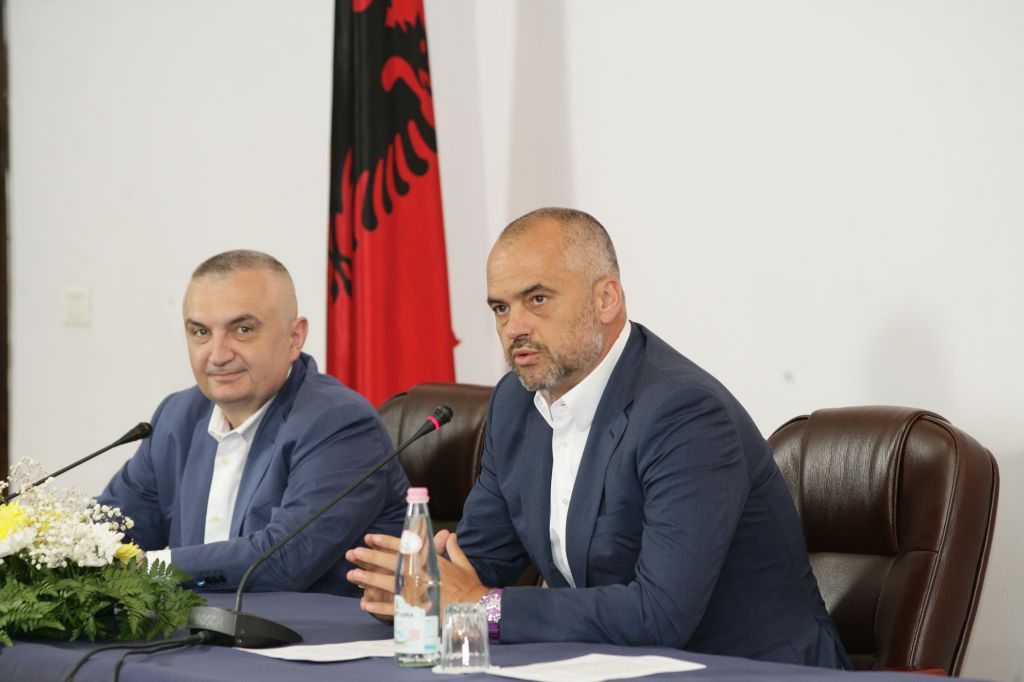
Following these statements, a meeting was held between Prime Minister Edi Rama with SMI chairman Ilir Meta in the late hours of Wednesday. It was also attended by the Minister of Justice Ylli Manjani. The meeting is reported to have proved fruitless as the stances of the political leaders were still divergent after it. While no public declarations were made after the meeting, the two government allies are split on differing views on justice reform, the Socialist Party relies on the draft prepared by experts whereas the Socialist Movement for Integration is asking for political consensus.
Earlier this week, the Socialist Movement for Integration had expressed its dissatisfaction via Justice Minister Ylli Manjani, who represents SMI in the Rama cabinet, by saying that the reform will lack public trust and will not be sustainable in the long term without the support of the Democratic Party.
The Ministry of Justice also considered the draft prepared by experts as one-sided since its proposals were only partially taken into consideration. It insisted that the experts who prepared the draft had no authority to sift through proposals, but should submit them to the ad hoc committee in their entirety instead.
The top disagreement between the two political camps seems to be the number of votes required in Parliament for the appointment of the country’s top justice institutions.
The opposition insists on a constitutional majority of 93 votes, whereas the draft proposed by the high level experts foresees a qualified majority of 84 votes, which the opposition claims will lead to the capture of the justice system by the government.
The opposition says that the formula with three fifths of the vote will give to the Prime Minister control of 8 justice institutions, while the Democrat experts on the justice reform said on Wednesday that the final draft has ignored 11 recommendations of the Venice Commission.
The Democrats added that they will ask the ad hoc committee on justice reform to reject the scheme which according to them leads to the capture of the justice system by the government.
“Who is going to appoint those who control and promote judges and prosecutors? This has been the matter of contention. These people should not be persons that are appointed by the Prime Minister, whether his name is Edi Rama or Lulzim Basha. The appointments should be made with a majority in Parliament. The current situation is that the current majority already has 84 votes. Thus, a higher number of votes is needed to select these people,” said Democratic Party MP Eduard Halimi during a press conference on Wednesday.
Meanwhile, experts say they have taken into consideration some of the opposition’s proposals, however, the number of votes required for appointing top judges and prosecutors remained unchanged at three fifths or 84 votes, despite the opposition’s objections.
According to the final draft prepared by experts, the Constitutional Court shall consist of nine judges, with three members each respectively appointed by the President and Parliament while another three will be appointed after a joint meeting of the High Court and the High Administrative Court.
The Constitutional Court will no longer be able to abolish as unconstitutional constitutional changes approved by Parliament.
According to the experts, the justice system is composed of the High Court and the High Administrative Court. Meanwhile, the Ministry of Justice does not consider the High Administrative Court as a separate unit.
Under the same document, the right of appointing High Court and High Administrative Court judges rests with the President based on proposals made by the High Council of Justice. According to the draft, the judges shall have a nine-year term without the possibility for reelection. The President can reject a candidature only once, however, if the High Council of Justice by majority rejects his disapproval, the judge is considered automatically elected.
The experts foresee a quota of one fifth of the members of these courts to be non-judges, whereas the Ministry of Justice is of the opinion that courts should contain only judges.
The high level experts recommend that the High Judicial Council should consist of eleven members, six of which elected through voting by judges of all levels, and five other members chosen from Parliament with three fifths of the votes. The competences of this body include the appointment, evaluation, promotion and transfer of judges of all levels.
The same formula will apply to the High Prosecution Council with six members elected through the vote of prosecutors and five other members from Parliament with three fifths of the votes. It is this body, which will make proposals regarding the election of the General Prosecutor, which will require three fifths of the votes in Parliament. In case the required votes are not reached, the candidature that has been ranked highest by the High Prosecution Council is elected, according to the draft.
Experts have also proposed the creation of the Justice Tribunal, a body which will investigate into violations involving members of the judiciary, while its rulings can only be appealed by the Constitutional Court.
The draft prepared by experts also provides for the process of evaluation of judges and prosecutors. An international mission comprising foreign experts will serve as a monitor in order to guarantee transparency and avoid abuses in the evaluation procedures.
The group of high level experts finished the draft on justice reform on Tuesday without the participation of the opposition and now the document will be submitted to the ad hoc parliamentary committee for approval before it is sent to the Venice Commission for final evaluation.
Although signals of consensus were given at the start of the year and talks resuming on Jan. 4, consensus proved to be frail.
The experts of the opposition abandoned talks last Sunday with the motivation that the ruling majority is committed to elect members of the country’s highest justice institutions with three fifths of the votes in parliament, which the opposition insists is not recommended by the Venice Commission. Instead, the opposition had proposed two thirds of the parliamentary vote as an alternative.
Albania’s justice system enjoys low public trust as a result of a high level of perceived corruption and a reformation of the system is seen as key to Albania’s aspirations for joining the European Union.
The United States embassy and the European Union delegation have been the reform’s strongest advocates, often playing the role of intermediaries to bring consensus on constitutional changes between political camps.
Before meeting with his government ally Meta, Prime Minister Rama met with U.S Ambassador in Tirana Donald Lu and the head of the EU delegation in Albania Romana Vlahutin, a meeting which comes after the deadlock created in the justice reform as a result of the approval of the draft without the presence of the opposition.
The efforts of foreign diplomats to bring the opposing camps into an agreement will be joined next week by Angelina Eichhorst, External Action Service Director for Western Europe, Western Balkans and Turkey during her scheduled trip to Tirana.