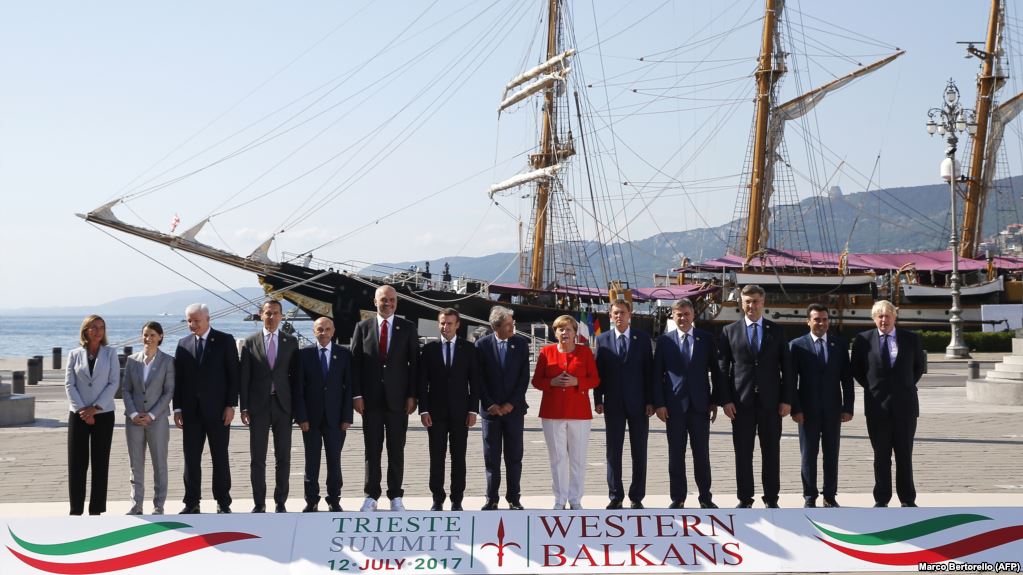
TIRANA, July 13 – An agreement on a regional economic zone and more EU funding for infrastructure were the direct results of a major summit of heads of states and governments of the six Western Balkan countries, Italy, Germany and France in the Italian city of Trieste, marking another stage of the Berlin Process, launched in 2014.
The Trieste summit aimed to create conditions for economic growth and good neighborly relations, in particular through the preparation and financing of concrete projects for investments in regional infrastructure in the transport and energy sectors.
German Chancellor Angela Merkel and French President Emmanuel Macron were among the leaders present at the summit. Albania was represented by Prime Minister Edi Rama. Ahead of the summit, Merkel said the EU had a duty to move the region “slowly but surely” toward the bloc.
“Political stability in the region means political stability for us too,” Merkel said. “We know this from experience.”
Western Balkan countries, however, are increasingly growing concerned about the long time it is taking to achieve membership in the European Union.
“We have learned to temper our expectations,” Rama told reporters, adding everyone in the region knows there is no alternative to EU integration.
A final statement issued by Italy, the host country, noted: “The future of the Western Balkans lies in the European Union, a Union open to those European countries which respect its values and are committed to promoting them.”
The summit agreed on seven new “connectivity projects with a total investment of over 500 million euros,” including 194 million euros in EU grants and loans from the European Investment Bank and the European Bank for Reconstruction and Development, the statement said.
The summit pledged a further EU grant of 11.4 million euros for energy and transport projects in the region.
The European Union has offered an additional 48 million euros to support of entrepreneurship, hoping give new fuel to economic growth in the region, which remains far behind the EU.
A Transport Community Treaty was signed at the summit, aiming to integrate transport networks in the region with those of the EU.
Western Balkan states also agreed to an action plan to develop a Regional Economic Zone in order to increase investment attractiveness and generate new jobs.
Based on the results of the youth forum, the Tirana-based Regional Youth Cooperation Office (RYCO) will further develop its work program to foster cooperation among young people in the region.
The Trieste meeting is the fourth in a row, following the first one organized in Berlin.
The Western Balkans Regional Economic Area aims at developing an area where goods, services, investments and skilled workers can move without obstacles. It will scale up the market available to potential investors in the region: access to almost 20 million consumers from a single base, and opportunities to create value chains across borders will boost Western Balkans economic attractiveness, also taking advantage of trade relations with the EU.
EU officials emphasize that the ultimate goal is to have Western Balkan countries join the EU and the Berlin Process in not an alternative to EU integration.
“The progressive deepening of the economic integration in the region should be based on EU rules and principles. Such an approach will secure both integration within the region and with the EU. In this way, this initiative will be an important milestone for preparation for EU accession,” the EU said in a statement.