Pristina and Tirana push back against Kyiv’s stance, insisting that Kosovo’s sovereignty cannot be diminished or equated with Russia’s aggression against Ukraine.
Tirana Times , August 09, 2026 – Ukrainian President Volodymyr Zelenskyy’s confirmation in Belgrade that Kyiv has not changed its position on Kosovo has triggered criticism in Albania and Kosovo, exposing a growing tension between moral solidarity with Ukraine and the political realities facing small states in the Balkans.
Speaking at a joint news conference with Serbian President Aleksandar Vucic, Zelenskyy said Ukraine continued to respect what it considers the territorial integrity of its partners. He thanked Serbia for supporting Ukraine’s territorial integrity, including Crimea, and said Kyiv’s position on Kosovo remained unchanged.
The statement did not represent a new Ukrainian policy. Ukraine has not recognized Kosovo since it declared independence in 2008. Its political impact, however, was amplified by the location and timing. Zelenskyy delivered the message in Belgrade, standing beside a Serbian president whose government continues to oppose Kosovo’s independence and campaigns against its international recognition.
The first formal response in Pristina came from Kosovo’s acting foreign minister, Glauk Konjufca, who expressed regret over Zelenskyy’s reaffirmation of Ukraine’s refusal to recognize Kosovo and placed Kyiv’s position against Kosovo’s record of support since the start of Russia’s full-scale invasion.
“We note with regret President Zelenskyy’s statements in Belgrade, where he reaffirmed Ukraine’s non-recognition of the Republic of Kosovo. From the first day of Russia’s full-scale aggression, Kosovo has stood unequivocally with Ukraine. We condemned the invasion, fully aligned with the European Union’s Common Foreign and Security Policy, imposed sanctions on Russia and Belarus, provided humanitarian assistance and shelter for Ukrainian journalists, and contributed aid and military training in support of Ukraine’s defense. We did so despite Ukraine’s non-recognition of our state, because solidarity with a people defending its freedom, sovereignty and territorial integrity is a matter of principle,” Konjufca wrote on X.
Konjufca said Kosovo was a sovereign and independent state born from its people’s struggle for freedom and from its liberation in 1999, after years of systematic repression and what he called the genocidal campaign of the Milosevic regime.
“What followed was not an act of annexation, invasion or territorial occupation, but a comprehensive international process under United Nations administration and years of internationally mediated negotiations on Kosovo’s final status. When those negotiations had exhausted every possibility for a solution accepted by both sides, the United Nations special envoy, Martti Ahtisaari, recommended independence as Kosovo’s final status and presented a comprehensive framework for the new state, including some of the broadest constitutional guarantees in Europe for non-majority communities,” he said.
Konjufca’s intervention gave the dispute an official diplomatic dimension. The reaction in Pristina was also immediate and highly symbolic: municipal authorities removed a large Ukrainian flag and the “Free Ukraine” banner that had been displayed in the center of the capital for about four years.
Pristina Mayor Perparim Rama announced the decision on social media, saying Kosovo’s statehood must be respected.
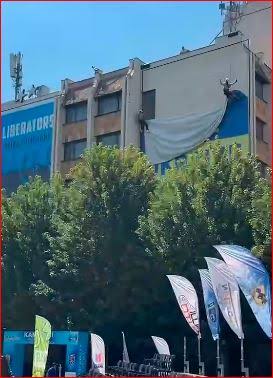
“When Kosovo is not respected, the capital Pristina always responds in the same way,” Rama said.
He stressed that the city’s empathy and solidarity would remain with people facing war, violence and persecution. But he added that no cause or foreign policy could be built by diminishing Kosovo’s statehood or the sacrifices made by its people.
The removal of the banner did not amount to a change in Kosovo’s broader support for the Ukrainian people. It was instead a public expression of frustration with what many in Kosovo see as a lack of political reciprocity from Kyiv.
Konjufca’s account reflected Kosovo’s broader alignment with the United States and the European Union since Russia launched its full invasion of Ukraine. That support continued even though Kyiv withheld recognition of Kosovo.
The Albanian government offered a more diplomatic but equally firm response.
Albania’s Ministry for Europe and Foreign Affairs welcomed dialogue between Ukraine and Serbia but rejected any comparison between Kosovo’s independence and Russia’s aggression against Ukraine.
The ministry said Albania would continue to stand firmly behind Ukraine’s sovereignty, independence, territorial integrity and European future. At the same time, it said Albania would defend Kosovo’s sovereignty, independence and rightful place in the Euro Atlantic community.
According to the ministry, attempts to establish an equivalence between Kosovo and other international disputes are wrong and politically misleading. It cited the advisory opinion of the International Court of Justice, which found that Kosovo’s declaration of independence did not violate international law.
The ministry argued that Russia’s invasion of Ukraine was fundamentally different because it represented a violation of the United Nations Charter and of the international legal order.
It also described Kosovo’s independence as an irreversible political reality and said lasting stability in the Western Balkans required its acceptance. Normalization between Kosovo and Serbia, the ministry said, should ultimately lead to mutual recognition and a shared European future.
At the same time, Tirana acknowledged that Zelenskyy’s visit to Serbia primarily served Ukraine’s national interests. Albania said any step that encouraged Serbia to distance itself from Russian influence and move closer to Europe should be viewed positively. But it also warned that engagement with Belgrade should not come at the expense of Kosovo’s international position.
Albert Rakipi, a former Albanian deputy foreign minister and chairman of the Albanian Institute for International Studies, said Zelenskyy’s position revealed the limits of symbolic solidarity in international relations.
Rakipi argued that Kosovo’s statehood should not be treated as a political choice between Belgrade and Pristina.
“That is a false equation,” he said.
He noted that Zelenskyy had built much of his international moral authority by rejecting political realities imposed by stronger powers and by defending the right of a nation to sovereignty, freedom and political existence.
For that reason, Rakipi said, Ukraine’s position on Kosovo deserved particular scrutiny. Kyiv appeared willing to accept what he described as a political fiction that conflicted with the reality created in Kosovo over more than two decades.
Rakipi said the large Ukrainian banners in Pristina and the grand summits organized in Tirana may havedemonstrated solidarity with Ukraine. But he added that solidarity could not replace strategic clarity or political realism.
For small states, he said, realism did not necessarily mean cynicism or the abandonment of principles. It meant understanding that recognition, political support and reciprocity could not be assumed.
“For small states, realism is ultimately a form of self preservation,” Rakipi said.
Kosovo analyst Agon Maliqi directed much of his criticism toward Kosovo’s own foreign policy and political leadership.
Maliqi argued that the period after the start of the war, when Ukraine was more dependent on the United States and the administration of President Joe Biden, may have offered Kosovo a stronger opportunity to seek a change in Kyiv’s position.
According to Maliqi, Kosovo failed to invest enough political capital in building a direct and sustained relationship with Ukraine. He said relations could also have been developed through Albania, Turkey, Britain and other partners with influence in Kyiv.
Meanwhile, Serbia had used military supplies, technical assistance and political engagement to improve its standing with Ukraine and Western governments. Maliqi argued that Belgrade had successfully used this cooperation to strengthen its position and limit Kosovo’s access to Ukrainian decision makers.
He also criticized Kosovo’s confrontational approach toward some of its allies, saying friendly states would have little incentive to invest political energy in helping Kosovo if its own leadership appeared uninterested in sustained diplomatic coordination.
His argument shifted part of the responsibility from Ukraine to Kosovo itself. While Zelenskyy’s statement was disappointing, Maliqi suggested it was also the predictable result of a foreign policy that relied too heavily on public declarations of solidarity and not enough on patient diplomatic engagement.
Konjufca’s statement became the most senior formal response from Kosovo’s government, while the removal of the banner remained the most visible public gesture. Together, the two reactions combined an official defense of Kosovo’s statehood with a symbolic expression of frustration over the lack of reciprocity from Kyiv.
The controversy highlights the different calculations driving Ukraine, Serbia, Kosovo and Albania.
Ukraine needs diplomatic support, military supplies, reconstruction partners and wider international engagement. Serbia offers Kyiv practical cooperation while continuing to maintain relations with Russia. For Zelenskyy, improving ties with Belgrade may serve the immediate interests of a country at war.
For Serbia, the visit offered international legitimacy and allowed Vucic to reinforce the argument that support for Ukraine’s territorial integrity should be matched by Ukraine’s continued refusal to recognize Kosovo.
For Kosovo, the episode demonstrated that shared experiences of war and occupation do not automatically produce shared diplomatic positions. Kosovo’s political and public support for Ukraine has not yet translated into Ukrainian recognition.
Albania attempted to balance two principles. It defended Ukraine against Russian aggression while insisting that Kosovo’s independence could not be treated as comparable to territorial conquest or foreign occupation.
The removal of the Ukrainian banner in Pristina was therefore more than a municipal gesture. It reflected a wider reassessment of how small states should distribute solidarity, political capital and diplomatic support.
Sympathy for the Ukrainian people is likely to remain strong in both Albania and Kosovo. But Zelenskyy’s statement has made clear that solidarity without recognition can become politically difficult to sustain, particularly when it appears to benefit a regional rival that has invested more effectively in its diplomatic relationship with Kyiv.