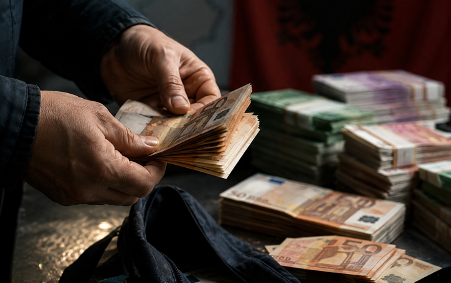
Cash outside Albania’s banking system reached a record 5.6 billion euros, last month.
Tirana Times, August 30, 2026 – The amount of cash circulating outside Albania’s banking system has reached a record high, raising fresh concerns over the scale of the informal economy, the possible presence of illicit money and the effectiveness of government efforts to move financial transactions into formal channels.
Cash held outside banks rose to more than 522 billion lek, or approximately 5.6 billion euros, last month, according to figures reported by Albanian media. It is the highest level ever recorded and represents an increase of around 71 billion lek compared with July last year.
The figure is particularly striking when compared with the overall amount of money circulating in the Albanian economy, estimated at around 2.1 trillion lek. Cash outside the banking system now accounts for roughly 25 percent of that total.
While cash held outside banks cannot automatically be classified as informal or illegal money, economists argue that the unusually high level raises important questions about the size of Albania’s cash based economy and the sources of some of the funds circulating beyond the banking system.
Economic expert Zef Preçi told A2CNN that the phenomenon cannot be separated from Albania’s persistent problems with informality and criminal proceeds.
“Money circulating outside the banking system is part of the informal economy, and together with it there is also money originating from criminal activities conducted inside or outside our country,” Preçi said.
The scale of the phenomenon appears even more significant when compared with European Union countries, where, according to the figures cited in the report, cash outside the banking system does not exceed around 9 percent of the overall money supply.
For Albania, therefore, the record level of cash is not merely a question of payment habits. It points to a broader structural problem, with a significant part of economic activity continuing to take place beyond the full visibility of banks and public institutions.
Preçi argues that both weaknesses in public administration and the circulation of money generated through illegal activities have contributed to the situation.
“Partly because of the inability of the administration and partly by allowing the entry of money from criminal activities, we have reached such a high level of money outside the banking system,” he said. “Although the Fiscal Amnesty was not allowed to be adopted as law, in practice it has happened.”
The reference to the proposed fiscal amnesty is politically significant. The initiative generated controversy because of concerns that mechanisms designed to legalize undeclared wealth could potentially provide opportunities for money of unclear origin to enter the formal economy.
The latest figures suggest that, regardless of the fate of that initiative, Albania continues to face a substantial accumulation and circulation of cash outside banks.
The trend also feeds into another long running debate in the Albanian economy, the unusual strength of the lek and the continued depreciation of the euro and other foreign currencies.
Some economists believe that large volumes of informal cash entering and circulating in the economy are among the factors placing downward pressure on foreign currencies. Preçi said he shares the assessment of international institutions that informal money may have an effect on exchange rate developments, while stressing that commercial banks alone cannot be expected to address the problem.
“I agree with the international institutions that it may have a certain effect, but we can in no way pretend that informal money can be fought by commercial banks,” he said.
The government has already attempted to reduce the use of physical cash. Since January 1, cash payments have been subject to a ceiling, with individuals allowed to make transactions in cash of up to 500,000 lek.
So far, however, the restriction appears to have done little to reverse the broader trend. Instead of declining, the amount of cash outside the banking system has continued to expand and has now reached an unprecedented level.
That creates a policy dilemma for Albania. Restricting cash transactions may encourage greater use of banks, but administrative limits alone cannot address the reasons why individuals and businesses choose to remain outside formal financial channels. Nor can they determine the origin of billions of euros circulating in cash.
The record 522 billion lek therefore represents more than an unusual monetary statistic. It has become another indicator of one of Albania’s most persistent economic challenges, the gap between the formal economy visible to institutions and a large cash economy operating outside the banking system.
For a country seeking deeper economic integration with the European Union, reducing that gap will increasingly be not only a fiscal issue, but also a question of financial transparency, institutional credibility and the rule of law.