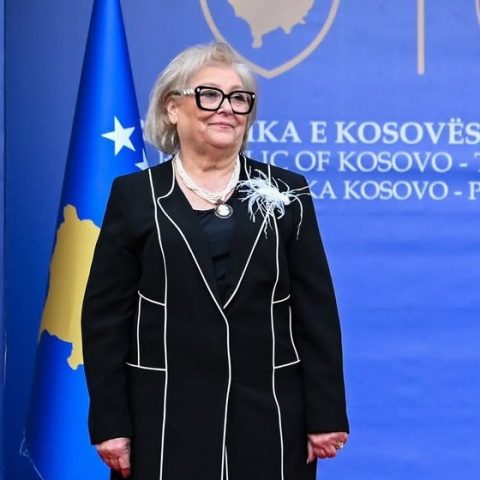
The election of respected academic Justina Shiroka-Pula averts another political crisis and highlights Kosovo’s tradition of female leadership and religious coexistence, while offering new prospects for political stability and international engagement.
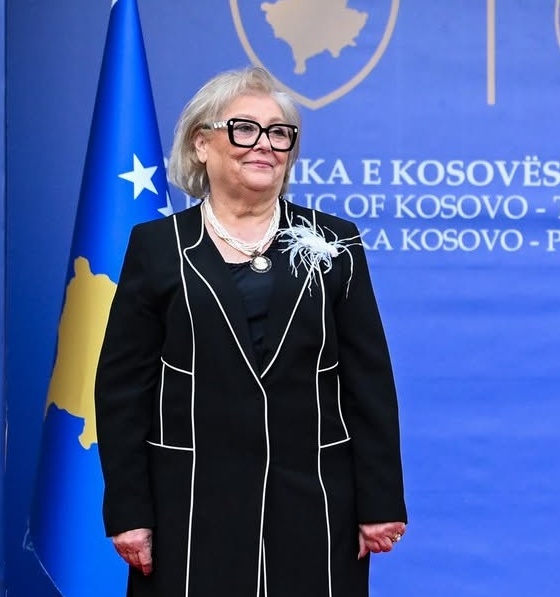
Tirana Times, October 08, 2026 — The election of Justina Shiroka-Pula as Kosovo’s new president has brought an end to a prolonged political deadlock, averting another round of parliamentary elections and offering the country an opportunity to restore institutional stability after more than 19 months of political uncertainty.
The economist, professor and former president of the Kosovo Academy of Sciences and Arts was elected in a dramatic late-night parliamentary session on October 6–7, securing 81 votes in the 120-seat Assembly, just above the two-thirds threshold required. Her election followed a last-minute agreement between Prime Minister Albin Kurti’s ruling Vetëvendosje movement and the main opposition Democratic Party of Kosovo (PDK).
The agreement prevented the dissolution of parliament and another early election, an outcome that would have deepened Kosovo’s political instability at a particularly sensitive moment for the young Balkan state.
Shiroka-Pula’s election has been broadly welcomed at home and internationally, drawing numerous congratulatory messages from foreign leaders and diplomatic representatives. Among those congratulating her were Albanian President Bajram Begaj, Prime Minister Edi Rama and Foreign Minister Ferit Hoxha, Slovenian President Nataša Pirc Musar, Saudi Arabia’s King Salman and Crown Prince Mohammed bin Salman, and Qatar’s Emir Sheikh Tamim bin Hamad Al Thani.
Albanian President Bajram Begaj emphasized that Albania and Kosovo would stand together in facing challenges and advancing toward a European future, while Prime Minister Rama described Shiroka-Pula as a renowned academic assuming office at a challenging time for Kosovo, the region and Europe.
The European Union’s representative in Kosovo, Dirk Schuebel, also welcomed her election, expressing hopes for renewed political and institutional stability and progress toward European integration. The British and German ambassadors conveyed similar messages, emphasizing their countries’ longstanding partnerships with Kosovo and their commitment to supporting its European and Euro-Atlantic aspirations. Slovenian President Pirc Musar expressed her expectation of constructive cooperation, including within the Brdo-Brioni Process, while the Saudi and Qatari leaders wished the new president success and expressed support for continued progress in bilateral relations.
The international response offers an encouraging diplomatic opening for the new presidency and reflects expectations that Kosovo can move beyond its recent political paralysis.
Yet the importance of Shiroka-Pula’s election goes beyond resolving an immediate political crisis. She brings to the presidency an established academic reputation, substantial institutional experience and a personal profile that reflects some of the distinctive characteristics of Kosovo’s society.
An Academic at the Head of State
Unlike many political figures who have occupied Kosovo’s highest office, Shiroka-Pula comes from a long academic career. An economist by training, she spent decades teaching and conducting research at the University of Prishtina, focusing on economic development, demographic investment and public policy.
Before becoming president, she made history as the first woman to lead the Kosovo Academy of Sciences and Arts, one of the country’s most important intellectual institutions.
Her career has also included political responsibilities. She served as minister of Energy and Mining from 2008 to 2011 in the government of former Prime Minister Hashim Thaçi and was a member of parliament representing the PDK from 2011 to 2014.
This combination of academic experience and public service contributed to her emergence as an acceptable compromise candidate when political parties appeared unable to agree on a new head of state.
Her selection also suggests a broader recognition that Kosovo’s presidency, particularly at a time of political polarization, needs a figure capable of representing the state beyond party divisions.
A Symbol of Religious Coexistence and Female Leadership
Shiroka-Pula’s election carries another important symbolism in Kosovo, a country where more than 90 percent of the population identifies as Muslim.
The new president comes from a Catholic family, part of Kosovo’s small but historically significant Catholic community. Her elevation to the country’s highest office offers a striking illustration of Kosovo’s tradition of religious coexistence, where national identity and shared political aspirations have generally taken precedence over religious differences.
In a predominantly Muslim society, the election of a president from a Catholic background without significant controversy over her religious affiliation sends a positive message about the secular and inclusive character of Kosovo’s state institutions.
Her election is also significant for women’s political representation. She becomes Kosovo’s third female president, following Atifete Jahjaga, who served from 2011 to 2016, and Vjosa Osmani, who served from 2021 to 2026.
For a relatively young state, having three women occupy its highest office represents a notable political tradition, particularly in a region where senior political leadership remains predominantly male.
The Kosovo Women’s Network welcomed the election as an important development for women’s representation in public life.
A Presidency with Limited Executive Power but Considerable Influence
Although the presidency in Kosovo is largely non-executive, the office carries considerable constitutional authority and political significance.
Under Kosovo’s Constitution, the president represents the unity of the people, safeguards the constitutional functioning of institutions, represents the country internationally and serves as commander-in-chief of the Kosovo Security Force. The president also has important responsibilities in foreign policy, senior state appointments and constitutional procedures.
Shiroka-Pula therefore takes office with powers that, while limited compared with those of the government, can become particularly important during periods of political confrontation.
Her principal domestic challenge will be to demonstrate that she can exercise the presidency independently and serve as a unifying figure, rather than remain dependent on the political arrangement that made her election possible.
Her first major test may come almost immediately.
The Specialist Chambers: An Immediate Constitutional Test
Shortly before electing Shiroka-Pula, Kosovo’s parliament approved controversial amendments to the law governing the Kosovo Specialist Chambers, the Hague-based court established to prosecute certain crimes committed during and shortly after the 1998–1999 Kosovo war.
The amendments, approved with 88 votes, seek to restrict aspects of the court’s jurisdiction and limit prison sentences to a maximum of 15 years. They also address the possibility of serving sentences in Kosovo and presidential pardons.
The changes followed the September 16 verdict sentencing four former Kosovo Liberation Army leaders, including former President Hashim Thaçi, to prison terms ranging from 13 to 25 years.
The verdict provoked widespread public anger and demonstrations in Kosovo, where many citizens and political leaders fear that the judgments could undermine the historical legitimacy of the country’s struggle for independence.
The legislation became a crucial part of the political compromise that enabled Shiroka-Pula’s election.
But the issue now presents the new president with a delicate constitutional and political decision.
Under Kosovo’s Constitution, the president has eight days after receiving legislation to promulgate it or return it once to parliament for reconsideration. If the president takes neither action within that period, the law is considered promulgated. The legislation may also be subject to constitutional scrutiny.
The European Union has expressed serious concern about the amendments, arguing that they conflict with Kosovo’s international obligations.
Shiroka-Pula will therefore face competing pressures: strong domestic expectations that the legislation be enacted, the constitutional responsibilities of her office and the concerns of Kosovo’s international partners.
Her handling of the legislation could provide an early indication of how she intends to exercise the independence and constitutional judgment associated with the presidency.
International Challenges and Opportunities
Beyond domestic politics, Kosovo faces several unresolved foreign policy challenges.
Its relations with Serbia remain difficult, while the EU-facilitated normalization process has produced limited progress. Kosovo’s international recognition remains incomplete, and its ambitions for membership in NATO, the European Union and other international organizations continue to face significant political obstacles.
Maintaining close relations with the United States and European allies will remain central to the country’s security and diplomatic strategy.
The new president will also be expected to help strengthen trust with international partners while representing Kosovo’s interests in a regional environment marked by continuing geopolitical tensions.
The numerous international congratulations accompanying her election provide a positive starting point. Her academic background, institutional experience and relatively broad political acceptance could offer advantages in diplomatic engagement. But success will depend on cooperation with the government, the opposition and other state institutions.
Ultimately, Shiroka-Pula’s election is significant not only because it prevented another institutional crisis, but also because of what her presidency represents: a respected academic leading a young republic, a president from a Catholic background in a predominantly Muslim society, and a third woman assuming the highest office of a state still consolidating its democratic institutions.
Her election demonstrates that political compromise remains possible even after prolonged institutional confrontation. It also offers an opportunity to strengthen the presidency as an institution that stands above party divisions and represents the country’s broader national interests.
For Kosovo, the immediate political deadlock has ended. The election of a new president now opens a chapter in which renewed political dialogue, institutional stability and stronger international partnerships could help the country move forward.