Eric Wendt presents credentials in Tirana as Albania and the United States look to the next phase of their strategic relationship
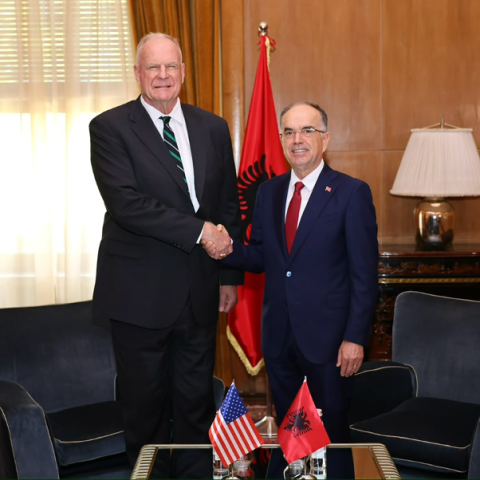
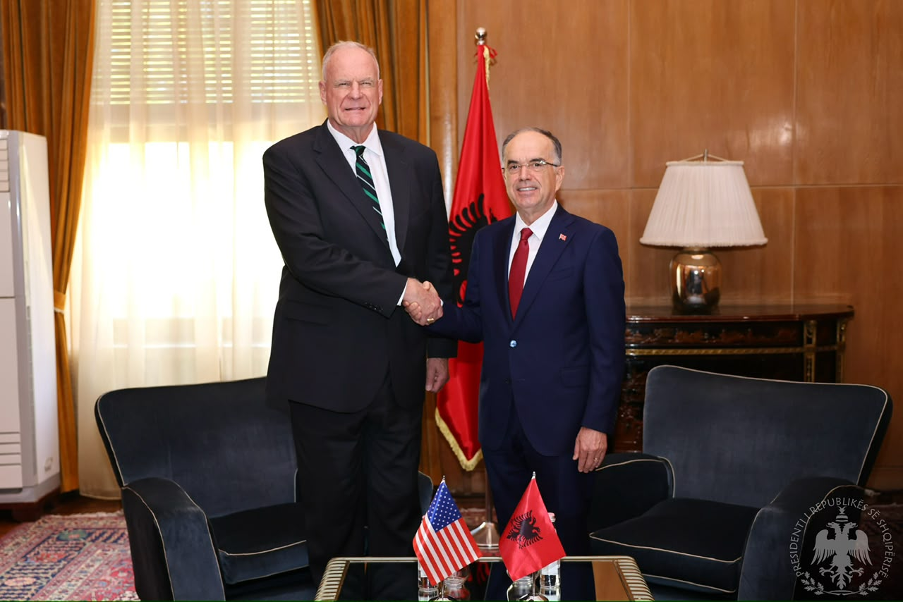
Tirana Times, September, 27, 2026 – Eric P. Wendt, a retired U.S. Army lieutenant general and former commander of NATO’s Special Operations Headquarters, has formally taken up his post as the new United States ambassador to Albania, presenting his credentials to President Bajram Begaj and beginning his mission at a time when the longstanding U.S.-Albanian strategic partnership is entering a new phase.
Wendt presented his Letters of Credence to Begaj at the Presidential Office in Tirana on Saturday, Sept. 26, formally assuming his duties as U.S. ambassador. He was accompanied at the ceremony by his wife, Katherine Wendt.
Begaj wished Wendt success in his mission and reaffirmed Albania’s commitment to further strengthening its strategic partnership with Washington.
“The United States remains an indispensable partner for Albania, as well as for our security and prosperity,” Begaj said following the meeting.
The U.S. Embassy in Tirana said Wendt and Begaj reaffirmed the strong partnership between the two countries and discussed priorities including defense cooperation, economic growth and the fight against transnational criminal groups.
Wendt’s arrival restores ambassador-level U.S. representation in Tirana after an extended period in which the embassy was led by chargés d’affaires and other temporary representatives following the departure of former Ambassador Yuri Kim in 2023.
His appointment comes against the background of a relationship that has played an exceptional role at several decisive moments in Albania’s modern history.
Albert Rakipi, a former Albanian deputy foreign minister and chairman of the Albanian Institute for International Studies, said the historical importance of Washington’s role goes far beyond conventional diplomatic relations.
“Few countries owe as much to the United States at decisive moments of their modern history as Albania. President Woodrow Wilson stood against the partition of Albania when European powers were prepared to divide it; the United States strongly supported Albania’s post-communist democratic transformation and its NATO membership; and American leadership was decisive in NATO’s intervention in Kosovo and in the path toward Kosovo’s independence. In Tirana in 2007, President George W. Bush made the U.S. position unmistakably clear: Kosovo’s end result would be independence.”
The relationship between Albania and the United States has repeatedly been linked to questions of statehood, security and Albania’s Western orientation. Wilson’s opposition to plans threatening Albania’s territorial integrity after World War I became one of the defining moments in Albanian perceptions of the United States.
After the collapse of communism, Washington strongly supported Albania’s democratic transformation and integration into Euro-Atlantic structures. Albania joined NATO in 2009, a milestone that firmly anchored the country within the Western security architecture.
The Kosovo crisis further strengthened the strategic bond. The United States played a leading role in NATO’s 1999 intervention and subsequently supported Kosovo’s independence. During his visit to Tirana in June 2007, President George W. Bush publicly stated that the process concerning Kosovo should result in independence.
Wendt arrives in Albania with an unusually extensive military and security background.
A retired Green Beret, he served more than 34 years on active duty in the U.S. Army and held a series of senior command positions. His final military assignment was as commander of NATO Special Operations Headquarters, where he oversaw special operations forces assigned to the alliance, including cooperation with Albanian military units.
His career also included service as chief of staff of U.S. Pacific Command and as commanding general of the U.S. Army John F. Kennedy Special Warfare Center and School.
Wendt additionally spent two years working with the U.S. State Department at the U.S. Embassy in Jerusalem, where he led an eight-country coalition as U.S. Security Coordinator for Israel and the Palestinian Authority and reported directly to the secretary of state.
His links with Albania predate his diplomatic appointment. During his NATO service, Wendt worked with Albanian defense officials and troops and had responsibilities involving Albanian forces in international missions.
President Donald Trump nominated Wendt in April as ambassador extraordinary and plenipotentiary to Albania. The U.S. Senate confirmed him in August, and he later took the oath of office before traveling to Tirana.
During his confirmation process, Wendt identified security cooperation, the fight against corruption and transnational organized crime, cybersecurity and stronger economic and commercial relations among the main areas he intended to address. He described Albania as a strong U.S. partner and NATO ally and emphasized the importance of cooperation between the two countries for regional security and stability.
His arrival also comes at a moment when the partnership is increasingly facing questions about how to move beyond its historical foundations and adapt to a changing geopolitical environment.
Albert Rakipi said the next stage of the relationship will require more than reliance on the strength of the past.
“Albanian-American relations are now entering a period of transition. The historical foundations of the partnership remain exceptionally strong, but history alone is not enough to sustain a strategic relationship. Albania and the United States need new ideas and a more mature partnership , one based not on dependency, but on shared strategic interests, stronger democratic institutions, economic cooperation and Albania’s ability to play a meaningful role in the security and stability of the Western Balkans.”
Economic relations remain one of the less developed dimensions of the partnership, particularly when compared with the depth of political, diplomatic and military ties. Albania’s future role in the Western Balkans, the strengthening of democratic institutions and the expansion of economic cooperation are likely to remain important elements in defining the relationship in the years ahead.
Wendt earned a bachelor’s degree from the University of California, Santa Barbara, and a master’s degree from the Naval Postgraduate School in Monterey, California. Following his retirement from military service, he taught command and leadership as a professor of practice at the Naval Postgraduate School.
He speaks Arabic and Korean and has received numerous military and civilian honors, including the Defense Distinguished Service Medal, the Distinguished Service Medal, the Bronze Star Medal and the U.S. Department of State Superior Honor Award.
Wendt now begins his assignment in Tirana with extensive experience in NATO, multinational security operations and diplomacy, as Washington and Tirana seek to define the next chapter of one of Albania’s most consequential international partnerships.