Kosovo-born, Austria-based artist honored for a career that has turned memory, displacement and identity into a bridge between cultures
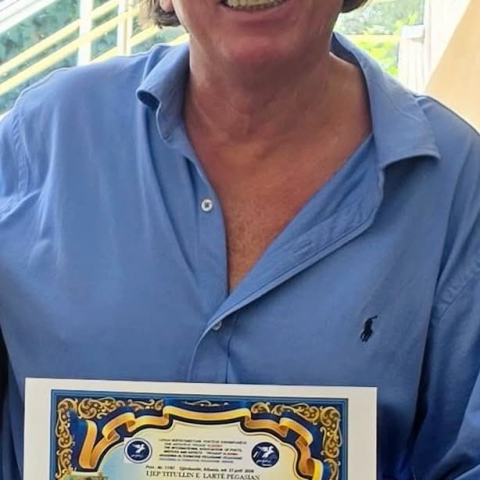
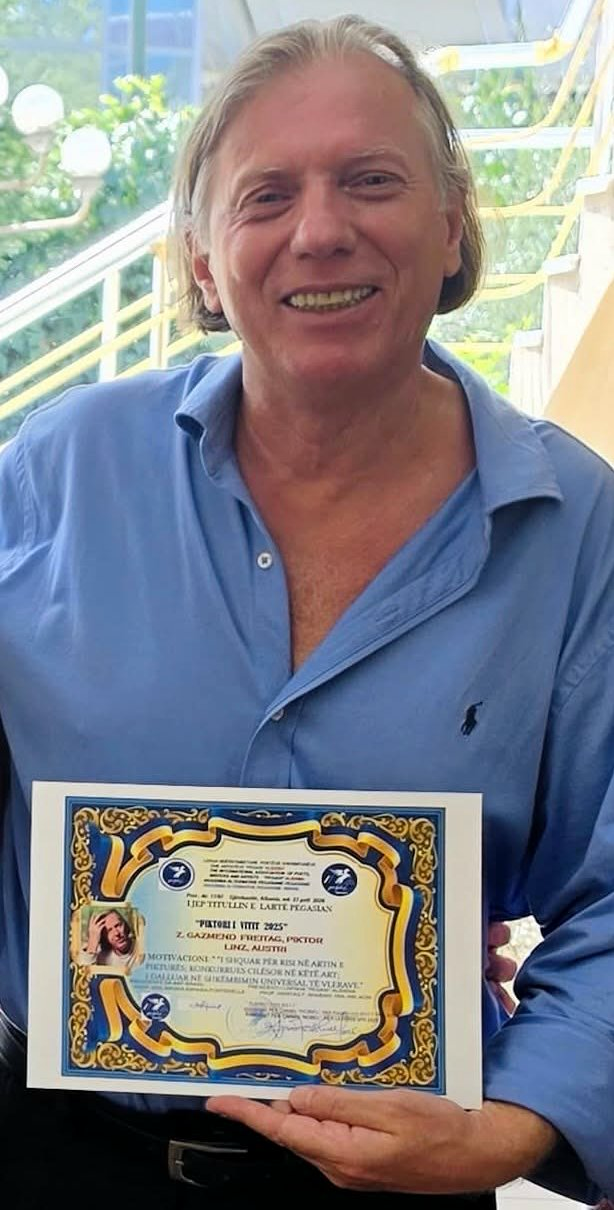
Tirana Times, September 29, 2026 – Kosovo-born Albanian painter Gazmend Freitag, who has built his artistic career in Austria, has been awarded the title “Painter of the Year 2025”, receiving the distinction during a cultural ceremony held in the historic city of Gjirokastër.
The award was presented by the League of Albanian Writers, Artists and Creators “PEGASI” Albania, in cooperation with the Pegasian Alternative Academy of Albania and the Alternative Academy of Brazil, as part of the cultural event Festaniada of Titles. Organizers said the distinction recognizes Freitag’s artistic dedication, creativity and sustained contribution to cultural bridge-building through the visual arts.
For Freitag, whose life and work have unfolded between Kosovo and Central Europe, the award carries a symbolism that goes beyond artistic recognition. His paintings have long drawn on the landscapes, faces and memories of his homeland while at the same time reflecting his life in Austria making his work a visual conversation between belonging and displacement, memory and a new home.
Born in Pataçan i Poshtëm, Kosovo, in 1968, Freitag showed an early interest in drawing and literature. He later began studying law at the University of Pristina, but the political upheavals of the late 1980s and restrictions imposed on Albanian students interrupted his studies. In 1990, amid growing repression and instability, he left Kosovo for Germany. He eventually chose an artistic path and, in 2004, settled in Linz, Austria, where he continues to live and work.
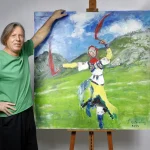
Over the years, Freitag developed a body of work centred especially on portraiture, landscapes, the human figure and still life. Working in oil on canvas as well as pencil, chalk and ink, he frequently returns to autobiographical themes and childhood memories, as well as scenes from Kosovo and from the places that later became part of his European life. His artistic training also included figure drawing at the University of Art and Design Linz.
His international profile grew after his participation in the First Biennale of Creativity in Verona in 2014, and his works have since appeared in exhibitions and art fairs in Austria and abroad. He has also become particularly associated with portraiture, capturing writers, cultural figures and people encountered in everyday life.
Freitag’s work, however, is perhaps most distinctive in the way it transforms the experience of the Albanian diaspora into a broader artistic language. Critics and biographical accounts of his work have repeatedly emphasized the connection between his art and the experience of leaving Kosovo, rebuilding a life abroad and continuing to maintain an emotional and creative relationship with his birthplace.
That connection has remained visible even as his artistic subjects have widened. Earlier this year, Freitag presented “Bäume — Eine Hommage” (“Trees — A Homage”) at the Wissensturm in Linz, an exhibition devoted to trees as symbols of beauty, vulnerability and endurance, themes that resonate strongly with an artist whose career itself has been shaped by roots, movement and continuity.
Receiving the “Painter of the Year 2025” title in Gjirokastër therefore brought together several strands of Freitag’s personal and artistic journey: a painter from Kosovo, formed partly through migration, established in Austria, and returning through his art to an Albanian cultural space.
The medieval stone city offered an especially fitting setting. Gjirokastër, itself defined by layers of history, memory and artistic heritage, hosted the award ceremony as part of a wider international cultural gathering involving artists and writers from Albania, Kosovo, Austria and a number of other countries.
For Freitag, the recognition is another milestone in a career that has consistently placed art at the intersection of identity, memory and cultural dialogue. His canvases may begin with deeply personal experiences, but they increasingly speak to a wider story familiar to many Albanians abroad: the effort to build a new life without severing the emotional and cultural ties to home.