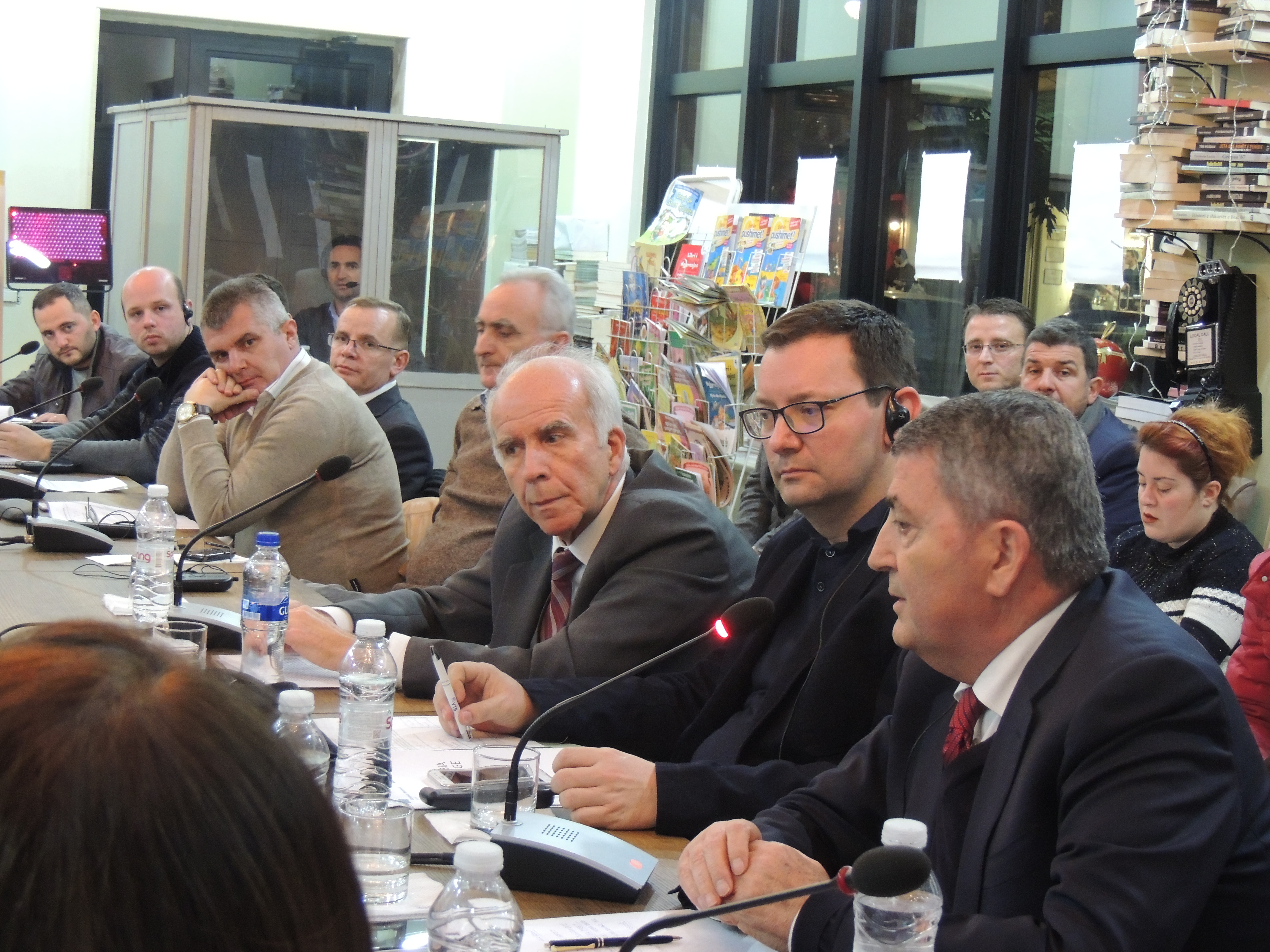
 TIRANA, Dec. 15 – Two years after Prime Minister Edi Rama’s historic visit to Belgrade and one year after the establishment of a joint Albania-Serbia center, the former tense and Cold War-like relations between Albania and Serbia have taken a U-turn and 2016 is considered the best year in cooperation between the two countries in the past seven decades, experts said at Tirana economic round table organized by the Albanian Institute for International Studies (AIIS), one of the country’s top think tanks.
Miroljub Zaric, the Serbian Ambassador to Tirana, who has spent some 15 years in Albania since the early 1990s when Albania’s communist regime collapsed, described 2016 as the best year in Albania-Serbia relations, especially regarding the strengthening of business ties.
“2016 is the best year in Albania-Serbia relations, especially in business with the establishment of the joint Albania-Serbia Chamber of Commerce and the host of the Nis business forum,” Zaric told participants at a round table organized by the AIIS and the European Movement Serbia, two regional top think tanks that a year ago established the joint Center for Albania-Serbia Relations.
Albania and Serbia had a three-year honeymoon soon after World War II when the communists came to power in both countries but later parted ways on ideological grounds. Relations between the two countries in the past 25 years of transition have remained tense especially after the late 1990s Kosovo war leading to its independence from Serbia in 2008, but are now on track to improve as Serbia and majority ethnic Albanian-inhabited Kosovo are also holding continuous EU-mediated talks to normalize their relations.
Luan Bregasi, one of the country’s most successful businessmen who heads the Business Albania association and was one of the initiators of the Tirana-based joint Albania-Serbia chamber of commerce, also described 2016 as the best year in Albania-Serbia trade exchanges.
“Politics filled a void left over by history to increase cooperation between the two countries. We did nothing under pressure, but only materialized the business community’s strong desire for trade exchanges,” said Bregasi, describing last October Nis business forum attended by Albanian Prime Minister Rama and his Serbian counterpart Aleksandar Vucic as a real cooperation platform.
Albert Rakipi, the AIIS director and one of the key promoters of stronger Albania-Serbia ties, said the normalization of Albania-Serbia relations serves regional stability and that stronger economic, political and cultural cooperation is needed for this.
“It is time Albania and Serbia build a strategic relationship. This is the only way so that the whole region finally moves to an area of peace and cooperation. This means building Europe at home,” Rakipi has earlier said.
“A strategic relation between Albania and Serbia can sound as heresy and will for sure be attacked by ‘patriots’ who intercept and attack from the bunkers of isolation. But relations with neighbors are always strategic. War is strategic and peace is also strategic, but both war and peace mainly happen between neighbors,” he has noted.
Jelica Minic, a former diplomat who heads the European Movement Serbia, described the first anniversary of the joint Center for Albania-Serbia Relations when two forums were held in Durres and Belgrade, and there was exchange of researchers and journalists between the two countries, as a good start that promises higher intensity.
“We now have a functioning although virtual center. It has been a good year and we hope to continue with higher intensity,” she said.
“Unfortunately we don’t know enough about each other although we have an agenda sharing common interests to join the EU,” added Minic.
“Political support is being reflected on the official communication between chambers of commerce from both countries. The Berlin Process, under the auspices of German Chancellor Merkel, projects in energy and infrastructure support the re-invigoration of exchanges, the strengthening of tourism industry, the free movement of people,” Minic said earlier this year at Durres forum on Albania-Serbia relations.
Johan Ndisi, Sweden’s ambassador in Tirana whose government is financially supporting stronger Albania-Serbia ties, said relations between the two countries were key for stability and peace in Europe.
“It is possible to draw parallels between Western Balkans and the Nordic countries in the sense that the regional trade partners are the most important ones, said Ambassador Ndisi.
“It is key that Western Balkans leaders continue to work together in order to improve the environment for investments and eliminate barriers to trade, both within the region and in relation to the European market,” he added.
“At the end of the day, you’ll trade most with your neighbors and that’s why good neighborly relations are very important as investors look at the region as a whole and not particular countries,” he added.
Relations getting better, AIIS survey finds
Relations between Albania and Serbia are considered important, especially from an economic point of view, by a majority of Albanians and are on track to improve, according to a survey conducted by the AIIS with 1,400 face-to-face interviews in the country’s 12 regions in October-November 2016.
About three quarters of respondents described relations between the Albanian and Serbian governments as normal, good and very good and about half believe relations with further improve, shows the AIIS survey.
Relations between Albania and Serbia are also considered key by a majority of Albanians for the Western Balkans economic development and the region’s security and stability.
As the two countries move closer toward EU integration, most Albanians believe the two countries should strengthen relations because of mutual economic benefit rather than because it’s a requirement by the EU.
Albania’s contacts with Serbians remains sporadic as only a minority of 18 percent of respondents said they had travelled to Serbia, of whom only 13 percent to do business and the remaining part on holiday, in transit, to attend conferences.
Economic relations between the two countries were described as normal, good and very good by about three-quarters of respondents, half of whom said they didn’t know what goods the two countries exchange and about three-quarters were not aware of the joint economic projects, including the Albania-Serbia chamber of commerce.
A majority 58 percent of Albanians also described Albania as a travel destination for landlocked Serbia.
An earlier AIIS survey issued in late 2015 had also found a plurality of residents of Albania believe relations between this country and Serbia are normal and likely to improve in the future and such improvements are in the best interest of both countries.
In October 2014 a drone with Albanian nationalistic and patriotic symbols flying over the Partizan stadium in Belgrade in the midst of a Serbia-Albania Euro 2016 qualifier put Albania-Serbia relations into a Cold War status quo.
One month later, Prime Minister Edi Rama paid a historic visit to Serbia, the first by an Albanian Prime Minister in 68 years, in a tense climate following the drone incident, but paving the way to the normalization of relations between the two countries which are considered key players for the region’s security, economic development and the Western Balkan’s European integration.
Economic cooperation set to boost
Economic cooperation between the two countries although increasing in the past few years remains significantly low and below potential although there are promising fields of cooperation in trade, energy and tourism, Albanian and Serbian experts said introducing research papers in Tirana at the AIIS ;round table.
Elena Pici, an AIIS associate researcher, said regional economic cooperation between Albania and Serbia provides a new impetus for the enlargement and integration process in the EU.
“Regional cooperation will create a business environment that will provide for foreign and national direct investment, create much-needed jobs and encourage individual initiatives leading to higher living standards,” she said.
“In many areas such as trade, energy, transport, tourism and finance, because of the limited size of both countries and the fragmentation of economic space in the region, there is no other option but to embark on intense regional cooperation as the only realistic way forward,” added the researcher, noting the need for both Albania and Serbia to focus on industry and human capital for further economic development.
The AIIS researcher also noted the need for a change in the mostly EU-mediated top-down approach in Albania-Serbia regional cooperation.
“The future of economic cooperation indicates toward a mixed approach, combined with the bottom-up. Both Albania and Serbia should be willing to initiate new regional economic projects on their own, after having realized that the creation of regional market provides the ground for a ‘win-win’ situation for all,” she added.
Predrag Bjelic, an international trade professor with the University of Belgrade, unveiled how the current low level of trade exchanges dominated by Albanian imports from Serbia still rely on Middle Ages-like trade exchanges such as wheat, maze, tomatoes and cucumber.
“Our analysis of trade flows between Albania and Serbia showed that the level of trade is quite low and unbalanced. This is unexpected, as there is a free trade agreement in place which provides significant trade preferences for bilateral trade between these economies,” said professor Bjelic.
According to him, bilateral resistance factors lie beyond the trade regime conditions, and could be more dependent on infrastructural quality, product structure of exports, or even political factors.
“Trade potential analysis shows that there is significant room for improving the trade between Albania and Serbia in many sectors. The new sectors where we see enormous potential are trade in services and exchange of private capital in the form of foreign direct investment,” he added.
In the case of Albania, trade potentials are observed in cucumbers, but there is also significant potential regarding tomatoes and Portland cement, he says in his research paper.
As far as Serbia is concerned, trade potential is stronger for iron and steel scrap, but there are also higher opportunities for the export of wheat, while the smallest trade potential is for maize.
Other experts noted barriers remain a key issue to tackle as Albanian lorries exporting to Serbia still have to go through Macedonia instead of a shorter way through Kosovo which Serbia doesn’t recognize.
A Serbia-Kosovo legal dispute over the transmission grid is holding back the operation of a newly built German-funded Albania-Kosovo interconnection line and Albania’s plans to set up a joint energy market and a power exchange with Kosovo, Albania’s northeastern neighbor.
The Air Serbia carrier offering direct Tirana-Belgrade flights and the completion of the Durres-Prishtina-Nis highway are promising for the further development of trade, especially tourism which is seen as a key sector that can benefit Albania, experts say.
Some 100 Serbian SMEs currently operate in Albania, mainly in construction, industry, tourism, services while the number of Albanian companies in Serbia is estimated far lower.
Serbia is currently Albania’s sixth largest trading partner while Albania is out of Serbia’s top ten partners for trade exchanges.
Albania-Serbia trade exchanges at only an annual €173 million are dominated by electricity and grains and fresh vegetables, according to Albania’s state statistical office, INSTAT.
Albania’s exports to Serbia rose to 3.2 billion lek (€23.3 mln) in 2015 but imports were seven times higher at almost 21 billion lek (€153 mln), according to INSTAT, Albania’s state statistical INSTAT.