TIRANA, Jan. 16 – Albania and Macedonia were on the brink of a serious crisis this week due to Skopje’s decision to issue visas to Albanians only at its embassy in Tirana.
While Skopje was saying the visa issue would be ultimately decided at the premiers’ meeting next month, Tirana was silent until Wednesday, in a sign of pressure.
Then, Prime Minister Sali Berisha’s spokeswoman came out to say that Macedonian Premier Nicola Gruevski was officially invited and welcome to Tirana and the date would be set in diplomatic talks, probably in the next four months.
Both countries are hoping to receive NATO membership at its April summit in Bucharest.
Official Tirana was late to react to the Skopje decision on the visa.
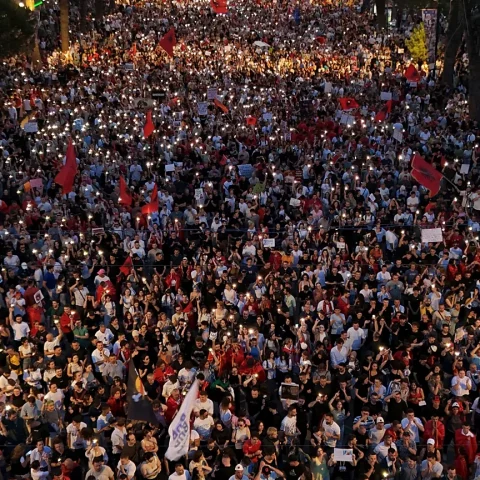
It was first the local media and the political parties in both countries (ethnic Albanians in Macedonia) that produced an outcry, saying it was unfair for Skopje to require such a measure exclusively to Albanians, adding past good relations had helped to keep a stable security and economic situation in the Balkan region.
Moreover, many personalities in Albania said that Skopje had a moral obligation toward Albania, which was the first to recognize it upon independence from the former Yugoslavia.
However, officials in Skopje first said that the decision on visas was made more than a year ago and had to be applied.
Later, though, it bent showing signs of amending that decision.
The government spokesman has recently said that a final decision will likely be taken at the government meeting on Saturday and that had to be finalized during the premiers’ meeting next month.
Albania and Macedonia have signed a ten-year agreement on facilitating visa regulations.
The premiers’ meeting would focus on the visa issue, co-operation between the two countries, Euro-Atlantic integration (NATO and EU) and the Kosova status, according to Macedonian spokesman Ivica Bocevski.
Despite the recent outcry in both countries, Tirana has said it will not require Macedonians to come to an embassy for a visa.
The Albanian Foreign Ministry issued a statement last week insisting that free movement had always been the motivation behind a stable region. It also added its willingness to continue with the consultation process aiming at improving the situation.
The statement stressed that even though the two countries are trying to fulfill the standards along the Euro-Atlantic integration path, this should not narrow communications between them and increase barriers.
There have been many loud voices from Albanians.
Former Albanian Premier Aleksander Meksi said that Skopje owes a lot to Tirana, which was the first to recognize it as a sovereign state after leaving former Yugoslavia.
Both Chambers of Commerce in Tirana and Skopje have protested, saying such a move would have a negative effect on bilateral commercial exchanges, more negatively affecting Macedonia.
Albania police says no notification from Skopje of change of visa regime
Albanian Interior Ministry officials reported Sunday they had no notification from their Macedonian counterparts on an alleged change of visa regulations beginning February 1.
Ministry spokesman came out on Sunday to say there was no “official notification for the change of the regime of the movement of the citizens toward Macedonia,” adding the move would continue the same as before.
Skopje has announced Albanians will need to ask for visas at their embassy in Tirana, which has sparked an outcry from Albanians and their brethren in Macedonia.
Business complain
Businessmen in both countries complained that such a move from Skoppje would have negative effects on their activities.
The Chambers of Commerce in Tirana and Skopje reminded the Macedonian government that the restrictive visa regulation goes against the trend of their countries’ integration efforts into the European Union.
First it was said that Macedonians would be most negatively affected by the new regime, as there are hundreds of thousands of Albanians who spend their money as tourists in the neighboring country.
But later it was also said that Albanian businessmen, too, would have grave consequences as Macedonia is also used by them as a transit route for their trucks coming from Kosova, Bulgaria and Turkey, which are important markets for them.
Ohrid mayor concerned by new visa regulations
The Mayor of the Macedonian town of Ohrid, Alexandar Petreski, is against creating new visa regulations for Albanians, saying it would negatively affect his city where hundreds of thousands of Albanian tourists came every year, according to a Bulgarian news agency.
Speaking to the Focus news agency, Petreski expressed opposition against the change in the visa issuing regulation for foreign citizens, which is planned to now be issued in embassies and consulates of Macedonia instead of at border checkpoints, as it has been up until now.
Petreski is also a chairperson of Euroregion, made up of Macedonia, Albania and Greece. The municipalities of Ohrid, Struga and Debar will send a letter to the government and the Ministry of Foreign Affairs with the demand for canceling the decision for issuing visas for Albanian citizens in the embassy in Tirana instead of at the border checkpoints.
“The consequences from this change would not be felt only in Ohrid. This is the Euroregion – Macedonia, Albania and Greece. A few municipalities are included: Ohrid, Struga, Bitola, Resen – from the Macedonian side; Pogradec and Korca – from the Albanian side; and Voden and Folorina from the Greek side. We have made great efforts over the last years to revive this region. The municipalities on the Macedonian side, through the Ohrid lake and the border checkpoints, are bordering to Albania and are to a great extent dependent on the tourism and trade with this country,” said Petreski.
The practice of tour operators shows that there has been a great number of tourists from Albania, Serbia, Bulgaria and Greece, according to him, accounting for about 40 percent of the total number of tourists. They also return a few times a year. Results show that the revenues of Ohrid from tourist fees is 8 times larger than two years ago.
“The new visa regime with Albania would negatively affect the development of tourism in Ohrid. Struga and Debra would also be affected. This means that the decision of the government would negatively affect 60,000 citizens of Ohrid, 70,000 citizens of Struga and 40,000 citizens of Debar. If the Albanian citizens stop visiting Macedonia due to the visa regulations, it could effect 200,000 citizens of our region who deal with tourism or trade,” he said.
Petreski said they “expect the government would postpone its realization if there is no possibility for its full cancellation. There is no need for the decision to come immediately into effect. We consider that the visa regime may not be needed if both Macedonia and Albania join NATO.”
Early consequences already present
Though the new visa regime will officially start February 1, there are already signs that the Macedonian border is becoming harder to cross for Albanians.
There have been media reports that Macedonian border guards have asked Albanians trying to cross into their country for the life insurance, a practice not previously requested.
That has angered many Albanians who regularly use Macedonian tourism resorts during the winter.
But it will also very negatively affects the population living close to the border.
Until now, they had a special visa-free regulation which they used not only for tourism but also when looking for jobs and establishing family ties.