The conflict over a commemorative plaque in a small ethnic Albanian town in southern Serbia marks the latest sign of renewed ethnic tensions in the region
PRESHEVO VALLEY, Jan. 23- In the early morning of January 20, about 200 masked and heavily armed Serb paramilitary police, backed by armored personnel carriers, rolled into the largely ethnic Albanian town of Preshevo, in southern Serbia, and hauled away a monument located at the center of town.
The two-meter memorial slab paid tribute to 27 fallen members of the Albanian Liberation Army of Preshevo, Medveda and Bujanovac, which in 2000-2001 fought a short-lived insurgency aiming to unite the region with neighboring Albanian-dominated Kosovo. To the region’s ethnic Albanians, the 27 were heroes. To the Serbs, they were enemies of the state, and the memorial was seen as “a provocation.”
Though the removal went without incident, soon after there were protests in Preshevo, where Albanians said the removal was the latest sign of discrimination against them by the Serb state.
Observers note that the conflict over the memorial is a sign of renewed ethnic tensions in a region where politicians are keen to focus on nationalism as a distraction to larger issues, such lack of economic opportunities.
Ethnic Albanians protest against discrimination
Ethnic Albanian areas in southern Serbia are that country’s poorest region. As a result, the current situation of the ethnic Albanian community in the valley is not very good, local leaders say.
They accuse Serbia of discrimination that has lead to the unequal economic situation with the rest of the country, saying Serbia has focused on building military bases instead improving the daily lives of the Albanians, who feel marginalized.
Under these conditions in Serbia, when the economy is bad, joblessness high and life insecure, it is easy for citizens to turn to turn into the wish to join their brethren in Kosovo for comfort, analysts note.
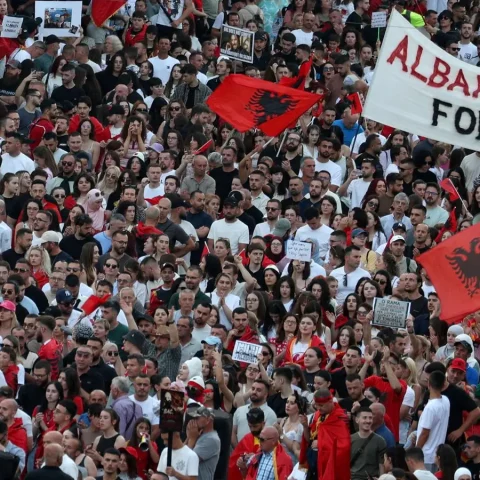
About 2,000 people gathered in Preshevo’s main square after the removal of the memorial, and held a peaceful protest. Similar, smaller protests took place in Kosovo and Albania as well.
Demonstrators at the rally in Preshevo carried banners saying “Stop violence and discrimination,” “Europe, open your eyes” and “Stop Albanophobia”.
Leaders of the ethnic Albanians in the Preshevo Valley say they wanted a compromise solution and were talking to Serb authorities about moving the monument themselves before the police forces intervened. Those negotiations failed, and the Serb authorities said they acted to stop “the provocation” against the Serb state.
Furthermore Serb Prime Minister Ivica Dacic said the security situation in Preshevo is an “internal matter” of Serbia. While his government issued a statement saying the “memorial was set up illegally,” and that’s why it was removed.
“We are determined not to violate anybody’s human, national and civic rights, but no one has the right to humiliate Serbia,” said Dacic.
The commemorative plaque was put up in late November, as part of Albanians everywhere celebrating the 100th anniversary of Albania’s independence.
But instead of simply honoring the fallen, the memorial ended up bringing ethnic tensions in the Preshevo Valley at their highest point since May 2001, when the armed conflict between Albanian insurgents and Serbian government forces ended with the intervention of the international community under the premise that there would be no border changes and that Albanians in the valley should be given equal rights as citizens of Serbia.
Kosovo dialogue ‘seriously endangered’
In Kosovo, where ethnic Albanians have their own long and violent history of living under Serb rule before proclaiming independence in 2008, the move to cart the monument off with a bulldozer also was also heavily criticized.
What happens in Preshevo is important to Kosovo’s relations with Serbia. In fact, Kosovo Prime Minister Hashim Thaci accused the Serbs of creating an incident in Preshevo to distract the international community from the Belgrade-Prishtina dialogue over normalization of relations.
There is also worry that Serbs aim to split Kosovo, in particular tying Preshevo’s fate with the of northern areas of Kosovo, which have Serb-majority population and are de-facto out of Prishtina’s control.
“The move by the Serbian government seriously endangers the process of a dialogue on normalization of ties between Kosovo and Serbia,” said a government statement from Pristina, referring to ongoing European Union-brokered talks between Pristina and Belgrade, which rejects Kosovo’s self-proclaimed independence that has been recognized by about 90 states including the United States and a majority of European Union members.
Progress in normalizing relations with Kosovo is a key condition for Serbia to get a date to start EU accession talks.
President of Kosovo Atifete Jahjaga said the removal went contrary to basic human rights and the European Charter of Local Self-Government.
The international community has also expressed concern. The United Nations said it is “following developments in the Preshevo Valley and is appealing for calm,” said UN spokesperson Martin Nesirky.
“The UN has consistently underscored the need for international and regional reconciliation in the western Balkans,” he said.
Reconciliation ‘missing’ a decade after conflict
The latest events in Preshevo need to be seen in the the political and philosophical aspect as an issue of a missing reconciliation, says Albert Rakipi of the Albanian Institute for International Studies. “The events in Preshevo and similar incidents elsewhere in the former Yugoslavia are a reminder that the process of reconciliation has not yet taken place,” says Rakipi. “This requires first dealing with the past, and recognizing what has happened. Serbia in particular has not done this yet.”
Further, he adds, there is worry that the latest events in are the latest reinforcing a trend that the spirit of populism and nationalism is making a comeback in the Balkans, where many political parties are increasing their nationalist rhetoric, diverting attention from the real problems citizens of these countries face and manipulate them into blaming others for their ills.
In Serbia, Kosovo, for example, is often the focus of political campaign when issues that affect everyday life, such as the economy, are in dire need of debating.
Test case for Albania’s renewed focus on national issues
With interest on national issues riding high in Tirana ahead of the upcoming elections, there has been keen interest about the fate of the roughly 100,000 ethnic Albanians in southern Serbia, and the removal of the monument is likely seen as a test case about forging patriotic credentials for many Albanian politicians.
Albanian authorities strongly denounced the removal of the memorial. Prime Minister Sali Berisha said Tirana would reconsider ties with Belgrade, though he did not define what that meant.
All official visits to Serbia had been suspended, the foreign ministry noted.
“The Albanian heroes fell to become immortal in the fight for freedom, human and national dignity against the barbarous regime of Slobodan Milosevic,” Albania’s government said in a statement.
Tirana said the move was “another proof of Albanophobia of the official Belgrade that shows in a crystal clear way that the racist anti-Albanian heritage of Milosevic is still alive and dominates the official policy of Belgrade.”
It said that Belgrade had “openly breached the international laws and conventions like the European Convention on Human Rights, the Council of Europe Convention on Minority Rights as well as the European Charter of Local Self-Government of the Congress of Local and Regional Authorities which Serbia has adopted and is obliged to apply.”
Demographic data for municipalities in southern Serbia with large ethnic Albanian populations:
Ethnic Composition
Presevo: Total 35,191
Albanians: 31,089 (89.1 per cent)
Serbs: 2984 (8.55 per cent)
Roma: 1,118 (4.72 per cent)
Bujanovac: Total 43,302
Albanians: 23,681 (54.69 per cent)
Serbs: 14,782 (34.14 per cent)
Roma: 3,867 (7.25 per cent)
Medvedja: Total 10,759
Serbs: 7363 (66.57 per cent)
Albanians: 2916 (26.17 per cent)
Montenegrins: 373 (3.46 per cent)
Roma: 107 (1 per cent)