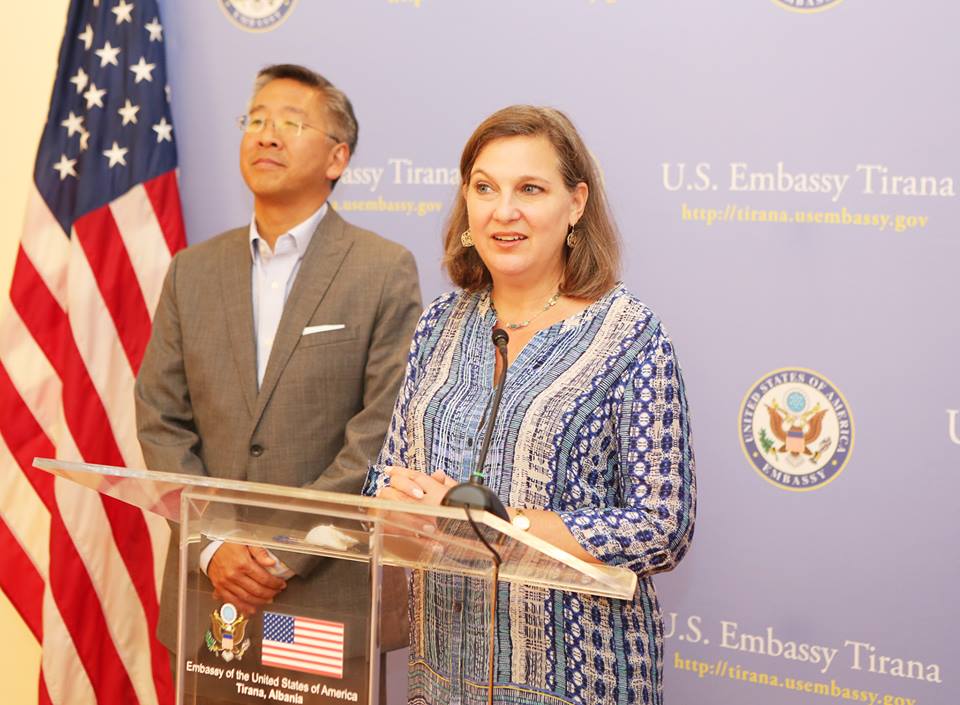
 TIRANA, July 12 – The U.S. has urged the ruling Socialists and the opposition Democrats to reach a deal over the long-awaited justice reform to pave the country’s way for EU membership talks with a back to square one proposal on broad political consensus on what is considered the country’s most important reform in its past 25 years of transition to democracy.
During her brief visit to Tirana last Sunday, U.S. Assistant Secretary of State for European and Eurasian Affairs Victoria Nuland presented a new “hybrid” proposal that aims to bring parties back to consensus and dialogue. “In the last 24 hours, we have tabled a new proposal which endeavors to bridge the distances. This is a hybrid proposal that has taken ideas from the opposition and the majority and is in the line with Venice Commission recommendations. It is based on the very good, active listening that Ambassador Lu and his EU counterpart have been doing and it attempts to combine an appropriate level of international monitoring with a strong defense of Albanian sovereignty,” she said.
Nuland failed to disclose the exact formula related to the vetting process regarding new officials in the judiciary system, however, she made it clear that political parties must find consensus on the new proposal and urged leaders to not lose any more time. Nuland argued that the proposal supported by Washington provides the international experts involved in the reform a suitable role in the monitoring process that does not violate Albania’s sovereignty.
“On behalf of Washington and EU colleagues I urged Prime Minister Edi Rama and chairman of opposition Lulzim Basha to come together over the proposal. It is time to agree, the Albanian people are waiting,” Nuland underlined. She noted that the justice reform that the parliament, government and opposition negotiators are working on, is vitally important for the health and the democratic strength of this country. “It will make an essential contribution to ending the culture of impunity and ensuring that Albania has a justice system that truly works for the people of this country” .
At a press conference following separate meetings with Prime Minister Edi Rama and opposition leader Lulzim Basha, Nuland told reporters that “both leaders express the desire to come to an agreement on the reform.” “It is not a secret to you all that politics is rough in this country, but I felt that they both know that it is a moment for leadership,” she added.
Prime Minister Edi Rama on the other hand insisted that the ruling majority is open for “any compromise that doesn’t threaten the reform and at the same time, is considered by the U.S. and EU in full compliance with the joint objective for a justice system decent for an EU member country.”
Meanwhile, opposition Democratic Party leader Lulzim Basha said that the opposition is convinced that the reform can only be approved through political consensus. “There is no and there cannot be any other healthy foundation for the reform in justice, besides political consensus between the sides,” he said.
U.S. and EU experts have been directly involved in drafting the legislation, and the process has also been reviewed by the Venice Commission, a body of legal experts with the Council of Europe human rights group.
The Albanian parliament needs a two-thirds majority to pass constitutional changes required for the justice reform on July 21st otherwise the country will not be able to launch accession talks with EU. The numbers however cannot be achieved without the opposition Democrats. The proposed constitutional changes set up new regulations for the functioning of judiciary institutions. The sticking point revolves around whether the new laws will give political parties any power to make judicial appointments. The ruling Socialists want no party appointees, while the Democrats want some to limit government overreach. The role of international monitors in the vetting process is also part of the dispute.
The United States Ambassador Donald Lu and EU Ambassador Romana Vlahutin have stepped up their efforts to bring the parties together. Vlahutin recently warned that if Albania loses its momentum, then the country will lose several years in the integration process. In the meantime, U.S. Ambassador Donald Lu earlier urged the country’s political parties to reach a compromise on a judicial reform package, or for lawmakers to vote independently. If the package is approved on July 21st, then the European Commission will have enough time to decide on launching membership negotiations with Albania. Any failure of the vote might cause hardship to the government, delay EU talks for another year or even trigger new elections.