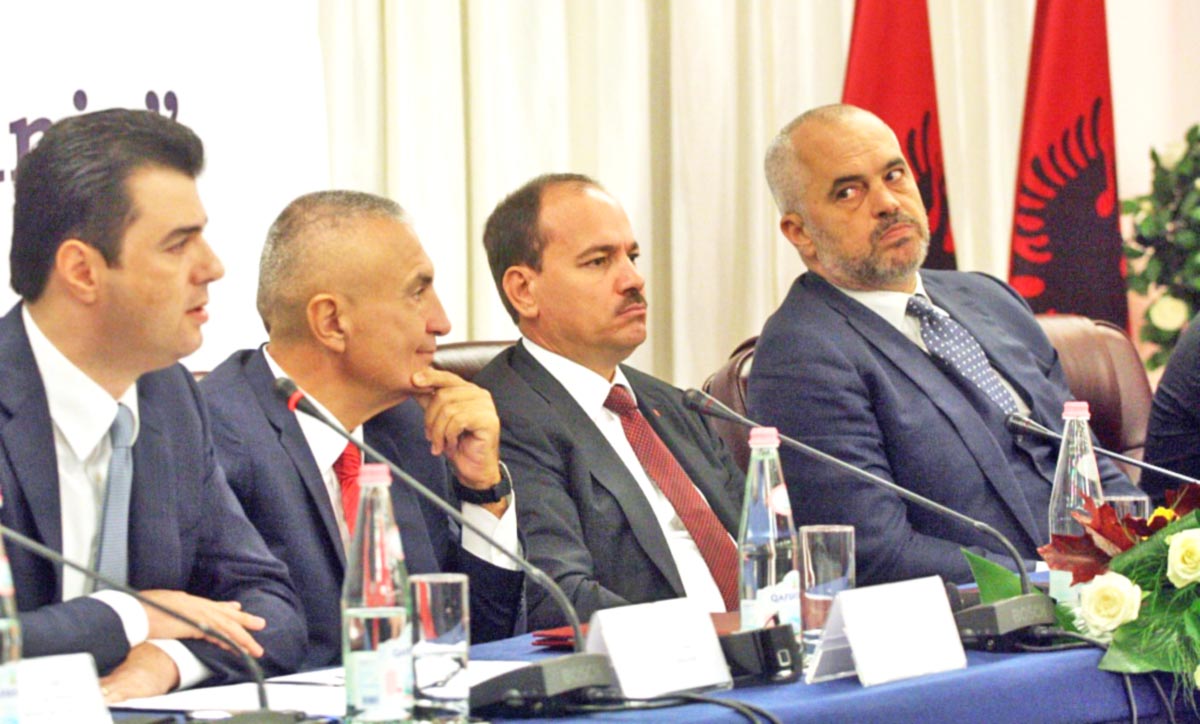
TIRANA, July 14 – With only few days to go before an expected vote in Parliament, the internationals’ role in the vetting of judges and prosecutors in the much-rumored justice reform has deepened the divide between the ruling Socialists and the opposition Democrats with the latter claiming that their proposed decision-making role puts the country’s sovereignty at risk. When everything seemed to be heading back to square one and broad political consensus following new U.S.-brokered talks, a rift has also emerged in the ruling coalition with the Socialist Party’s junior ally, the Socialist Movement for Integration, also voicing concern over the proposed constitutional changes and the internationals’ role in the vetting process.
The long-awaited reform in the highly perceived corrupt justice system is considered the country’s most important reform in its past 25 years of transition to democracy and is a key requirement for the country to open EU accession talks with the European Commission after the EU candidate status in mid-2014.
The Chairman of the Socialist Movement for Integration parliamentary group Petrit Vasili said Thursday that the justice reform must be agreed in consensus by all parties and be in accordance with the Venice Commission recommendation. He underlined that the reform must not be used as an electoral alibi for the upcoming elections. “We are opting for a consensual reform under the Venice Commission recommendations. This reform is a necessity for the country. The Venice Commission is the single body whose authority has been accepted by all political parties,” Vasili said. The senior SMI official also urged parties to not mythicize experts.
“Albania is a parliamentary republic and not a republic of experts. There can be no experiments in the name of experts. We had a similar experience with the case of Crown Agents in the customs and results from mythicizing experts did bite back,” Vasili said.
The official stance of the junior coalition partner seems to echo that of the opposition parties who have rejected the “hybrid” proposal made by United States of America and European Union. The proposal says that international experts must be given a bigger role to filter candidates before they can proceed in the selection process. The Democrats however demand a special committee where international experts are only given the role of observers. During talks with his Democratic Party parliamentary group, chairman Lulzim Basha said that the opposition accepts 95 percent of the U.S. proposal but disagrees with the role of international experts. “We cannot agree on giving constitutional or quasi-constitutional rights to the international monitoring mission,” Basha said. He suggested that the international experts involved in the process can be supervisors with full access but with no democratic accountability, since any additional involvement would be a sui generis case and an absolute precedent that has never happened in other countries with similar judicial problems such as Croatia or Romania.
“If things go wrong in this mission, who will be responsible – the Prime Minister of Finland or the Swiss one?” Basha asked.
The Democratic Party refusal to the U.S.-backed proposal caused disappointment among EU and USA officials in Albania. U.S. Ambassador Donald Lu said that “United States felt deeply disappointment over DP’s decision to reject the last proposal made by the U.S. in relation to the judicial reform.”
“Basha proposed something, while being perfectly aware of the conflict of interest and totally in discordance with the Venice Commission proposals. Negotiations with both pairs are still ongoing aiming to reach a consensus on the hybrid proposal,” Lu said in a press statement.
The EU Delegation to Albania also commented the DP’s rejection on the compromise proposal. “The credibility of the judicial reform overall depends on the credibility of the vetting of judges and prosecutors. To guarantee this, a limited targeted role of the international community through the International Monitoring Operation is crucial. This is fully in line with the Venice Commission Opinion that envisages this role for the International Monitoring Operation. The International Community has never suggested having any executive power since it is essential for the Albanian authorities to keep full ownership. Negotiations must come to a positive conclusion now,” the statement read.
Prime Minister Edi Rama on the other hand accused the Democrats of fearing the role of international experts in the vetting process. “With this refusal, the Democrats just wants to keep the EU and U.S. away from the process,” he added. Rama underlined the importance the reform has for Albania’s EU integration and invited Basha to another meeting on the reform to try to find a solution.
The hybrid proposal was put to the desk of negotiations on Sunday during the visit of Victoria Nuland, the Assistant Secretary of State for European and Eurasian Affairs at the United States Department of State. Nuland argued that the proposal supported by Washington provides the international experts involved in the reform a suitable role in the monitoring process that does not violate Albania’s sovereignty. “The justice reform is vitally important for the health and the democratic strength of this country.” “It will make an essential contribution to ending the culture of impunity and ensuring that Albania has a justice system that truly works for the people of this country,” she concluded.
U.S. and EU experts have been directly involved in drafting the legislation, and the process has also been reviewed by the Venice Commission, a body of legal experts with the Council of Europe human rights group.
The Albanian parliament needs a two-thirds majority to pass constitutional changes required for the justice reform on July 21st otherwise the country will not be able to launch expected accession talks with EU. The numbers however cannot be achieved without the opposition Democrats. These constitutional changes set up new regulations for the functioning of judiciary institutions. The sticking point revolves around the role of international monitors in the vetting process and whether the new laws will give political parties any power to make judicial appointments. The ruling Socialists want no party appointees, while the Democrats want some to limit government overreach.
Recently United States Ambassador Donald Lu urged the country’s political parties to reach a compromise on a judicial reform package, or for lawmakers to vote independently. If the package is approved on July 21st than the European Commission will have enough time to decide on launching membership negotiations with Albania by next autumn. Any failure of the vote might cause hardships to the government, delay EU talks for another year or even trigger early elections although general elections will be held next year.