TIRANA, May 17 – Massive bee losses in Albania during the past year and its link to the rising cannabis cultivation have also attracted the attention of French media who blame the phenomenon on the use of pesticides in cannabis plantations.
“Between 2015 and 2016, 142,000 beehives out of a total of 360,000 couldn’t survive the 2016 winter. That was the first time this happened and it became more tragic considering that thousands of households live on local honey production, one of world’s best,” writes Le Courrier des Balkans.
“Of course everybody is wondering to understand the reasons for this. It is true that the winter was harsh, it is also true that bees were infected with parasites and that Albanian beekeepers can’t afford using modern products, but this is not enough!” says the French portal dedicated to Balkan issues.
“In fact there is another reason for such high mortality rate: the cannabis cultivation. In the past few years Albania has become Europe’s biggest cannabis producer leaving behind Bulgaria, Kosovo and Serbia. And the thing is about hundreds of hectares!”
“Just to figure out, in 2016, the Albanian police assisted by their Italian counterparts destroyed 2.5 million cannabis plants. To produce this huge amount, Albanians used huge amounts of banned pesticides, which is the reason for what happened with bees. To sum up, Albanian bees and beekeepers are victims of the cannabis cultivation outbreak and the massive use of pesticides, but also local mafia and the hypocrisy of consumer countries with France being Europe’s number one,” says Le Courrier des Balkans.
The French portal is not optimistic things will changes as Italy, France and Germany, the main importers of Albanian cannabis have not committed to seriously tackling this issue, paving the way for the Mafia.
The other reason is that Albania is a very strategically located country. “You only need to cross the Adriatic to take the drugs to Italy. This is less complicated than importing from Morocco. And last but not least because Albania farmers are experts in this.”
Albania has been a cannabis producer since the communist era of late dictator Enver Hoxha when it was one of the world’s most isolated countries, but legally exported cannabis, especially to Switzerland for its pharmaceutical industry.
TV5 Monde also blamed the massive bee losses on the massive cannabis cultivation and use of pesticides.
“Farmers treat cannabis plants with banned and outdated pesticides and in industrial quantities in order to prevent infection and keep their plants in check. The other side of the coin is that bees are very sensitive to these chemicals and die massively,” says TV5 Monde.
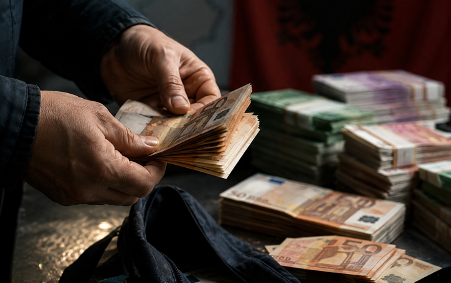
The French TV says the fight against this phenomenon has been complicated with the arrival of thousands of migrants from recession-hit neighbouring Greece and the fact that a kilo of cannabis sells at Euro 200 to 300 locally, a huge amount equal to cultivating about 1 metric ton of traditional crops such as wheat or corn.
The reports on the French media came after the Albanian Association of Beekeepers estimated that 40 percent of the bee population in the country disappeared in the course of one year, mainly due to severe weather conditions as the country faced its harshest winters in three decades with snowfall and freezing temperatures even in coastal area, but without excluding the effects of rising cannabis cultivation distracting and even killing bees while pasturing.
Nationwide losses from the destruction of 144,000 beehives, about 40 percent of the total, are estimated at Euro 60 million, a considerable amount for Albania’s underdeveloped agriculture sector, employing about half of the country’s population but producing only about a fifth of the GDP.
Albanian economy experts have warned the massive nationwide cannabis cultivation even after the mid-2015 crackdown on the notorious internationally renowned marijuana-growing village of Lazarat, southern Albania, is having detrimental effects on the key agriculture sector, driving farmers away from cultivating traditional crops and making them take the risk of much more profitable illegal cannabis growing. Experts say the phenomenon shifts attention from the key agriculture sector, distorts the labor market and strengthens the criminal economy.
Albanian organic honey and its royal jelly also known as ‘bee milk’ is known for its effects on balancing between low and high blood pressure, all kinds of anemia and the Alzheimer’s disease.
Albania’s annual honey production is more than 3,200 metric tons a year, with a kilo or organic honey at about €10. However, production leaves a lot to be desired due to lack of disciplining and underdeveloped agriculture sector which directly influences on the performance of beekeeping.
Agriculture university professors say domestically produced honey has more than doubled in the past decade with imports covering only about a tenth of the country’s needs.
Most production is sold in the domestic market while exports are relatively small due to not meeting EU requirements and tough competitiveness from regional countries offering lower prices.
The majority of honey is produced in the southern Vlora and Korà§a and Saranda regions. The northeastern region of Tropoja is also famous for its chestnut honey which has good potential to succeed in the international market.
Some of the country’s biggest beekeeping farms have also turned to agritourism to boost their income, also attracting tourists such as the Morava farm in Korà§a, southeastern Albania.