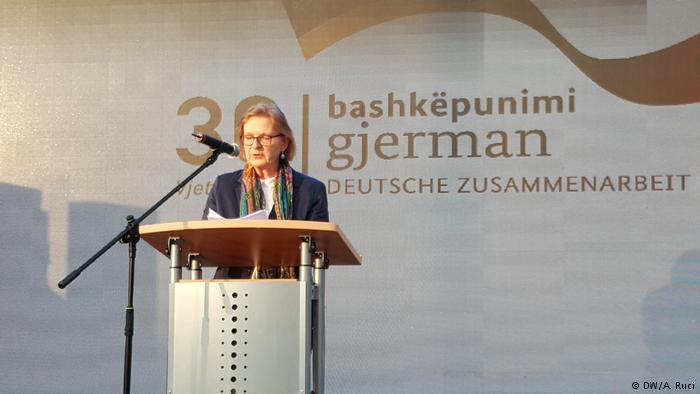
TIRANA, May 28 – Germany is considering new financial support to help Albania diversify its hydro-dependent domestic electricity generation, handle chronic floods and adopt environmentally-friendly transportation systems in addition to traditional energy, water, sewerage and waste management support it has provided in the past three decades.
The new cooperation projects were unveiled last weekend by Susanne Schà¼tz, the German Ambassador to Tirana, as the two countries marked 30 years of development cooperation with a street festival in downtown Tirana.
German-Albanian development cooperation started in 1988 following the reestablishment of diplomatic relations between the two countries at a time when the Berlin Wall had not collapsed yet and Albania was still under a hardline communist regime.
Since the late 1980s, Germany has invested about €1 billion in sustainable development projects in Albania, mainly energy, water supply and sewerage as well as SMEs and vocational training education, becoming the country’s main donor and ranking Albania among the top countries receiving German support compared to the country’s almost 3 million resident population.
“In 30 years of cooperation, Germany and Albania have undertaken projects in many priority sectors and have achieved considerable success. Thanks to this excellent cooperation, living standards for Albanian citizens have considerably improved and Albania is always moving closer to the EU,” says Ambassador Schutz as quoted by Deutsche Welle in the local Albanian service.
An EU candidate country since mid-2014, Albania is hopeful of launching accession talks next June pending the green light by EU leaders at the European Council following positive recommendation by the European Commission, the EU’s executive arm, earlier this year. Uncertainty about the long-awaited opening of accession negotiations persists amid hesitation by some key European powers.
“Germany supports sectors with the biggest needs to improve people’s living standards. It contributes to the sustainable development of the economy and agriculture which is the backbone of the Albanian economy,” said Ambassador Schutz.
Germany is planning to provide additional financing to Albania next autumn and in addition to traditional water, waste management and rural development and agriculture is also considering to help Albania diversify its current wholly hydro-dependent domestic electricity generation by producing solar energy given the country’s favorable geographical position and Mediterranean climate with plenty of sunshine.
Handling climate change effects and chronic floods as well as establishing environmentally friendly transportation systems are also on the agenda during next autumn’s negotiations between the two governments, Deutsche Welle reports.
Europe’s largest economy, Germany has been the top destination for dozens of thousands of ungrounded Albanian asylum-seekers during the past few years, but the wave of Albanian illegal migrants has considerably waned in the past couple of years and many are now legally migrating through employment contracts making use of Germany’s easier procedures for EU aspirant Western Balkan countries.
Germany has emerged as Albania’s second largest trading partner in the past few years, but the level of German foreign direct investment in the country remains low and Albania is still perceived as one of the least attractive South East Europe destinations for German investors, according to a survey by DIHA, the German Association of Industry and Trade in Albania.
Germany has provided about €85 million in development support for 2017 and 2018 in projects focusing on three priority areas including sustainable economic development, energy, and water, sewerage and waste management in a bid to what the German ambassador has earlier said “give the younger generation a perspective to live in their own country and prevent above all the departure of qualified Albanians.”
About 5,000 people escaped Albania in July 1990 ahead of the collapse of the communist regime by seeking asylum at Tirana embassies, mostly at the German embassy, giving the first blow to then communist regime.
The collapse of Albania’s communist regime in 1991 following student protests paved the way to a mass exodus with dozens of thousands leaving the impoverished country to go mainly to neighboring Italy and Greece.