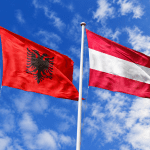
TIRANA, Feb. 19 – Low taxes are not enough when it comes to major Italian investors to consider Albania, their tiny neighbor across the Adriatic, as an investment destination, says Italy’s ambassador to Tirana, Alberto Cutillo.
“Investors insist on a factor considered crucial. They need clear laws. They can also accept higher costs, but also want to know about the investment laws when they develop a business plan and that they must be able to rely on the fact that these laws are clear and stable,” ambassador Cutillo has said in an interview.
“Despite considerable progress in several sectors, there is need to work and create conditions for a safe, fair and steady treatment as time goes by. If the tax rate plays an important role in selecting the investment country, in my opinion, but also the opinion of economic operators this embassy keeps in touch daily, that is no the key element,” he added.
The comments came as a delegation of some 200 Italian businesses led by Italy’s deputy economic development minister Ivan Scalfarotto visited Albania this week under an Italian-government supported initiative favoring the internationalization of Italian companies and serving Italian companies to consolidate their presence in Albania.
“Such a mission which in general targets much larger and geographically distant markets is something which also confirms Italy’s strong confidence in the Albanian market, bringing here its top companies with the target of easing useful investment for both sides,” Ambassador Cutillo told has local Monitor magazine in an interview.
Since 2014, the corporate income tax and the withholding tax on dividends, rents and capital gains have increased by 5 percent to 15 percent, making the tax burden in Albania one of the region’s highest and a key concern for foreign and local investors.
However, corruption and an inefficient judiciary have emerged as top concerns in the past few years as the country has been struggling to attract major foreign direct investors except for two energy-related projects such as TAP and a big hydropower plant that are set to complete their investment stage by the end of this year.
“The challenge for Albania is to be prepared to welcome this extraordinary opportunity. In order to do this, I think it is crucial to improve the current business climate, implement structural reforms in key sectors, and especially in the judiciary, having an efficient and healthy public administration and economy counterparts able to respect the rules and terms anytime,” says Cutillo.
“For a greater economic development of the country, there must be no space for informality, corruption and behavior that runs counter to the law on both sides. Lack of big Italian groups in the country’s strategic sectors such as telecommunication and insurance in some cases is also a result of unfavourable past experience because of phenomena such as corruption, problems with property ownership and widespread perception of an inefficient justice system that does not guarantee legal security and contractual relationship between parties,” he adds.
NATO member and EU candidate Albania is hoping to launch accession talks with the European Commission this year as it has started implementing a long-awaited justice reform, a key requirement by the EU and the foreign business community in the country.
Italy has been Albania’s traditional top trading partner during the past quarter of a century of the country’s transition to democracy and a market economy with trade exchanges hitting a historic high of 325 billion lek (€2.45 billion) and accounting for 36 percent of Albania’s total in 2017, according to state statistical institute, INSTAT.
The host of some 500,000 Albanian migrants since the early 1990s following the collapse of the communist regime, the Albanian migrant community in Italy has played an important part in the country’s development in the past 25 years of transition, contributing through remittances, investment and know-how.
However, when it comes to investment, the pace of Italian investment to Albania has been slowly progressing in the past few years with Italy ranking the fifth largest foreign investor in late 2017 with its FDI stock at €640 million in late 2017, according to Albania’s central bank.
The Italian ambassador says potential industry investors also request dedicated physical infrastructure such as industrial areas with access to key services as electricity, water and public transport for their investment in Albania which he calls a ‘natural partner’ for Italy.
“Albania has a lot of appropriate characteristics for the attraction of foreign investment such as important natural resources, competitive labor costs and taxation and the advantage of its geographical position as a hub to the whole region. The proximity and historical links between our two countries as well as the spread of Italian language and the massive presence of Albanian citizens in Italian territory, in my opinion, makes Italy, Albania’s natural partner, especially to accompany the Albanian economy to the European Union,” says Cutillo.
Albania’s links with Italy date back to ancient Roman times with traces of Roman civilization present in many historic sites. The first wave of Albanians moving to Italy dates back in 1468 after the death of Albania’s national hero Skanderbeg and the country shifting back to Ottoman occupation. Italian architects designed major public buildings and squares in Albania from 1925 to 1943.
A new massive exodus of Albanians to Italy resumed in the early 1990s after more than four decades of isolation under communism, with the Albanian migrant community there now estimated at half a million.
Some 2,000 Italians also live and work in Albania, mainly studying, but also working and in retirement.
PM seeks tourism investment
Addressing an Albania-Italy business forum this week, Prime Minister Edi Rama urged Italian investors to take advantage of the tax incentives in the tourism industry.
“Albania offers many growth potentials and investment opportunities in the energy, oil, mining, agriculture but especially the agri-food sector. But the space where opportunities are also accompanied by very strong demand that exponentially grows each year is that of tourism. There is still a lot to be done in this field as each year the growth in demand exceeds supply and our operators are forced to refuse 5 percent of demand. There are tourists from Central, Northern Europe, but also Italy,” said Rama.
EU companies operating in Albania are dominated by Italian firms whose number in 2016 dropped by a modest 91 to 2,662, but yet providing half of the employment generated by foreign companies in the country, according to Albania’s INSTAT. Italian companies in Albania are mainly involved in the services sector and dominated by micro-enterprises employing up to 4 people. Some 174 Italian companies employ more than 50 people, and operate mainly in the garment and footwear and call center industries, two sectors heavily reliant on demand from the neighboring country across the Adriatic, the Eurozone’s third largest economy.
“Taxes are at very low rates and bureaucracy as well. We have a very advantageous legislation for everybody who comes to invest in tourism. Let’s just bring to mind that whoever invests in a hotel or 4 or 5-star accommodation unit, will operate tax-free for 10 years, they will not pay the construction tax, the property tax, no corporate income tax, but a 6% VAT for 10 years. They can also get the casino and marine licenses for free if they want to,” said Rama.
“We are preparing a program accompanied with incentives on agri-tourism based on the Italian model, especially the model that Italy followed in the early 1990s with its support program deeply changing and exponentially growing agri-tourism,” added Rama.
The stock of Italian FDI in Albania grew to €640 million at the end of the third quarter of 2017, up from about €500 million in early 2014, ranking Italy the fifth largest investor in Albania after Greece, Canada, Switzerland and the Netherlands, according to Albania’s central bank.
Italian legal changes making the supply of services from non-EU countries have already given a blow to the call center industry, employing about 25,000 people, with dozens of companies having closed down and others diversifying in English-language support services and speculative services such as online trading platforms or currency exchange investments.
Italy has been a strategic partner for Albania and one of the main supporters in the country’s Euro-Atlantic road.
Europe’s third largest economy will be heading to general elections on March 4, amid uncertainties over the new government as the economy is slowly picking up.