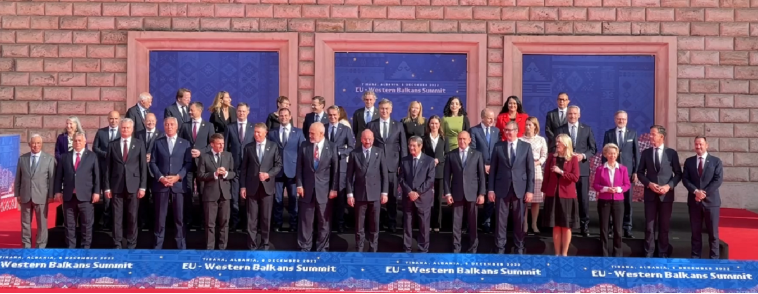
TIRANA, Dec. 6, 2022 – Leaders of 27 EU member states and the six Western Balkan countries came together in Tirana on Tuesday for a summit, the first of its kind to take place in a non-EU country.
The high-level meeting was an opportunity to reaffirm the key importance of the strategic partnership between the EU and the Western Balkans, officials said.
Many Albanians are frustrated with the slow pace of EU integration and were hoping to get news on a more clear timeline on EU membership. There was none.
Instead, there was hope some of the benefits of membership can be extended to candidate countries before formal membership, as talks continue, Albanian officials said.
The top issues discussed included the consequences of the Russian aggression against Ukraine, political and policy engagement between the region and the EU, building resilience against foreign interference, migration and the fight against organized crime.
“It is the first time that we hold a meeting with the Western Balkans, in one of the countries of the region. I am absolutely convinced that the future of our children will be safer and more prosperous with the Western Balkans, within the EU,” said President of the European Council Charles Michel. “And the support that we want to give to the region in relation to the energy crisis and energy difficulties, which are consequences of the Russian aggression in Ukraine, proves our commitment to strengthen integration and cooperation with the Western Balkan region.”
Albanian Prime Minister Edi Rama said that holding the meeting in the Albanian capital “is a strategic turn in the history of the EU of recent years, a turn towards a completely new approach to the Western Balkans.”
The consequences of the Russian aggression in Ukraine will be one of the central topics of the discussions, according to EU officials. The leaders discussed working together in the face of common challenges stemming from Russia’s aggression against Ukraine.
Migration, another problem that the EU continues to face, will also be part of the discussions due to what is known as the “Balkan route,” which has third-country nationals going through the region to reach the other parts of the EU.
The summit, which had some of the continent’s most senior political leaders in attendance, led to entire areas of Tirana being cordoned off as a security measure.
Just outside the security perimeter, Albania’s opposition held a rally led by former Prime Minister Sali Berisha and former President Ilir Meta, who heads the Freedom Party.
They accused the Albanian government of violating European values and hamperting democracy.
The EU has announced an aid package for the entire region to help address the energy crisis, but Albania’s share is not fully clear.
Before the summit started there was good news on lower phone bills for travelers. A roaming agreement was signed, which lowers the tariffs of telephone services between the EU countries and the Western Balkans, starting next year.