TIRANA, Jan. 28 – Tens of thousands of Albanians held a sober rally Friday to remember three people killed in an anti-government demonstration the previous week.
The opposition said, or, better say, vowed to keep up its peaceful anti-government protests.
The Friday two-hour protest to honor the three killed demonstrators ended without violence and incidents.
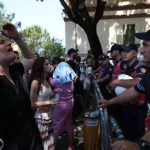
Hundreds of police guarded the main government building in the Tirana city center, fearing a repeat of the deadly clashes that injured more than 150 protesters and security officers.
Police considered the demonstration a security threat, and refused to guarantee protesters’ safety.
However, the march, led by opposition Socialist leader Edi Rama, senior members of his party and relatives of the victims, appeared to be more of a funeral procession than a protest.
As loudspeakers played somber music, protesters laid flowers and lit candles under giant photos of the three dead men outside the government building.
The Socialist Party said some 200,000 people were on the streets. The figure was hard to verify and police gave the other extreme, 6,000.
Family members of victims were at the beginning of the procession, followed by Rama, leaders of other opposing parties and their supporters, some of which came from other cities.
Procession walked down the central boulevard in silence, all the way to the spot where the protesters were killed and laid flowers in front of their photos, set in front of Prime Minister Sali Berisha’s office.
Latest developments in Albania, which caused concern in Brussels and Washington urging American and European officials invite leaders of the Albanian parties to solve disputable issues and differences with a dialogue, avoiding new violence and bloodshed, seemed to be relaxed after the rally.
A big stage with the three pictures of the fatalities had written a word in Albanian and in English _ Justice.
People poured into the downtown area near the government buildings, bringing traffic in central Tirana to a standstill.
After the march demonstrators dispersed under the watchful eye of hundreds of police in anti-riot gear.
No change from the government
Prime Minister Sali Berisha held a press conference at his office only two hours before the official start of the opposition rally.
Berisha has refused to resign, and accused the opposition of attempting to stage a coup d’etat.
He said Albanians’ right to protest would be respected, but warned Rama not to try to overthrow the government, or “he will face consequences he cannot imagine.”
He also repeated the accusations of siding for Prosecutor General Ina Rama saying she lied when said there was no request to open an inquiry for the organizers of Jan. 21 protest.
What was new at his news conference, which last for about 50 minutes and held at his office in a sign of a challenge, was his attack against President Bamir Topi.
Berisha harshly spoke against him and his first reaction Jan. 21 not mentioning the word “violence” at all in his appeal.
Berisha’s words for him were a clear indication that Topi can no longer claim or make any effort of mediation between the political parties.
Berisha’s party, which has said that last week’s violent protests were a bid by Rama to stage a coup, also criticized Friday’s demonstration.
“Today Edi Rama returned to the scene of the crime, he wanted to benefit politically from the deaths,” Democratic Party lawmaker Aldo Bumci said.
The opposition pledges continued protests
The Socialists insist on the resignation of Prime Minister Sali Berisha’s government for alleged corruption, following months of friction over disputed national elections.
After the rally opposition leader and Tirana mayor Edi Rama said they would keep up demonstrations but insisted he rejected all forms of violence.
“We will continue our peaceful protest to call for the end of this regime (of Prime Minister Sali Berisha) and open a new chapter but it will be up to the Albanian people to say who should write this (chapter),” said Rama.
“Early elections are the only way out of this situation” he told reporters, stressing that the “current situation in Albanian is very fragile”.
It was very clear that at the mourning rally Friday there was no room for politics but the opposition said they will continue with demonstrations.
Rama urged the international community to reconsider its relations with the government, pledging to organize more peaceful protests.
“I call on the United States and the European Union to no longer tolerate in this country what they do not tolerate in their own countries, that they do not choose stability without the rule of law at the expense of democracy,” he told a news conference.
What next?!
Well, the opposition held the protest. the government, which had cancelled its own, denounced it. The international community insisted the country should get calm, violence is no solution. And, last but not least, the president also called for a suspension of the protests until the crises is over.
What was done?
Only the government canceled its anti-violence rally.
Nothing else. The opposition held it and it was so peaceful, contrary to what Washington and Brussels, and Topi had asked for.
But did it resolve its requests _ government resignation and early elections?
No!
This crisis has been running ever since the opposition disputed the results from the June 2009 parliamentary election.
Albania, a NATO member since spring 2009, submitted an application for EU membership almost two years ago, but has not even received formal candidate status yet.
Brussels has warned Tirana that the ongoing deadlock is one of the obstacles to progress on the path to EU membership.
So, what next?
The opposition has pledged to continue the protests.
It has also called on the international community to mediate in achieving a solution.
But protests have shown not to be of any use, other than attracting almost all the international media attention (which had brought not only correspondents but also many TV crews and some of them broadcasting it live.)
Berisha has told the opposition they may continue the protests as much and as often as they want, but the next general elections are in 2013.
The Socialists have tested all kind of protests, including the hunger strike.
They attracted the attention of the world only when a protest turned violent.
So what next? Another protest? Yes, but they say peaceful and peaceful protests had resulted in no results.
The violent protest attracted the attention and concern of the international community.
But that does not mean other protests will be violent because that would damage not only the country’s image but especially the opposition’s one. They would not dare do that.
So, again in a blind ally, none seems to be capable of shredding some light into.