TIRANA, Dec. 6 – The end of the summer dominated tourist season and the launch of a renewed nationwide campaign against informality had a negative impact on government revenue last October.
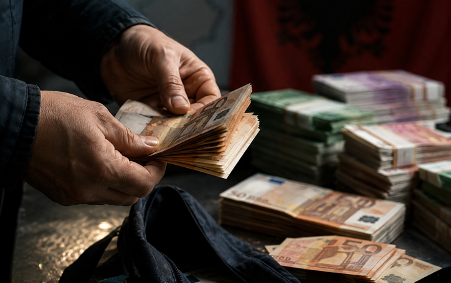
A monthly finance ministry report shows government revenue slightly dropped to 36.3 billion lek (€ 270 mln) last October, down 0.2 percent year-on-year and missed their monthly target by 1.6 percent or 603 million lek (about €4.5 mln).
However, government revenue during the first ten months of this year remain on track to their target, having registered a 6.4 percent increase mainly thanks to a moderate hikes in the key value added tax and excise duties, accounting for about half of the country’s total tax income.
The situation has been boosted by a positive impact some major energy-related investment have had on the country’s economy and the peak tourism season despite uncertainties in the run up to the June 25 general elections.
The performance for the first ten months of this year has also been positively affected by some legal changes disciplining government expenditure during election years in a bid to achieve a long-term debt target of 45 percent of the GDP, compared to a current 70 percent debt level, estimated to be too high for the current stage of Albania’s economic development.
However, the October performance exactly when the Albanian government launched a new nationwide campaign against informality and when the season tourism season was over, hints of problems with public finances at a time a prolonged drought has cost state-run operators relying on domestic hydropower production a staggering €200 million in costly electricity imports since mid-2017.
The tax administration says they imposed penalties on 4,400 businesses, one out of five inspected companies, and closed down 523 businesses not registered with the authorities or not issuing tax receipts during October-November as part of a renewed nationwide campaign on tax evasion, one of the top concerns for foreign and local investors.
The renewed nationwide campaign against tax evasion that the Albanian government has launched will focus on the country ‘big fish’ starting next January when the so-called ‘double standard balance sheets’ and underreported wages that private sector companies commonly employ to avoid paying taxes will be the tax inspectors’ new target.
Prime Minister Edi Rama says nearly half of the country’s 800 largest enterprises underreport wages and double balance sheets is a common phenomenon when it comes to borrowing from banks and reporting to the tax authorities.
Starting April 2018, the VAT threshold on businesses will be lowered to annual turnover of 2 million lek (about €15,000), down from a current 5 million lek (€37,000) while the property tax will be collected on a value-based formula applying a 0.05 percent rate on homes and 0.15 percent on business facilities starting next January, according to the 2018 fiscal package.
The operation is expected to trigger a hike in government revenue, but could have a negative impact on domestic consumption due to a further hike in the tax burden, already one of the region’s highest and being one of the top concerns in the country’s competitiveness compared to other regional economies.
The recent flooding affecting thousands of household in central and southern Albanian areas is also expected to have a negative impact on consumption and the key agriculture sector next year when the Albanian government expects the economy to grow by 4.2 percent, up 0.5 to 0.7 percent compared to what international financial institutions expect for the Albanian economy in 2018 when major energy-related projects such as the Trans Adriatic Pipeline complete their investment stage.
In a bid to bring down public debt to 60 percent of the GDP by 2020, the Albanian government has applied a tight spending policy during this year with public investment at about 6.3 billion lek (€46.6 mln) lower compared to the target set for the first ten months of 2017.
The public investment was also negatively affected by the pre-election freeze in public procurement which lasted for about three months until last September when a new Socialist Party government led by Prime Minister Edi Rama took over.
Opposition concerned over drug proceeds impact on economy
The main opposition Democratic Party says high taxes and more than 300,000 Albanians having left the country in the past few years are leading to 40 businesses a day going bankrupt as a result of inability to survive in an unequal market and informal economy dominated by crime, drugs and corruption proceeds.
“During the past five years in every budget that this government adopted, there were tax hikes for both big and small businesses. Today we pay 1.5 billion euros more in taxes compared to five years ago. Every day some 40 businesses close down because of inability to survive in an unequal market,” said Democratic Party MP Jorida Tabaku this week.
“Today the largest informal economy is that of drugs and it is useless that [finance minister] Ahmetaj sits down with businesses to discuss how informality can be reduced. Today, 1.2 billion euros are injected only as a result of drugs. Economic growth in Albania is currently called into question as the whole of it comes from the construction sector at a time when the Bank of Albania says it remains unknown what the sources of financing it are,” she added.
Cannabis cultivation peaked in 2016 when it registered a 3-fold hike, but the government says the phenomenon has been sporadic this year.