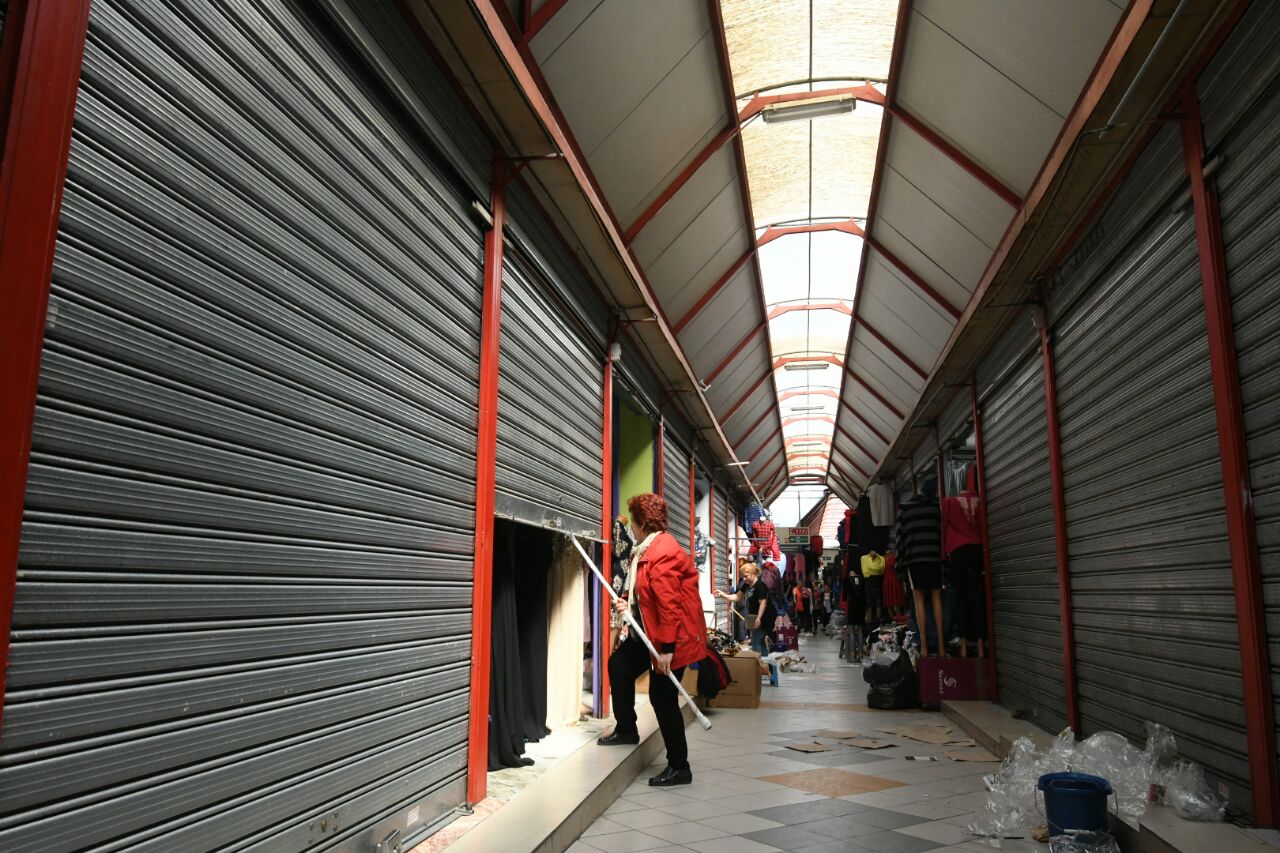
TIRANA, April 10 – Small businesses in Albania’s main regions massively downed shutters for about an hour on Tuesday in protest of legal changes which they say increase their tax burden and place them at bankruptcy risk.
Organized by small business association opposing the inclusion of small businesses in the value added tax system, the protest was supported by the majority of affected businesses in Tirana, Durres, Fier and Shkodra.
The strike action comes following legal changes reducing the annual turnover threshold for a small business to be included in the 20 percent value added tax 2 million lek (about €15,000), down from a previous 5 million lek (€37,000), in a reform aimed at reducing tax evasion but significantly increasing costs for self-employed small business owners who have warned of massive bankruptcies.
The Small and Medium-Sized Business Association, the initiator of the protests, says including small businesses in the VAT system will be an ‘earthquake’ that risks taking to bankruptcy half of small businesses due to unaffordable tax burden.
“The VAT inclusion will increase tax evasion, corruption and selectivity. Everybody will try not to exceed the 2 million lek (€15,000) turnover threshold,” says Albert Nasto, the association’s head.
“The new system favors monopolies, specifically three big companies leading the country’s internal industrial and food markets and destroys the overwhelming majority of businesses,” he adds.
This week’s temporary shutdown of businesses with posters reading “I protest” was the second since the April 1 VAT legal changes became effective.
Business representatives have warned they will escalate their protests and even go on hunger strike unless Prime Minister Edi Rama withdraws from the VAT decision.
The government estimates only about 11,000 businesses will be affected from the VAT legal changes and has assured there will be no fines on wrong reporting with tax authorities until next December as small businesses get used to the new rules.
Nikollaq Neranxi, a businessman who heads the Association for the Protection of Traders and Albania’s Market and led efforts to successfully oppose a sharp hike in penalties following a late 2015 nationwide campaign against tax evasion, hailed Tuesday’s protest as a powerful reaction by traders.
“I strongly hope that [Prime Minister] Edi Rama, [Tirana Mayor] Erion Veliaj and other government officials know how to read the anger of the peoplewho can no longer put up with their bankruptcy policies,” said Neranxi.
“This is the reality in the country they have committed to lead, this is real Albania and not that of their propaganda. High taxes are taking fair businesses to bankruptcy every day. We shouldn’t tolerate that,” he added.
Opposition Democratic Party and Socialist Movement for Integration joined the protests as part of their campaign calling on citizens for civil disobedience, an action that was launched after a March 31 protest opposing tolls on the highway linking Albania to Kosovo tuned violent leading to the arrest of some 23 protestors.
However, not all business businesses joined the protest and there were cities in the southern regions of Gjirokastra and Vlora that boycotted the protest.
Main opposition Democratic Party leader Lulzim Basha says including small businesses in the VAT system is only related to favoring oligarchs and preparing the ground for a VAT concession.
“Small businesses proved all over the country that they will not keep silent against arbitrariness and will not allow that their businesses and efforts are robbed by Edi Rama and his clients,” said Basha.
“Including small businesses in VAT is a blow to businesses, the economy and Albania. Small businesses are the driver of every economy and society, they create employment, bring development and welfare,” he added.
However, finance minister Arben Ahmetaj says that the legal changes’ focus is big businesses involved in tax evasion and operating as small businesses.
“We don’t target making small businesses a driver of income. The focus is big businesses accounting for 99 percent of VAT,” says Ahmetaj, adding that the government collects only 1 billion lek (€7.7 million) in VAT from small businesses.
“The opposition lies when they say that costs and prices will increase. There will be no fines for wrong reporting until December 31, 2018 for small businesses. Go on with your jobs and don’t down your shutters for even 5 minutes to keep alive a sick political ego that is not related to you,” Ahmetaj told reporters on Tuesday.
Tax authorities have earlier said business costs will be minimal as small businesses that will be included in the VAT system will only pay the VAT difference for the products they trade and continue reporting quarterly with tax authorities.
However, when it comes to the services sector such as small coffee bars and fast food restaurants, the 20 percent VAT means the costs will either be transferred to customers, as has happened with the price hike in the past few years, or business owners will have to handle with lower profits.
Albania’s tax administration says that more than 3,800 businesses, mainly small ones and operating in key regions of Tirana and Durres switched to passive status in the first three months of this year, ahead of the inclusion of more than 11,000 businesses nationwide in the 20 percent VAT system.
At 42 a day, the number of closures registered a 50 percent hike compared to the first three months of last year and more than double compared to the first quarter closures in the previous years, according to Albania’s tax administration.
The sharp hike in business closures comes amid an increase in the tax burden, sluggish consumption and fierce competition by supermarket chains and shopping centers, already in VAT system.
Economy experts have also warned applying VAT on small businesses could have a negative impact on the economy considering their huge impact on private sector employment.
Albania has some 160,000 businesses, 90 percent of which small family-run ones employing up to four people. About 90,000 businesses with an annual turnover of more than 5 million lek (€37,000) are already in the VAT system.
The finance ministry has earlier noted some 70,000 small businesses will continue to remain out of the VAT system because of their low turnover.
Levied at a fixed 20 percent rate on almost all goods and services, VAT is the key tax the Albanian government collects, accounting for about a third of total revenue.
High levels of informality and unfair competition is one of the top concerns for local and foreign businesses operating in Albania, along with high perceived corruption, and an inefficient judiciary.