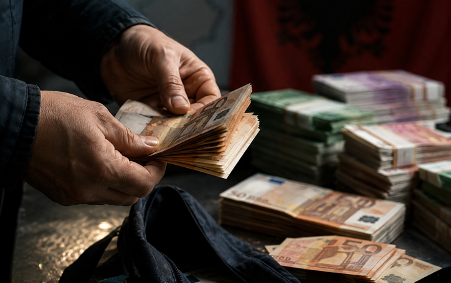
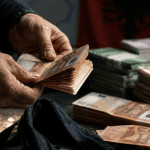
TIRANA, Aug. 29 – Currency outside banks has seen a sharp increase in the past four years in Albania as declining interest rates have made traditional bank deposits an unfavourable option to invest while credit has struggled to recover amid high levels of non-performing loans keeping lending standards tight.
With investment in the past few years mainly triggered by some foreign companies involved in some major energy-related projects, the hike in currency outside banks has also worried commercial banks operating in the country who have recently identified a rise in informal borrowing by both businesses and households as a key concern for poor demand for new loans.
Central bank data shows currency outside depository corporations peaked to 250 billion lek (€1.87 billion) in June 2017 when Albania held general elections, up 21.3 billion lek (€159 million) or 9.3 percent compared to mid-2016.
The hike in currency outside banks started in late 2008 at the outbreak of the global financial crisis when Albanian savers massively withdrew deposits from Greek-owned banks in the country in panic over the critical situation of their parent banks. The situation later stabilized following some legal changes making subsidiaries of foreign owned banks in Albania operate as independent from their parent banks.
The new hike began in 2014 when currency outside banks rose by about 18.5 billion lek (€138 million) to 217.6 billion lek (€1.62 billion) before reaching 230 billion lek (€1.71 billion) in 2015 and climbing to 249 billion lek (€1.86 billion) at the end of 2016, according to central bank data. The amount represents about a quarter of total deposits in the country’s banking system and about half of total credit to the Albanian economy, unveiling high levels of cash use in the Albanian economy and informality rates, estimated at about 30 percent of the country’s 11 billion Euro GDP.
The consecutive cuts to the key interest since September 2011 when the key rate was cut to 5 percent before undergoing another 13 consecutive 0.25 percent slashes to reach a historic low of 1.25 percent have considerably discouraged investment in bank deposits, pushing savers to seek alternative investments such as the emerging investment funds and even risky investments in online trading platforms, only few of which are licensed to offer services in Albania.
Both deposits and lending have been struggling to recover in the past few years as the Albanian economy has been growing between 1 to 3 percent, compared to a pre-crisis decade of 6 percent annually, which experts estimate is the ideal growth rate to bring welfare to one of Europe’s poorest economies.
Savers withdrew about 25.4 billion lek (€190 mln) in bank deposits in the first six months of this year and increased investments in the more profitable investment funds by about 6.4 billion lek (€48 mln) compared to December 2016.
Investment funds, heavily investing in government securities, have attracted more than 31,000 investors since their launch in early 2012, with their net assets estimated at about 72 billion lek (€537 mln) at the end of June 2017, according to the Financial Supervisory Authority.
Average loan rates in the national currency slightly rose to 7.5 percent in June 2017 and were up to 4.5 percent for loans denominated in Europe’s single currency. Meanwhile, deposit rates stand close to zero, reflecting historic low key interest rates applied by the Albanian and European central banks.
Despite the high level of non-performing loans, currently at a 6-year low of 15.6 percent, down from a record high of 25 percent in mid-2014, the Albanian banking system has been well-capitalized, liquid and profitable during the past eight years.