Tirana Times
TIRANA, Oct. 11 – A second former political prisoner in Albania was hospitalized Wednesday after deliberately setting himself on fire. The first did the same act on Monday.
Gjergj Ndreca, 51, set himself ablaze on Monday after pouring petrol on himself.
Another colleague tried to help and was also injured slightly. Ndreca was sent to the hospital and after two days doctors said he was not in life-threatening condition.
Police arrested Perikli Shqevi, another hunger striker who allegedly set Ndreca on fire after he failed to do that with his match. Ndreca declared after two days publicly that he had set himself ablaze in an apparent move to save his friend from the arrest.
Former political prisoners said through their coordinator Skender Tufa they considered Shqevi’s arrest as a political move and called on authorities to release him.
But Prime Minister Sali Berisha angrily called him Wednesday a “criminal.”
Two days later, his close friend Lirak Bejko, 47, also made the same act. Bejko suffered more severe burns on Wednesday as people were not so attentive. Television footage showed Bejko pouring petrol over his body and setting himself on fire before policemen intervene.
Some 20 former communist-era dissidents began a hunger strike Sep. 22 saying the government has failed to pay them agreed compensation.
The former political prisoners have vowed to burn each other in sacrifice for their cause if the government ignored them. And they have threatened they will do that also in front of the government and parliament buildings. They have threatened there is a hidden compiled list of persons and moves they will do.
But Berisha exploited the news conference he was holding together with EC Ambassador to Tirana Ettore Sequi on the announcement of the status candidate for the country, to respond to the strike.
Berisha said he was deeply concerned for the injured and wished them quick recovery. He said the first thing he did when heard of Bejko’s self-immolation act Wednesday was to urge his health minister take good care of him.
Berisha denied claims that he was ignoring the plight of former political prisoners, arguing that his conservative government had taken several initiatives to compensate them. He said that his governments, over the years since 1992 had paid some $100 million to the former political persecuted and that is done in cash and also in privatization vouchers. That has helped them start or buy 2,763 businesses or objects across the country. He specifically mentioned that Ndreca himself had bought a flour factory in a northern town and had also taken bank credits, which he had not been able to pay back and that became the reason that the factory was confiscated. He also said more than 2,000 apartments were spread among those families. Thousands of scholarships were offered to the children of these families. Berisha also said that the second installment of the financial compensation has already started.
The next day, on Thursday Berisha directly accused the opposition Socialists that the group of the participants in the hunger strike “is controlled by you.” He also accused the Socialist lawmakers of “taking bottles of petrol to them.”
“You, who organized and took them into the strike, go and take them out. Or pay your salaries, become human persons and I will congratulate you,” Berisha said at the parliament.
Berisha’s party, the governing Democratic Party of Albania, was the first opposition party to form after the communist regime opened up the political sphere. They gained a massive following as a result of their promise compensates political prisoners, a promise which they have yet to keep 22 years later.
Berisha added that police officers in charge of monitoring the strikers would be held accountable for Wednesday’s incident, but did not elaborate further.
Police say that overnight they have stepped up efforts to monitor the men on hunger strike, and have seized flammable materials from the site in the Albanian capital of Tirana.
The protesters want the government to honor an earlier promise to pay victims of the former regime 2,000 leks ($18.32; 14.05) for each day they were imprisoned. The Albanian government is led by an anti-communist says it has already started overcome the payment delays. About 100,000 Albanians were executed, imprisoned or sent to labor camps by the communist regime between 1944 and 1990.
The hunger strikers in the capital Tirana accuse the government of failing to deliver that entitlement.
Skender Tufa, head of the association of former political prisoners, said the two self-immolations were “desperate acts” by people he described as “walking corpses, deprived of any dignity”.
They have pledged to hold regular protests in front of the parliament every week and also other acts of protest.
The international community seems to be in a very bad position on how to behave in such moments.
There have been visits from western ambassadors, the U.S. and EU ones to the site of the strike. They have called on the protesters not to refer to such acts of self-immolation though acknowledging their right of protest. At the same time they have called on the government to negotiate with the protesters.
Strangely there has not been a single government official sent to the strikers to talk with them.
On Wednesday the Delegation of the European Union issued a statement on the strike expressing “compassion and concern following the serious incidents which took place during the hunger strike by a group of former persecuted persons and political prisoners on 8 and 10 October.” It also called upon the parties not to exploit this painful human situation for political ends. “The EU Delegation takes note of the existence of the compensation plan provided for in the 2007 law and appeals for dialogue to address the individual cases which would not be resolved by this plan.”
US Ambassador Alexander Arvizu has made two visits at the strike and has insisted that self-immolation acts are not the answer or the solution of the problem.
Well, political parties, and basically the main opposition Socialist party have tried to stay aside and not get engulfed in such a strike. There have been casual but not regular reactions from them on the strike. There have been lines of reactions from different politicians among them or their leader Edi Rama.
Berisha openly considered the strike as a politically motivated one though he did not put the finger to the opposition Socialists.
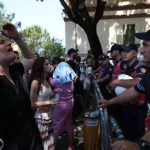
In fact there have been the other rightist groupings, the new ones like the New Democratic Spirit Party and the Red-and-Black Alliance that have been loudly asking the parliament hold a special session on them or accompanying them in the protests, like that on Thursday.
Now that the hunger strike has r4ecieved the attention in the country and outside, the former political prisoners have threatened with other acts and regular protests. But there seems no solution and they are not that clear if their strike will end if, say, the government pays all the compensation to them. Or what? Because it is very clear that the government cannot do that. It has no money.
Despite the repeated calls from the former political prisoners that the strike is not political but economical, there is the fear that the strike will be potentially exploited for political purposes.
And that would likely mean no fast or clear solution to the former prisoners.