The U.S Department of State expressed concerns over pervasive corruption, independence of the judiciary, restrictions on freedom of expressions and the press, impunity, and failure to enforce child labour laws in Albania. In a detailed report of 28 pages, the State Department’s analyzed the annual performance of Albania on Human Rights Practices, where it concluded that “corruption was pervasive in all branches of government, and officials frequently engaged in corruption practices with impunity,” citing as an example the inclusion in the 2019 mayoral candidate elections of an individual previously convicted of drug trafficking. While the report acknowledges that the law provides criminal penalties for corruption by public officials, and also prohibits individuals with criminal convictions from serving as mayors, parliamentarians, or in government or state positions, it says also that “the government did not implement the law effectively.”
Some of the challenges in fighting corruption remains the “limited resources, investigative leaks, real and perceived political pressure, and a haphazard reassignment system.” The report gives a summary of the vetting process, whereas of November 2020, 125 judges and prosecutors were dismissed, 103 confirmed, while 48 others had resigned rather than undergo vetting. Between January and September, the prosecutor general’s office registered 20 new corruption cases and dismissed seven. The Department of Administration, Transparency, and Anticorruption investigated 29 cases, resulting in 115 administrative and 153 disciplinary measures. The December 2019 establishment of the Special Prosecution Office on Corruption and Organized Crime, one of two entities constituting the Special Structure on Anticorruption and Organized Crime, resulted in 327 new criminal investigations and 65 requests sent to court as of November. While prosecutors made significant progress in pursuing low-level public corruption cases, including corrupt prosecutors and judges, prosecution of higher-level suspects remained rare due to investigators’ fear of retribution, a lack of resources, and corruption within the judiciary itself. In September the appellate court remanded the conviction of a former interior minister for retrial. In November the Special Prosecution Office filed charges against a former prosecutor general for hiding assets and seized several of those assets in December. The High Inspectorate reported that through August, it had referred 60 new cases for prosecution, involving two Assembly members, one deputy minister, three mayors, 32 general directors of public agencies, one head of public procurement at
customs, and five heads of regional customs departments. Charges included refusing to declare assets, hiding assets, or falsifying asset declarations; money laundering; tax evasion; falsification of documents; and general corruption.
Of particular concern remains also the issue of vote-buying. The document gives space to the Organization for Security and Cooperation in Europe report about the last 2017 parliamentary elections, according to which they “respected fundamental freedoms but were marred by allegations of vote buying and pressure on voters.” The report took into analysis also the local elections of 2019, where it gave space to the conclusion of the OSCE, by saying that “the organization identified credible allegations of vote buying as well as pressure on voters from both the ruling party and opposition parties.”
Police corruption continues to be a problem, where thousands of complaints have been received through the anticorruption hotline; these complaints alleged “a failure to act, violation of standard operating procedures, abuse of office, arbitrary action, police bias, unfair fines, and passive corruption.” Moreover, personal associations, political or criminal connections, deficient infrastructure, lack of equipment, and inadequate supervision often influenced law enforcement, suggests the report.
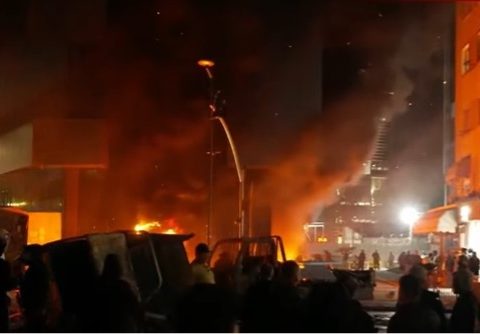
Another issue of concern remains the violence against the protesters, which has been raised in the previous months by numeral international organizations and institutions. “The ombudsman reported that police used excessive force when arresting protesters who took part in rallies, mainly in Tirana. The ombudsman received several complaints of excessive use of force and injuries from tear gas during those protests and referred one case for prosecution,” suggests the report. In the category “Arbitrary Deprivation of Life and Other Unlawful or Politically Motivated Killings,” the report mentions the episode in which the police shot and killed a man in Tirana who was violating a COVID-19 curfew.
While the constitution and law prohibit tortures or other cruel, inhuman or degrading treatment or punishment, the report says that there are allegations that police and prison guards sometimes beat and abused suspects and prisoners, usually in police stations. In 2019 the Council of Europe’s Committee for the Prevention of Torture reported receiving a significant number of allegations of mistreatment of criminal suspects by police officers during some visits in 2018 in various Albanian prisons. Most allegations involved use of excessive force at the time of or immediately following apprehension. Several allegations also concerned mistreatment during transport or initial questioning, apparently to extract a confession, obtain information, or as punishment.