Ali Oseku was the artist who never agreed with the creative method of socialist realism
Tirana Times
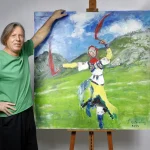
TIRANA, May 10 – An exhibition featuring paintings by veteran Tirana-based painter Ali Oseku opened on Thursday afternoon at the National Arts Gallery. The exhibition by the 67-year-old painter who was imprisoned to four years during the early 70s because of his modernist trends comes immediately after a one-month display of works by late Kosovo painter Muslim Mulliqi. The new exhibition brings a number of oil on canvass paintings created by the artist during the past two years and will remain open until the end of May.
Ali Oseku is one of the examples who represents an essential moment for evaluating contemporary art in Albania, where the efforts for a new art, were mostly evidenced during the second half of the last century. Ali Oseku was the artist who never agreed with the creative method of socialist realism, curators of his exhibitions say.
His paintings today are a continuity of the entirety of elements which characterized his modernism then. “In Ali Oseku’s paintings there are no figurations. At times one distinguishes a mountain, and at times it seems we notice the shape of a crater. In another one there is a vertiginous vortex that it reminds you of the genesis of the world.”
It is the slamming of the prison door closing behind his back, with him who doesn’t know where to go, and what to do. In front of him it was misty and it was difficult to see ahead.
In the early 70’s, late dictator Enver Hoxha personally launched the campaign against modernism in Albanian music and art that victimized Oseku.
After four years at Spac, the painter was released, but again condemned to manual labor at the Enver Hoxha Metallurgical Conglomerate at Elbasan, a heavily polluted city 35 miles southeast of the capital, on the Shkumbin River
Oseku’s exhibition follows earlier shows by Gazmend Leka, the winner of the Onufri 2010 visual arts competition, which remained open until March 27. The exhibition featured some 40 paintings mainly in the oil on canvass technique.
The first half of 2011 agenda at the National Arts Gallery will close with a photo exhibition by Martin Parr which is brought to Albania in cooperation with the British Council in Tirana.
Apart from temporary exhibitions, the National Arts Gallery boasts a rich permanent collection. In seven halls, the gallery displays the history of Albanian painting, dating from the end of the 19th century, a period which marks the beginning of secular painting in Albania, to nowadays.