
This is not the first international exhibition of the Albanian poet, translator and artist Ervin Hatibi, who has previously opened exhibitions with his “pop-scrolls” in Paris, Ferrara and Skopje. He is well known to the Albanian public. His exhibition was welcomed there was considerable interest of Turkish art lovers. This exhibition of Hatibi was open until 21 March. “During my childhood, middle of the seventies’ to the beginning of the eighties’ my secret work in Tirana of provincial paranoia of Stalinist isolation, were the labyrinths of the alphabet,” Hatibi said to an Albanian daily. : In the wooden trunk in the cellar there were piles of musty old documents stacked one on top of the other that had belonged to my Grandfather, with his flowing and elegant signature in Arabic, my pens and pencils and toys were milimetric alongside Chinese hieroglyphics, whilst the Russian letters would pop up on the tool boxes of my father or on the covers of the books of his childhood,” says the author. To Hatibi, Arabic was the sign of his Grandfather (born under the shadow of the Sublime Porte), Russian the sign of his father (Pioneer of the Global Soviet), and his Chinese which was the unplanned child of Mao. “The three of us were orphans of three enormous but divorced empires, which had left inscribed on the back of my country, their alphabets,” Hatibi adds.
Why should I not paint scrolls? “I took the decision once to stop drawing scrolls because I thought there were too many. Then I remembered that the Ottoman Porte never tired for six hundred years in producing and distributing in the most maniacal fashion, endless numbers of hand written scrolls, and here I was wondering if I should stop painting scrolls after five years. I realized that I could not let the world survive without scrolls-who knows perhaps the world had become fond of them.”
Ervin Hatibi, in Istanbul, paints scrolls

Change font size:
Recommended Articles

Latest from Culture
Gazmend Freitag Named “Painter of the Year 2025” in Gjirokastër
Change font size: - + Reset Kosovo-born, Austria-based artist honored for a career that has turned memory, displacement and identity into a bridge between cultures Tirana Times, September 29, 2026 – Kosovo-born Albanian
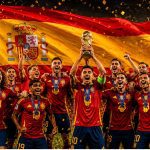
Spain Rules the World Again
Change font size: - + Reset Spain clinches second FIFA World Cup title as Europe continues its dominance on football’s biggest stage By Gautam Karve, Editor-in-Chief, World Media Organization Tirana Times, July
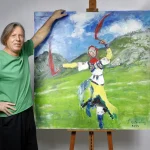
K’cimi dancing of Tropojë – Gazmend Freitag
Change font size: - + Reset by Monika Grill Tirana Times, July 11, 2026 – “K’cimi i Tropoja” – the dance that endured over centuries and kept the Albanian identity alive, has
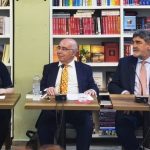
In Search of Albania’s Soul: Manuel Montobbio Returns to Tirana Through Literature
Change font size: - + Reset Tirana Times, July 02, 2026. The Albanian Institute for International Studies and Tirana Times book house hosted a special literary evening in Tirana with Ambassador Manuel Montobbio, diplomat, writer, poet

This Auditorium Comes With a Price Tag -Corruption in Albania’s Public Universities
Change font size: - + Reset Corruption remains one of Albania’s most stubborn obstacles toward development and its dream for European integration. Although the country marked its biggest historical leap in Transparency