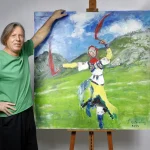
Paintings of different techniques are featuring in a special exhibition on St. Valentine’s Day by renowned Helidon Haliti who after 22 years has returned to his hometown of Lushnja, southwestern Albania. The painter is feturing 35 paintings created in 2011 and 2012 in the oil on canvass and watercolour techniques. Portraits and landscapes featured in the exhbiition belong to areas in his hometown and neighbouring surroundings.
Last August, Helidon Haliti displayed his first solo exhibition at the National Arts Gallery. His “Personal” exhibition is both a challenge and early dream for the 44-year old painter.The exhibition has been conceived on a poem written by his father who was sentenced to forced labour during the communist regime. Heldon Haliti belongs to the new generation of contemporary Albanian students who graduated during the early 90s from the Academy of Fine Arts in Tirana. He has been present in numerous exhibitions in Albania and abroad, especially in Greece, where he currently lives and works. Haliti creates his works in different genres and techniques. The drama of emigration and the spiritual distemper he is still suffering as an emigrant are reflected in several painting cycles, such as “The Legs”, “The pigeon”, “The cage”, “Eva and Adam”, etc.
Helidon Haliti’s paintings make a man to stop in front of them, maybe not knowing his name, age or birthplace, says Albanian internationally renowned writer Ismail Kadare. This is the first unrepeated act of art. An artist owning this talent, let’s say, has the key of the enigma. We know these scenes; we have met them on the world we are living, or deep in our consciousness.
“The style of Helidon Haliti’s paintings is that of controlled surrealism which can also be called magical realism. It is inspired by topics of national roots as well as those of personalized and intimate mythology. However, the painter is careful not to fall prey to the pantheism and folkorism preferring illustration from a child’s innocent point of view,” says Kosovo art critic Shkelzen Maliqi.