Tirana Times has the pleasure to offer an artistic review of the main events that graced the Albanian world in 2013
January
Record 1.7 million people visit Skanderbeg’s arms
After a special display of 45 days and drawing a record 1.7 million visitors, an unprecedented figure in the history of exhibitions, Skanderbeg’s arms are back in Austria. The Albanian national hero’s sword and helmet were displayed at the National Museum of History for one and a half months as part of events commemorating the country’s 100th anniversary of independence, arriving home for the first time after more than five centuries.
“The exhibition was visited by 1.7 million people, an unprecedented figure in the history of Albania’s museums. On November 28, the 100th anniversary of Albania’s independence, some 400,000 people visited the national hero’s arms,” said Luan Malltezi, the museum’s director. The sword and helmet of Scanderbeg, Albania’s 15th century national hero who for more than two decades kept the Ottoman army away from Albania and the region, came home on November 22 from Vienna.
Albanians’ Everest climb in an exhibition
More than 100 pictures featuring the courageous endeavour of an Albanian team of climbers to Mount Everest last year were shown in an exhibition at the FAP gallery of the National Arts Gallery in Tirana.
On May 25, 2012, an Albanian team of climbers became the first to raise the national flag on the summit of Mount Everest, the world’s highest as an initiative commemorating the 100th anniversary of Albania’s independence. The Albanian climbers had already climbed the Mont Blanc and Kilimanajaro summits before deciding to take the risk of climbing the world’s highest peak at 8,848 metres above the sea level located in the Himalayas on the Nepal-China (Tibet) border.
February
Puccini’s Tosca, a premiere at Opera House
Puccini’s Tosca, an opera in three acts containing some of the best-known lyrical arias by the renowned early 20th century Italian composer came as a premiere at the National Theatre of Opera and Ballet which this year marked its 60th anniversary. Directed by Albania’s Nikolin Gurakuqi, the opera brought on stage Eva Golemi and Marjana Leka, two of Albania’s best sopranos. Italian tenor Leonardo Gramegna performed in the opera. The chorus of the Opera House and pupils of the “Jordan Misja” arts school were accompanied by the symphonic orchestra.
Albania celebrates Francophone Spring
Tirana, Vlora, Berat, Pogradec, Saranda, Lezha, Permet and Gjirokastra were the eight Albanian cities hosting events celebrating Francophone Spring for two weeks. Events kicked off in Tirana with the opening of two photo exhibitions at the Theatre of Comedy and the Murat Toptani pedestrian area. The official programme brought a wide range of events such as concerts, exhibitions, conferences and debates on French literature and culture. Albania has been a full member of the International Organization of Francophonie since 2006.
March
Oedipus the King
Ancient Greek tragedy Oedipus the King brought together the Albanian and Kosovo national theatres in the first premiere in Tirana for the 2013 season. The tragedy directed by Kosovo director Ilir Bokshi made its premiere on March 8, the International Women’s Day. Helidon Fino, Yllka Mujo, Neritan Licaj and Ema Andrea were given the key roles in the drama.
Directed by Kosovo’s Ilir Bokshi, the tragedy came as cooperation between the Albanian and Kosovo national theatres, staging for three consecutive evenings. Kristaq Skrami, the director of the National Theatre described Bokshi as one of the most creative directors of the younger generation, appreciated not only in the pan-Albanian spaces.
La Traviata in a ballet
Following the successful stage of Puccini’s Tosca, Giuseppe Verdi’s La Traviata was the new premiere at the National Theatre of Opera and Ballet. The opera coming in a ballet was staged as Albanian-Italian cooperation on the 200th birth anniversary of Giuseppe Verdi, Italy’s most famous composer. “In Albania, La Traviata has seen six productions with the absolute premiere in 1956. This is a commemorative production which is dedicated to the performers of the Violetta in the 60-year history of the National Theatre of Opera and Ballet,” says director Zhani Ciko. The National Theatre of Opera and Ballet offered a choreographic reinterpretation of Verdi’s most famous operas to honor twelve performers of Violetta during its sixty-year history as an Opera House.
Concrete mushroom transformed into memorial
A concrete mushroom – symbol of Albania’s 45-year paranoid isolation, some items from the notorious Spac prison of the former politically persecuted, and some pieces of the Berlin Wall – whose collapse marked the end of communism in Eastern Europe have made up an installation dedicated to Albania’s almost five decades of isolation under communism. The installation named “Post Bllok” is an initiative of writer and analyst Fatos Lubonja who spent 17 years in the Spac labour camp as a political prisoner and artist Ardian Isufi. Placed just at the entry of the former Bllok area, home to the country’s former communist elite and just in front of the central boulevard and the former central committee, the memorial features Albania’s suppression of freedoms and rights, prison and torture under late dictator Enver Hoxha.
While the bunker has been at the construction site since decades, the concrete poles were taken from the Spac prison in the northern Mat district and the pieces of the Berlin wall are a present to the Municipality of Tirana, making one of the few memorials dedicated to communism in Albania.
‘Ali Pascha von Janina’
Ali Pascha von Janina” a single-act opera by German composer Gustav Albert Lortzing dedicated to the early 19th century Albanian ruler of Ioannina came as a premiere at the Opera House in Tirana. Under the baton of Opera House director, Maestro Zhani Ciko, and directed by France Patrizia Panton, the Ali Pasha opera made its comeback in an Albanian stage after almost two centuries following its world premiere in Germany. Albanian-born, Italy based baritone Gezim Myshketa was invited to perform the lead role of Ali Pasha in the opera. The opera focuses on Ali Pasha and a French captain who falls in love with an Albanian girl housed in Pasha’s harem.
April
‘Small territories of freedom’
“Small territories of Freedom” brought back internationally renowned Albanian painter Alush Shima in an exhibition focusing on his early career in the early 1970s during the communist regime when he secretly painted what would have cost him his life. The exhibition at the National Gallery of Arts in Tirana was curated by Italy’s Arturo Calzona and Vanja Strukelj who have focused in the early years of the artist’s work from 1968 to 1973, which they consider of double importance. “Firstly, during those years the Albanian culture experienced for a short time a relative freedom to experiment. Secondly, these are the years of Shima’s artistic shaping,” says the National Gallery.
Durres amphitheatre, an endangered site
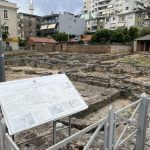
The Roman amphitheatre of Durres, one of the biggest in the Balkan region, has been shortlisted by leading European heritage organisation Europa Nostra for the ‘The 7 Most Endangered’ programme. The announcement came on the eve of the International Day for Monuments and Sites on April 17 when an international advisory panel composed of eminent experts selected 14 monuments and sites as threatened landmarks among 40 nominations submitted by civil society organisations and public bodies from 21 countries. “The discovery of this magnificent early 2nd century amphitheatre, which remained unknown to the world until the 1960’s, put the ancient city of Durr쳠back on the map of historic sites in Europe. It also poses a major challenge to ensure a successful integration of the site into the urban fabric and local community of Durr쳬” says Europa Nostra.
AIIS books promote the history of Brazil
Brazil is highly popular in Albania for its football, Carnival festivals and Samba dances, but few people have in-depth knowledge of its history, society and culture. Two books on Brazil’s history, “The Roots of Brazil” by Sergio Buarque de Holanda and “A Concise History of Brazil” by Boris Fausto are now available also in Albanian providing readers with two of Brazil’s best historical books translated into several languages. Promoted in launch ceremony at the Albanian Ministry of Culture on April 10, 2013, the publications by the Albanian Institute for International Studies (AIIS) were supported by Brazilian Embassy in Tirana
May
‘Art. 1″LGBT rights’
“Art. 1,” a touring exhibition from some of Sweden’s most prominent museums with accounts and reflections of the history and contemporary life of the LGBT persons arrived in Albania, considered one of Europe’s most homophobic countries. The exhibition which opened at the National Museum of History in Tirana ahead of the International Day Against Homophobia and Transphobia (IDAHO) on May 17 was an effort to break taboos about homophobia among Albanians by highlighting the LGBT history.
Taking the first article of the Universal Declaration of Human Rights as its point of departure, Art. 1 (Article 1) wants to take a small step in the long struggle to secure equal rights for all mankind.
Sabri Godo immortalized in marble bust
One and a half years after his death, historian and writer Sabri Godo, also one of the prominent figures of Albania’s political scene in the post 1990s known for his voice of reason and moderation, has been immortalized in a bust in the Tirana city centre. Located in the Murat Toptani pedestrian promenade next to the Parliament and Academy of Science buildings, the marble bust created by Italian sculptor Paolo Viaggi, was inaugurated on May 10 in a ceremony bringing together politicians, diplomats and family members.
Turkey’s ‘Times and Places’
“Times and Places: Istanbul.” The special exhibition displayed at the National Art Gallery in Tirana is an art collection of Turkey’s central bank displaying modern Turkish painting from the early 20th century to present day. The works have a common theme, the city of Istanbul with its landscapes and seascapes, which, according to the curator of the exhibition Prof. Dr. Kiymet Giray, has always inspired the Turkish artists. This exhibition apart from showing Istanbul as seen through the eyes of Turkish artists is at the same time an introduction in the history of painting of Turkey, considering that the artists in this exhibition are some of the most important names of modern Turkish art history.
‘A Midsummer Night’s Dream’
Shakespeare’s “A Midsummer Night’s Dream” made its premiere on May 31 in a special performance by a cast of Albanian actors and renowned American John Blondell as director. With costume and set design by Macedonia’s Blagoj MIcevski and music by Kosovo’s Trimor Dhomi, the comedy starred an Albania cast of young actors including Ervin Bejleri, Klea Konomi, Vasjan Lami. Directed by United States’ John Blondell, “A Midsummer Night’s Dream” was the great premiere the Albanian National Theatre plans to stage in the first half of this year.
“It is the first experience for me to stage Shakespeare in another country in the national language. The reason is because we are searching for an unknown land, or something new and fresh,”
says Blondell. The American director’s cooperation with the Albanian National Theatre emerged last year when Albania participated in London’s Globe to Globe festival with part II of Shakespeare’s Henry VI. Blondell was the director of the Macedonian theatre performing Henry VI’s part III.
June
‘Europa’ magazine launches first issue
Offering a critical approach to Albania’s European Union, but also analysis on current issues and arts and culture, the “Europa” magazine launched its first issue in June 2013. A publication of the Albanian Institute for International Studies (AIIS), a leading think-tank focused on integration and security issues, the “Europa” magazine has been perceived as a platform promoting an all-inclusive debate on EU integration issues, offering readers analysis and trends on Albania and Europe and dedicating considerable space to art and culture promoting the best Albanian and European values. The “Europa” magazine will specifically generate a critical approach over the European integration process, and ideas, concepts and paths that must be followed to prepare Albania for European Union membership, AIIS experts say.
Albanian singer becomes ‘The Voice of Italy’
Everybody felt proud of being Albanian when 19-year-old Elhaida Dani became the ‘Voice of Italy’ in a talent show where she emerged as favourite since its beginning. The talented singer from Shkodra, northern Albania, overcame all prejudice about Albanians in Italy, where more than 400,000 migrants, live and work, by winning the support of the Italian public which applauded and voted her since the beginning of the Voice of Italy’s first edition last March. She won by a convincing 72 percent of the vote in the final beating an Italian male contender in the final. “Wonderful. She sings beautifully, and is able to sing every musical genre, she has got the voice and magic feeling. When you have such talent, it is not important which country you belong to,” said The Voice of Italy coach Riccardo Coccante, one of Italy’s most famous singers and composers.
July
Pre硚ogaj’s new poetry book
“I believe this is my best book, it is part of the only book the poet writes during his lifetime,” said poet Pre硚ogaj at the launch ceremony of his latest poetry book called “Fundi, nje femijeri tjeter” (The end, another childhood). Poet, prose writer and politician Pre硚ogaj described it as his poetic diary at a time when he was actively engaged in the country’s political life.
Jerina Zaloshnja, the director of the Tirana Times R&Z publishing house described Zogaj’s book a special event for the vulgar reality Albania is facing, saying that his poems compete with the best of contemporary poetry, and are noted for their elegant love verses.
The new book comes after Zogaj successfully represented Albania in the 2012 Balkanika literary award with his “Occurrence on Earth” (Ngjarje ne Toke) volume of poetry, receiving critical acclaim as the only poet among other prose writers.
Butrint Theatre Festival
Five international theatre companies from the United States, Italy, Spain, Bulgaria and Ukraine participated in the 12 edition of the Butrint International Theatre Festival which returned to the UNESCO World Heritage site of Butrint from July 18 to 23 after a two-year absence. The event kicked off on July 18 with the Bulgarian troupe, to continue with the Madrid theatre which is staging “The House of Bernarda Alba.” American director John Blondell who recently staged Shakespeare’s “A Midsummer Night’s Dream” brought another Shakespare part this time “The Tempest.” The Kiev theatre participated with a love story while Italy with a performance by the Bergamo street theatre.
The festival’s director says that despite the delays, modest budget and the unpleasant electoral campaign atmosphere they are happy that the 12th edition of the Butrint international festival is finally back after a two-year absence.
August
700 years of music in Durres
“700 years of music in Durres, from Kukuzeli to present day.” This was the slogan of the eight edition of the “Classical music nights” brought to Albania by famous Spain-based violinist from Durres Florian Vlashi. This edition of the biennale traced the history of music in the ancient coastal city of Durres starting with 14th century musician Jan Kukuzeli to continue with some 15th and 17th century performances. Several composers from Durres have also dedicated some pieces to Byzantine composer Kukuzeli. Siglo XX, an instrumental band led by Florian Vlashi, also performed in the festival.
September
‘Henry Moor -The Printmaker’
Tirana became the third regional stop of Henry Moor – The Printmaker, an exhibition of 86 works by the late British artist featuring his legacy. After showing in neighbouring Macedonia and Montenegro earlier this year, the exhibition travelled to Albania to showcase at the National Art Gallery in Tirana. The exhibition includes maquettes and prints from the British Council Collection, some of which were donated by Henry Moore for the 50th anniversary of the British Council in 1984. The works form part of an extensive art collection, amassed over the past 70 years, which is used to promote British art, craft and design throughout the world.
German October’s seventh edition
For the seventh year in a row the German embassy in Albania is organizing the German Weeks in Albania this time under the motto “25 years of economic cooperation.”
Exhibitions, rock concerts, public readings and dance theatre were the highlights of this year’s edition. The German October events kicked off on September 27 with an exhibition called “the electrification of the everyday” a photo exhibition featuring the history, the present situation and the future of the electricity in Albania. Events continued until November 19 with a series of rock and classical concerts, exhibitions, a beer festival, and scientific conferences.
Last year, the German October events marked the 25th anniversary of the re-establishment of diplomatic relations between Germany and Albania/
October
Durres film festival
“The Sorrow of Mrs. Schneider,” a 2008 Albanian-Czech co-production directed by Piro Milkani, opened this year’s sixth edition of the Durres International Film Festival which due to lack of financial support is being staged as a non-competitive and retrospective edition.
Anila Varfi, the festival’s director said she decided to continue the tradition despite the great financial difficulty, making the screening of the latest film productions and the invitation of their directors and actors impossible.
The festival featured several productions by Albanian director Piro Milkani who was handed the Career award in the festival’s opening ceremony on October 2 at the local Aleksander Moisiu theatre in Durres.
Exiled artist returns home
Painter George (Gjergj) Pali returned home with a solo exhibition 25 years after dramatically escaping Albania just before the collapse of the country’s communist regime in the early 1990s. Pali, 56, returned to Tirana with his first solo exhibition at the National Art Gallery after a quarter of a century of living in the United States where he settled after courageously escaping Albania in 1988. His ‘Journey’ exhibition at the National Arts Gallery brought a number of works produced recently, most of which in 2013 in his studio in Stamford, Connecticut, USA, where he lives and works. Vladimir Myrtezai, the curator of the exhibition, says “Pali’s creative output demonstrates an intensive artistic research, a fertile imagination, which combines well the genres of painting and collage.” ”
November
‘Far and Close’
Fifty paintings from half a century of creativity by Kosovo painter Rexhep Ferri arrived in Tirana for a one-month display at the National Art Gallery. The exhibition called “Far and Close” brought a series of oil on canvas paintings by Ferri who is also a renowned writer and academic in Kosovo. Curated by Suzana Varvarica, an art researcher at the National Art Gallery, the selected paintings are part of a 50-year long evolving body of work, with the earliest, from 1967 entitled “Instruction”. The atmosphere of the exhibition revolves around the idea of the title, “Far and Close”, which encompasses an organic feeling generated from the developing art scene of the two Albanian-speaking countries since the start of the 20th century.
Tirana Book fair announces winners
Luljeta Lleshanaku was announced the “Author of the Year” in the 2013 Tirana book fair, grabbing the most important award of the book fair bringing together some 100 Albanian-speaking publishers. Lleshanaku, 45, was awarded the prize for her latest collection of poetry called “Pothuajse Dje” (Almost yesterday). “The gratitude goes beyond my personal ambitions. I have been working on this book for almost six years,” said Lleshanaku.
Some 100 publishing houses from Albania, Kosovo, Macedonia, Montenegro and the Diaspora are participating in the 16th edition of Tirana book fair, the largest book fair bringing together Albanian-speaking publishers held from November 13 to 17. The focus in this year’s edition was on copyright and piracy which the Albanian Association of Publishers estimates at around 30 to 40 percent of the Albanian book market.
Wagner makes Albania debut
Having been a forbidden composer during Albania’s communist regime, and unable to have any of its masterpieces performed during the past two decades, Wagner made his Albania debut in Tirana with one of his masterpieces, the Tannh嶳er opera. Staged as part of global celebrations of Wagner’s bicentennial, the opera made its Albania premiere on Saturday November 23, and be performed on November 24 and 25 at the National Theater of Opera and Ballet in Tirana. American tenor Roy Stevens who last year masterfully performed in the Skanderbeg opera ahead of Albania’s centenary of independence came be back in Albania to perform in Wagner’s Tannh嶳er in a show featuring a mostly U.S cast of singers and musicians.
December
Marie Kraja opera festival
A South Korean bass singer was announced the winner of the 13th edition of the Marie Kraja opera festival which made its comeback after last year’s absence due to financial problems. Ji Sang Ryu was awarded the first prize by an international jury headed by Brian Dickie, a former general director of the Chicago Opera Theatre. The second prize went to Italian-American Jessica Cambio while Albanian soprano Enkelejda Kamani grabbed the third award.
“This edition brought high quality of participant singers who underwent tough selection process. Most of them although at a young age had performed in key roles in the biggest Opera Houses and seven of them had won prizes in other international competitions,” said Zana ȥla, the festival’s host and producer.
First Albanian ballet back
Ten years after its last stage, the “Halili and Hajria,” the first Albanian ballet staged at the National Theatre of Opera and Ballet back in 1963, returned to Tirana to commemorate its 50th anniversary and the 60th anniversary of the establishment of the Opera House.
The ballet, considered one of the most successful Albanian pieces which has also toured around Europe, comes under a new choreography by Arian Sukniqi. The ballet is based on a drama under the same title by Kole Jakova confessing the bravery of Albanian highland fighters against Ottoman invaders in the 18th century.
Albanian artist wins Florence Biennale
Albanian born, Italy-based artist Xhovalin Delia was announced the winner of the 9th Florence Biennale bringing together 450 artists from all over the world. Delia was given the “Lorenzo il Magnifico” Award for distinguished merits in art, design and culture for his Big Bang multimedia project featuring painting, installation and video art.
Delia, 54, who is painter, writer and film maker, was awarded the prize for his project focusing on the concept of order, relationship and harmony. Delia describes his Big Bang project as “an approach and interpretation of the structure of the micro and macro world in a class aesthetic ‘dimension’ or better the dimension of man, sometimes called ‘Art.'”